Understated Zaragoza
A MACHINE-GUN with a lisp. That’s what comes to mind whenever I hear a local say ‘Zaragoza’. Their rapid-fire delivery of Tha-ra-go-tha is one of my favourite sounds in Spanish and the place itself, one of my favourite cities to visit.
Let’s get the bad news out of the way first: Zaragoza is oppressively hot during the height of summer, the nearest beach is a hardly handy 200km away, barely anyone speaks English and there are no direct flights from Ireland. If that’s enough to put you off ever setting foot in the place, let me tell you why, on the contrary, you’ll be very glad you did.
I first set my feet on the sizzling footpaths of Zaragoza on the last day of May this year. It was around 3pm, 33 degrees and the city was in siesta. I was in need of a nap myself so my first impressions were limited to “feels hot and looks clean”. I didn’t know a lot about the city before I arrived, so little in fact that I doubt I’d have been able to pick it out on a map. So once I’d had my forty winks, and the temperature outside had dropped somewhat, I took to its very-walkable streets to see this historic city for myself.
Zaragoza, the fifth-largest city in Spain, is the capital of Zaragoza province and the capital of the fiercely proud autonomous community of Aragon.
Aragon doesn’t get the same amount of column inches as its neighbour Catalunya, but as befits a region with four severed heads on its flag, it has a complicated and fascinating history. Zaragoza is located in the northeast of Spain, about half-way between Madrid and Barcelona.
Zaragoza is a warm, lively city that at last count was home to over 670,000 inhabitants. In its almost 2000-year history it’s had its fair share of interesting tenants, each of whom have left their mark.
The first to arrive were the Romans, who built Zaragoza in 24 BC and gave it its original name of Caesaraugusta. For a sense of Zaragoza’s Roman roots visit the first-century 6,000 seat amphitheatre situated in the heart of the city’s historic district and the accompanying CaesarAugusta Museum.
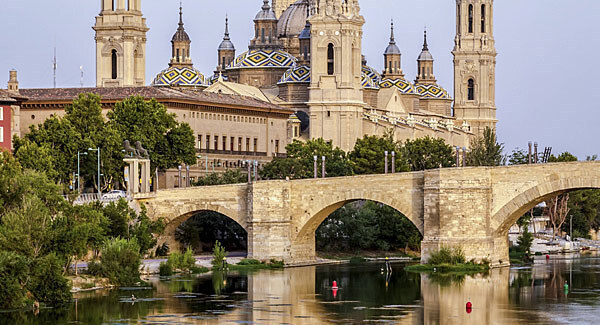
Next to make Zaragoza their home were the Moors (their’s are the severed heads on the Aragonese flag) who ruled for three hundred years from 714. They left behind the majestic Palacio de la Aljaferia, a stunningly beautiful fortified Islamic palace. Christian forces captured the city in the 1118, and the city’s most iconic Christian construction is also its most popular tourist attraction, The Basilica of Our Lady of the Pillar.
Because it’s out of the way of the most well-trod of tourist trails, Zaragoza is far from a tourist trap, and therein lies its charm.
If you like to sight-see, there’s plenty to keep you occupied, and you won’t have to shoulder past the population of small country to get prime position in the photograph section. Or if, like me, you like your city breaks with generous helpings of food and wine, and just a smattering of standing around looking at old buildings, then Zaragoza is the perfect place to sit back and soak up the atmosphere.
The Spanish are as serious about their fiestas as they are about their siestas. And if you’ve ever tried to buy a loaf of bread between the hours of two and five, you’ll know how serious that is. Zaragoza is no different, and its fiesta is celebrating its patron saint (and the patron saint of the Latin speaking world), Our Lady of the Pillar. During Zaragoza’s Fiesta Del Pilar, which takes place in the week around October 12, its population explodes to three times its size and the Plaza del Pilar is filled with a pyramid of flowers.
The Basilica itself is a beautiful construction and well worth a visit at any time of year.
If you turn away from the Basilica and make your way towards Gran Via, you’ll see signs for El Parque Grande. This is one of my favourite places to walk in Zaragoza, especially in the evening. It has beautifully-tended gardens and pretty water features and is popular with runners, cyclists and walkers.
Culturally, the artist Goya is Zaragoza’s most famous son and several of his portraits can be admired in the Museum of Zaragoza. The Aragonese sculptor Pablo Gargallo, a contemporary and close friend of Picasso, is honoured with his own museum Museé Pablo Gargallo, housed in a Renaissance Palace in the city centre, and well worth a visit.
There are no direct flights from Ireland. Best bet is to fly to Madrid or Barcelona and catch the AVE (high-speed train) to Zaragoza.
Where to stay
I stayed with friends but only heard good things about the centrally located hotels of Palafox and Catalonia El Pilar.
Palafox, Casa Jimenez s/n, 50004 Zaragoza (Casco Antiguo)
Catalonia El Pilar, C/ Manifestacion 16, 50003 Zaragoza
If you need some time away from your Spanish phrasebook, call into Bull McCabes (or as the locals might pronounce it, “Bull Mick Ca Bays”). Owned and run by an Irish couple, Fran and Peter Duffy, who’ve called Zaragoza home for more than 10 years, it’s one of the best bars in the city, Irish or otherwise. Call in for a drop of home and for insider tips on what to see and do.
Head for the El Tubo district to trek through tiny tapas bars.
Basilica of Our Lady of The Pillar, Plaza de las Catedrales, Zaragoza
CaesarAugusta Museum, Calle San Juan y San Pedro, 3-7, Zaragoza
Museé Pablo Gargallo, Plaza de San Felipe, 3, Zaragoza (Casco Antiguo)
Palacio de la Aljaferia, Aljaferia, Calle Los Diputados, Zaragoza