Saddling up for river valley trip
THE Werra river valley in Thuringia, eastern Germany, is something of a backwater. Foreigners might recognise only one relatively large, well-known town in the area, Eisenach. Opel makes the Corsa there. Martin Luther and JS Bach lived in the city and the Social Democratic party was founded in the Wartburg Castle which overlooks it all. Because it’s tucked inside a range of mountains, Werra valley has lots of other even less well-known but charming places worth visiting. I went there for four days to cycle the Werra’s 293km, from its source to its end.
I began my trip in the town of Erfurt, a half-day’s train ride from Frankfurt. From there, it was a further five hours by local trains to the start point of the bike route, Neuhaus-am-Rennsteig, at 800m up in the Thuringian Forest. The train travel itself should be counted as part of the trip’s entertainment: I love sipping a coffee and alternating between reading the newspaper and trying to read the landscape outside.
The cycle route is well-marked and begins about 20km from the source of the Werra. That’s a spout set in a stone wall from which jets a few litres of water a minute. But by the time you bike a couple of hours, the river is a good 10m across. It accompanies you all the way to the end of the route so you get to enjoy seeing the waters change character as the journey progresses.
This contrasts with some river routes where the path and river can be separated by a considerable distance. My first day’s pedalling took in a mix of open farmland and woodland edge. There are towns and villages every 10km or 20km, so you’re never far from a refreshing Radler (pilsner and lemonade) or a good, reasonably priced meal.
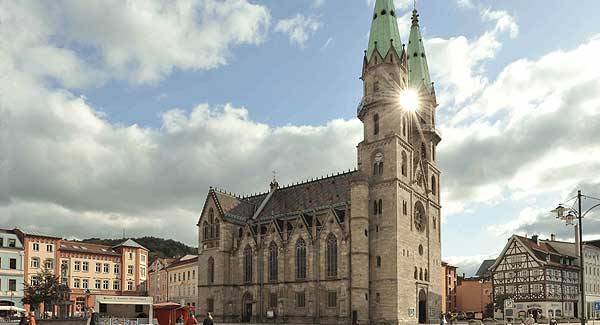
The first day ended in Meiningen, an elongated town squashed between the valley sides. One of the nice things you notice is how many of the streets end in high, green walls of foliage which are the valley’s wooded slopes. Most of the centre features 18th century classical architecture or the region’s traditional half-timbered buildings. I stayed in a nice, fairly low-price hotel, but a pair of splendid hotels stand on the main street near the train station. In themselves, these hotels would make a trip to Meiningen worthwhile. The Sachsicher Hof and the Henneberger Haus oppose one another at the corner of the gently disordered English Garden in the city centre. The bar of the Henneberger Haus has deeply carved oak panels and is of an exuberant late-19th century style. The Sachsicher Hof conveys an elegant, urbane, classical atmosphere. The restaurant has a superb menu, too. You could stay in one and eat in the other and get best of both worlds.
Like many towns in eastern Germany, Meiningen has a depopulation problem. While some buildings have been lovingly restored after decades of neglect, other buildings are empty or completely gone. One side of the main square in Meiningen is an empty space. The gap, however, allows an excellent view of the rest of the square and the lovely St Marien church, which dates from the 9th century.
On my second day, I covered 100km. The route mostly used dedicated cycle paths of a high quality or little-used laneways. In Eschwege, I lunched; around me, the old market place consisted almost entirely of half-timbered buildings. There are one or two 19th century structures of masonry and they look slightly strange amid the four- and five-storey black-and-white façades that predominate. Seeing so many of them is striking. None of the quaint English Tudor town centres that I know of offer such an extensively preserved collection of this type of building. Such buildings are quite common in this part of Germany. I ended the day in Eisenach where I found the birthplace of JS Bach (now a museum). Martin Luther lived in the town as a child and later returned to stay at the Wartburg Castle, in which he translated the New Testament into German. The castle is a Unesco-listed structure, overlooking the town from the valley side.
After Eisenach, I covered a further 100km and had another sunny day’s travel between the waters and woods of the Werra. One can see storks along the way together with a variety of other wildlife. I can’t say a whole lot about some stretches other than that I experienced a pleasant blur of empty-headedness interrupted by inexpensive, hearty meals and refreshing Radlers. There was no distraction and no focus. This, as much as the landscape’s details and the curlicued architecture, is part of the delight of a long-distance cycle tour. It can’t be overestimated. If biking consisted only of visits to interesting towns, it might become overwhelming. But the green spaces from village to town to village offer a chance for your mind to calm down, even switch off.
The last town on the itinerary is Hannoversch Münden. While one might become inured to the splendour of the half-timbered buildings along the way, the great height and density of those found in Münden will astonish the first-time visitor. I could easily have spent two more days there, just enjoying the views from a variety of streetside taverns. Right outside my low-priced, but individual hotel, was the end of the Werra. where it blends with the Fulda to become the Weser. From there the river carries on another 500km to the North Sea.
Although I did my trip in mid-summer, the early summer and autumn are very good times to visit the region. The honey-coloured light and colour-shifting foliage of the forests give each season a special character.
While the Werra is not the Ganges, Rhine, or Danube, coming to the end of the river’s course at the confluence was a surprisingly affecting experience. I felt I had achieved something with a beginning, a middle, and a distinct end. That sense of narrative completeness is another reason to try biking along a river.
There’s a story and you, the rider, are a part of it.
As noted in the article, the Werra region is out of the way. Here are the alternatives:
First, Cork-Munich, Aer Lingus, twice a week. Arrive circa 3pm. At Munich Airport hire bikes from German rail (DB), go by rail to Meiningen and onward to Neuhaus-am-Rennweg. You´ll get there for a late dinner.
Second, Dublin-Frankfurt, Aer Lingus, daily. Arrive Frankfurt c. 10am.
You can rent a bike from DB at Frankfurt Airport and then start your train journey right there. The first leg is to Erfurt and stay overnight. Then onward by local trains to Neuhaus Am Rennweg. Arrive around lunch-time.
I stayed at the Hotel am Kaisersaal, where a comfortable and charming double room and fine breakfast is about €110. The square around the corner, Wenigermarkt (“smaller market”), has several choices of restaurant, from pizza to German to Italian. There´s even a museum of mustard serving the famous Thuringian sausage.
Hotel Schieferhof (€75). It has a very highly rated restaurant offering the very best German food. Alternatively, the Rennsteighotel Herrnberger Hof offers good food in a very traditional setting. They offer three nights with board (allowing hikes and trails) for €130.
the central Saechsischer Hof has deals from €70. Across the road is the award-winning Hotel Henneberger Haus, with rooms from €55. I chose the cheaper Hotel an der Kapelle, which had a single room for €40. That included breakfast. And their restaurant was very good.
attracts expense account business folk to the Opel factory. Prices can be high. The Hotel Steigenberger offers a double room from about €90. I stayed in the more modern but no less expensive Goebels Marien Hotel which was also €90. Cheaper but outside town, on the bike route, is Das Tor zum Rennsteig, a family-run B&B for €50, double.
Hotel Im Anker was simple, clean and inexpensive; €50 with a great breakfast. The Hotel Alte Rathausschänke is not much dearer at €60 and is right by the lovely Town Hall Square. The Hotel Alter Packhof is more luxurious and faces the confluence of the Fulda and Werra. Expect to pay about €120 or more. But the quality is correspondingly high.
Meiningen: the Deutsche Bahn rail museum, Dampfklokwerk, has historic trains on display. The Veranstaltungen regularly has performances of classical music. Typical and very delicious Thuringian food is on offer at the Meiningen Schlundhaus which has the local dumplings, goose and Thuringian sausages. The English Garden is worth a quiet walk after a seriously large meal.
Eisenach: is associated with two Bach (J.S and Christoph), Pachelbel and Telemann. The Bach Museum is open daily with exhibits about his life and work. The building is architecturally very striking. Nearby is Wartburg Castle where Martin Luther stayed. It is open year round and offers great views over the town and wider area. The Automuseum has a display of 100 years of car building in Germany with a special emphasis on Wartburg and Opel vehicles.
Hann. Munden: Boat tours run from the city centre, travelling down the Weser river. These offer a good view of the river landscape while you have a fine lunch and another beer. One tour goes as far as Kassel from where trains can take you back to Frankfurt or Munich. The city centre has 700 half-timbered buildings and the town hall is alive with astonishing 16th century carvings, inside and out.
The food of the region is hearty and based on the ample supply of fruit, vegetables and meat, especially pork and wild game. The potato dumplings (Thueringer Kloss) are renowned. And the braised beef roll goes very well with any of the 193 regional beers. I liked Meininger Gold best. A trip to Germany must feature baked goods too. Rosinenschnecken are delicious pastry and marzipan spirals with raisins and sometimes nuts. The local “sheetcakes” come in a wide variety of forms. The breakfasts usually involve a buffet of German sausage, cheese, salad, breads, patisserie, fruit and yoghurt.
Trailfinders has a number of June specials on offer to South Africa with choice of flights from Cork, Dublin or Shannon. There is a choice of seven- or 15-night stays with prices ranging from €1,679 to €2,299. Details on 01-6777888/021-4648800 and 061-292700 or www.trailfinders.ie/
Falcon Holidays features nine facilities for children wishing to learn to swim on holidays this summer. Swim academies can be booked in advance through the company, who currently have family specials (2+2) from €3,000. Visit www. falcolnholidays.ie or call Falcon: 1850453545
Ihu’s Breakaway Falls — the tallest, steepest and only multi-drop tower slide of its kind in Orlando — is now open at Aquatica Water Park, part of the Seaworld Parks and Entertainment group. Three park tickets are priced from €100. Details on www.seaworldparks.ie
Former Celtic tenor Niall Morris will be amongst the performers at Loughcrew Castle in Co Meath on the weekend of July 12 and 13 to celebrate a link with the Boyne Valley Food Festival. Tickets are on sale at €60. Visit www.loughcrew.com or telephone 049-8541356.
A discounted September Eastern Caribbean cruise is available from American Holidays for bookings by May 31. It includes flights ex-Dublin, a night at the three-star Rosen Inn at Pointe Orlando and seven nights on Freedom of the Seas from €1,045. Call 01-6733804 or www.americanholidays.com.


CONNECT WITH US TODAY



Be the first to know the latest news and updates