From darkness to enlightenment in Norway
The snow underneath your boots creaks with dryness.
Above, the sky is a vast black dome, scattered with stars brighter and clearer than they ever are at home. Drawing in a breath is an icy shock to the system. What are we doing out here at midnight for heaven’s sake, when we could be warmly tucked up?
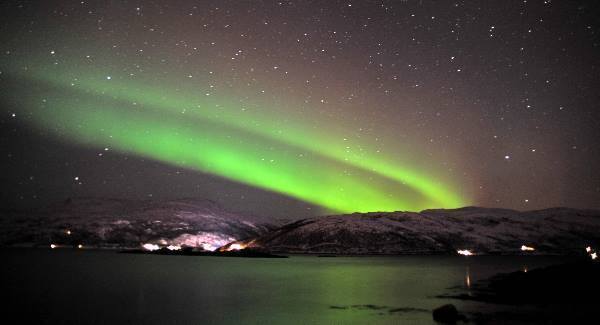
Then the guide says something in a low voice, touches you on the shoulder and points. And there, hanging strangely, oddly along the horizon, is a shimmering veil of translucent silver, shot through with strands of otherworldly green. The Northern Lights. And every discomfort is forgotten in sheer awe and delight.
Seeing the Aurora Borealis or Northern Lights is an experience most of us dream of. And this year could be your best bet yet. They have even been glimpsed here in Ireland over the past few months, but that’s rare. In fact you can never guarantee a sighting, wherever you go.
Elusive, contrary, fickle, they might illuminate the entire night sky, or they might stay obstinately hidden. They might make you wait several hours in sub-zero temperatures or decide to show up as you’re driving home. But, like any top attraction, they are worth waiting for. Oh they are.
Three basic conditions will increase your chances. One, you should be as far north as possible, preferably well into the Arctic Circle. Two, the skies must be absolutely clear, with no cloud cover. And three, you have to find the darkest place possible, far removed from light pollution.
Three locations in three different countries vie for the title of Best Place In The World To See The Northern Lights. Yellowknife, in Canada’s Northwest Territories is good, but getting there is both difficult and expensive. Prince William and his bride managed it with no problem, admittedly, but they probably had more strings to pull. Or from Toronto you could join a special tour which flies you up into the wilds for a night or two in a cosy log cabin, but that’s seriously expensive too. Another option is Iceland, tucked between ourselves and Greenland, a fascinating combination of snow and fire. We only hear about the major eruptions, but in fact minor ones happen all the time. You could miss your flight home because some ornery little volcano has decided to take out the main bridge on your road. It’s a starkly beautiful country, and Reykjavik, has a seriously lively nightlife, but the landscape outside the capital is somewhat lacking in the creature comforts our southern bodies, unused to such cold, demand.
The top choice is Norway, which manages to combine comfort with excellent opportunities for seeing the aurora. Tromso is so far north that the next option is a solo expedition to Greenland. Tucked away amid the western fjords, surrounded by mountains, water and ice, it sparkles like a jewel in the dark. Which it is at this time of year. Dark, that is.
From around late October to early March, the sun doesn’t peep above the horizon. “We wait for that first glimpse,” said a cheerful local. “When you see it, you punch the air and cheer because it’s spring!” Even then, you get more dark than light until midsummer. Which is good, in this case. It’s not that the aurora isn’t there in daylight; it might well be, but you can’t see it.
There are dozens of Northern Lights tours on offer. Car, minibus, dogsled, snowmobile; spend an evening with the reindeer-herders, a night in an ice hotel. There are trips suited to young families, and others aimed at the adventurous — not to say well-heeled. Yes, Norway is expensive. That is, it’s pretty much on a par with Ireland, perhaps even a little more.
The cost of a couple of beers in a jolly Tromso hostelry can make you blink. But it’s worth it for the weekend of a lifetime. And if you choose your hotel carefully, you can get breakfast and dinner included in the basic price, which makes quite a difference.
It’s a lovely little town, crammed full of cafes, restaurants, tempting shops. A trip on the cable car gives a spectacular bird’s-eye view of town and fjord. Tromso has a university, and at night you’ll find every bar packed to bursting, with live music on offer in most.
But we have something else to do. The transport is waiting outside the hotel at 9pm. Everyone is wrapped up to the eyes in warm woolly scarves, fur hats, thick trousers concealing thermal underwear. Incidentally, mittens — two layers of them — are considered better for keeping the hands warm than gloves. The driver is a fund of useful information as we head out of town and into the snow-covered night. He shows a brief video giving facts and figures about the aurora borealis, answers questions cheerfully. After half an hour, the bus turns off, bumps down a rough track. It stops, and we all tumble out, gasping as the freezing air hits our lungs. Torchlight flashes, and a rumbling, friendly voice welcomes us.
We follow this new guide across the snow to a black shape looming against the sky. He pushes open a door and firelight streams out.
Instinctively everyone pushes towards the warmth and you get a sudden realisation of what travel must have been like in olden times, before all the comforts we now take for granted.
This is a traditional Sami tepee, a base to retreat to during the night if the cold outside gets too much. Tree trunks act as seats, some with animal skins thrown over them.
The guide indicates thermos flasks of hot chocolate with a smile, and uncovers a tray of freshly-baked cake. “I did not make this, my wife did,” he explains disarmingly.
No-one waits for a second invitation. Strangers smile at each other over their mugs, children start to chatter.
But the lure outside draws us from the warmth and the cosiness.
It’s difficult seeing your way, and quite easy to plunge up to the waist into thick snowdrifts, but gradually the path slopes downward to — can it be a beach? It’s the shoreline of the fjord, and ahead the water rocks gently, shimmering with the reflection of thousands of stars. It’s the emptiest and the most beautiful place in the world.
And then, suddenly, they are there. Not as thousands of movies and magazine articles would suggest in vivid technicolor, but utterly beautiful, softly shimmering translucent silver veils swaying across the night sky.
Slowly the eye distinguishes thinnest layers of green, a hint, no more, of red. Lifting, dropping, moving this way and that, it reminds you of ancient temple dancers lifting and throwing their gauzy scarves (the Norwegians call the aurora “the sky maidens waving”). You stand there for hours, the cold completely forgotten, watching, staring, storing up the experience that may never come to you again.
SAS flies Dublin-Tromso via Oslo. Return from €400. www.flysas.com.
The Clarion Hotel in Sjogata, from €150 for double room, including buffet breakfast, dinner, and afternoon waffles. www.clarionhotel.com/hotel-tromso-norway-NO029.