'It's crying out for a film': The most audacious Irish escape you've never heard of
Colin Sheridan meets author Michael B. Barry to hear the story of Catalpa.
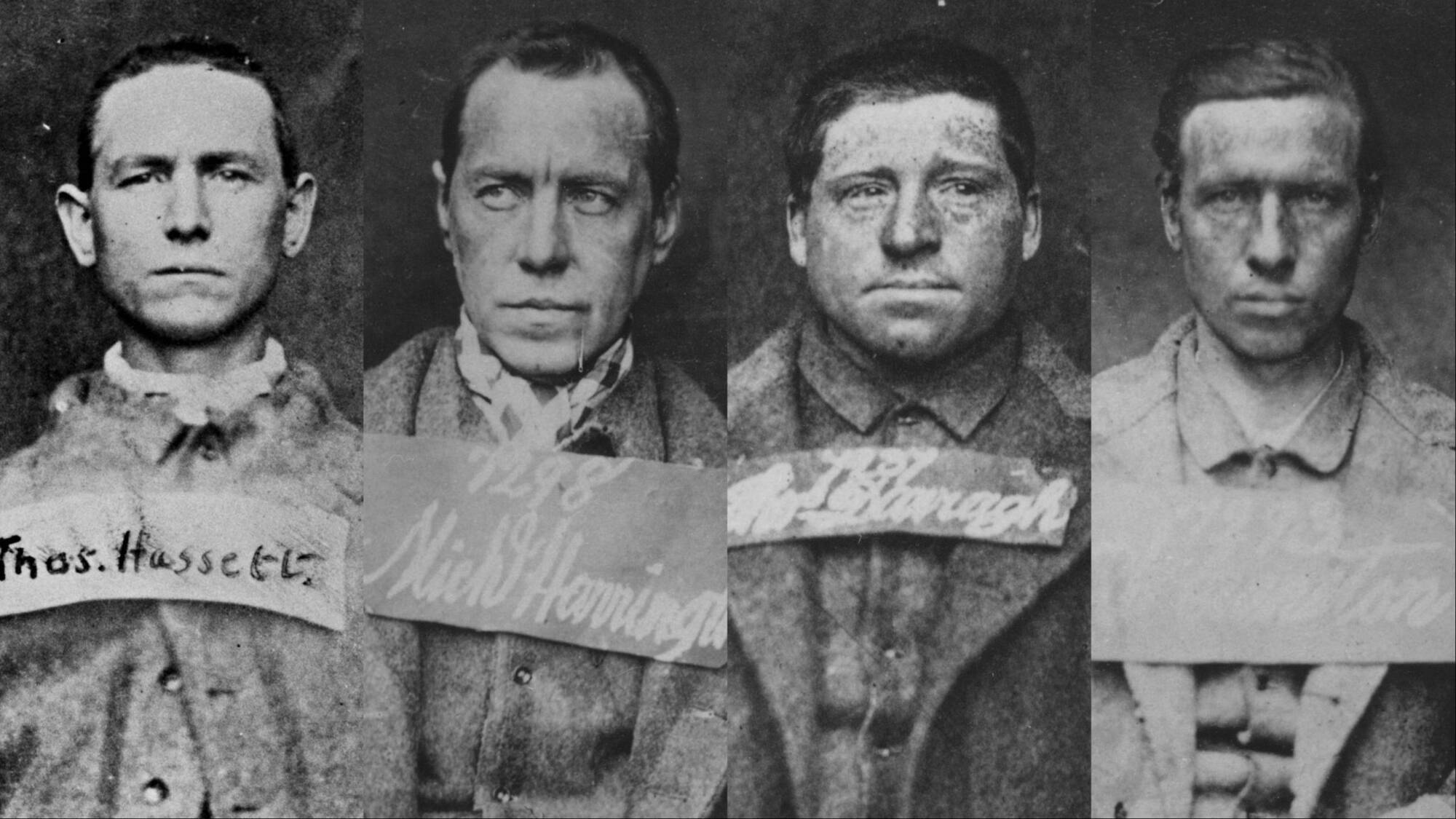
From left: Thomas Hassett. Born in Doneraile Co. Cork in 1842; Michael Harrington. Probably born in Goleen, West Cork, c.1825–8; Thomas Darragh. Born at Broomhall, Co. Wicklow, in 1834; Robert Cranston. Born at Stewartstown, Co. Tyrone, in 1842

From left: Thomas Hassett. Born in Doneraile Co. Cork in 1842; Michael Harrington. Probably born in Goleen, West Cork, c.1825–8; Thomas Darragh. Born at Broomhall, Co. Wicklow, in 1834; Robert Cranston. Born at Stewartstown, Co. Tyrone, in 1842

The cannon shot went across the bow of the Catalpa somewhere off the coast of Western Australia. On board the American whaling ship were six Irish men who had just escaped the prison to which the British empire had banished them for life. They had survived almost a decade of incarceration, a dash for the coast, a night in an open whaleboat, and weather that might easily have finished what the prison system had begun.
Now the colonial authorities had found them. The Georgette, a coastal steamer commandeered for the pursuit, had returned with armed men and a 12-pounder gun. The demand was simple: Surrender the prisoners.

But, as historian and author Michael B Barry tells me, Captain George Smith Anthony refused.

“Anthony was not Irish. He was a young American sailor from old New England Protestant stock, on his first command as captain, who had somehow found himself at the opposite end of the Earth participating in one of the most extraordinary prison breaks in Irish history.”

Barry recounts how Anthony pointed towards the Stars and Stripes flying from Catalpa. “They were beyond British territorial waters. Boarding his vessel now meant boarding an American ship.”

For perhaps half an hour, the vessels faced one another. Then Georgette turned away.

If somebody pitched the story of Catalpa as a film, you might suggest they tone it down. Barry does not disagree.

“It’s crying out for a film,” he laughs. His new book, Catalpa: The epic story of the greatest prison rescue in Irish history, returns to an episode of Irish history whose greatest mystery may be why so few Irish people know about it.

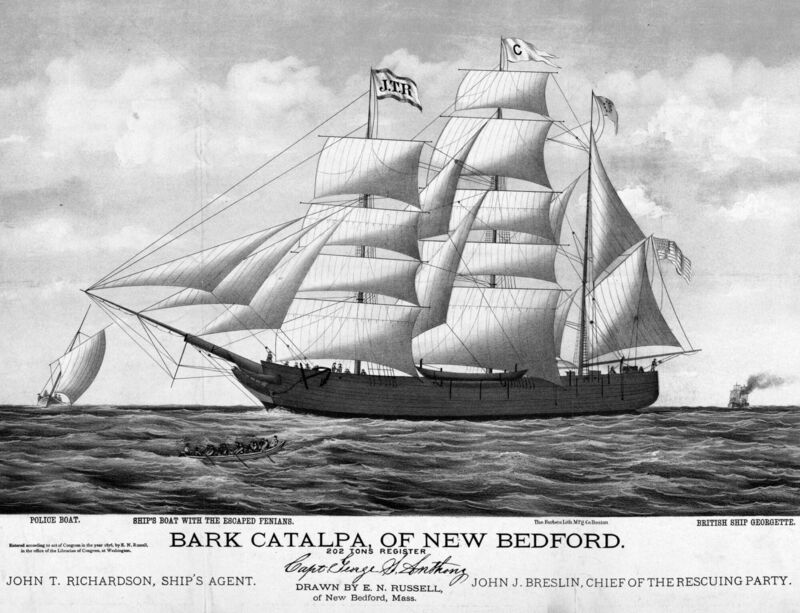
Bark Catalpa of New Bedford. This illustration shows the open whaleboat nearing the Catalpa, with the police cutter and the steamer Georgette in the distance. After some 28 hours at sea, the rescued Fenians finally climbed aboard the Catalpa on 18 April 1876.

“The strange thing is, people don’t know about it,” Barry says. We remember other escapes and exploits from the revolutionary tradition, he argues, but somehow not this one.

Barry, author of several acclaimed works of Irish history, had only a vague awareness of Catalpa until around 20 years ago, when he saw Dónal O’Kelly perform a one-man show about the escape.

With the 150th anniversary arriving this year, he returned to it. What he found was not only an irresistible adventure story but something particularly valuable to a historian: The people involved had left a paper trail.

“The participants were well-educated men,” he says. “They were quite articulate and well able to tell their story and put it on paper.”

The writings survive. So does an early biography of Anthony. Newspapers, letters, and contemporary accounts allowed Barry to get close to the people who actually did it.

It matters to him. He bristles at previous versions that fill historical gaps by imagining moonlight on the ocean or putting unverifiable words into characters’ mouths.

The extraordinary thing about Catalpa is that it requires almost no embellishment.

Its origins lie with a handful of Irish men marooned on the furthest reaches of an empire.

Among the Fenians transported to Western Australia after the revolutionary turmoil of the 1860s were men who had served in the British army while secretly participating in the Fenian movement. To the military establishment, theirs was an especially unforgivable betrayal.

Death sentences were commuted to life imprisonment.

When William Gladstone’s government subsequently granted an amnesty to Fenian prisoners, the military Fenians were excluded.

“They were just left there,” Barry says, effectively abandoned to life imprisonment in Western Australia.

One of them, James Wilson, eventually managed to smuggle a letter to an old comrade in America. Others had written before him but Wilson’s was different.

Barry calls it the most evocative.

It was a “voice from the tomb”.

And the man who heard it was John Devoy.

The more Barry researched the book, the more Devoy fascinated him.

“The more I learned, the more I really admired Devoy,” he says, while conceding that he was probably “a strong man” and “a tough guy to deal with”.

Devoy had joined the Fenians as a young man and helped recruit Irish men serving in the British Army. Imprisoned himself, he was released under Gladstone’s amnesty on condition that he leave Ireland, eventually establishing himself in New York as both a journalist and revolutionary organiser.

He had personally recruited many of the men now stranded in Australia.

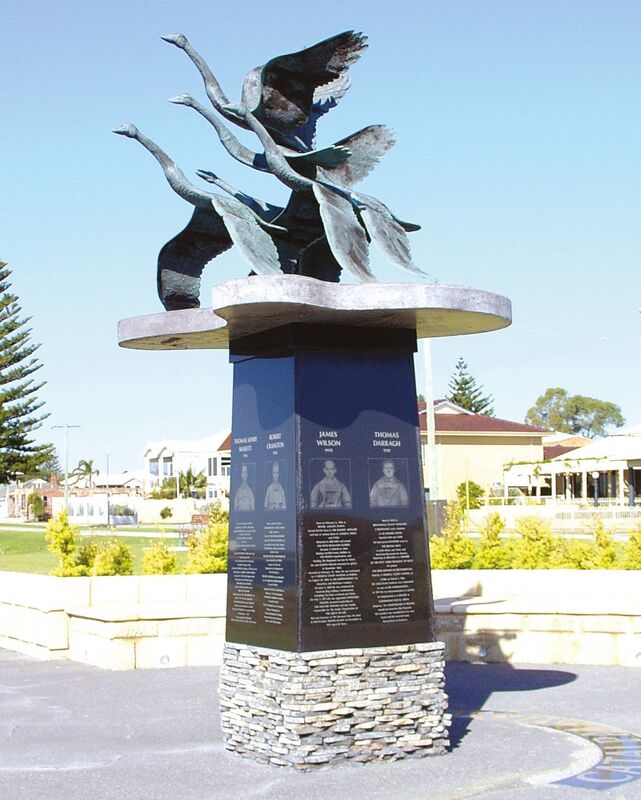
The Catalpa Memorial, Palm Beach, Rockingham, Western Australia. Unveiled in 2005, the six bronze wild geese symbolise the six rescued Fenians who flew to freedom from the farthest edge of the British Empire. (Ó Wikimedia Commons)

Their rescue presented him with a problem of geography.

Western Australia was not merely far away. In the 1870s, distance had a meaning almost impossible to comprehend now. Letters could take months. Telegraph networks were incomplete. Journeys were measured in seasons.

Devoy’s solution was magnificent in its simplicity and madness.

They would buy a ship.

They would disguise the mission as a whaling expedition.

And they would sail to Australia and steal the prisoners back from the British empire.

Even raising the money was an achievement. American Fenianism had splintered into factions and recriminations and there was deep suspicion around finances.

Getting the money, Barry says, was like “pulling teeth”.

Eventually, Catalpa was purchased and equipped. To help finance the enterprise, she would actually hunt whales along the way.

Then they needed somebody to sail her.

Enter Anthony.

Anthony had been working ashore in New Bedford when Devoy’s proposition reached him. He was young and eager to return to sea. He also seems to have regarded the imprisonment of the military Fenians as fundamentally unjust — men punished not as ordinary criminals but for acting out of love for their country.

Barry came away from his research liking him enormously.

“A sound man,” is his wonderfully understated verdict.

And, more importantly, “at every stage, he took the right decision”.

He would need to.

While Anthony brought Catalpa across the world, John Breslin arrived in Western Australia masquerading as James Collins, an American millionaire scouting business opportunities.

Breslin had form.

Years earlier, while working as a hospital steward at Richmond Prison in Dublin, he had helped mastermind the escape of Fenian leader James Stephens, arranging for keys to be copied and helping lead him out.

Barry describes Breslin as remarkably “calm” and “cool”. In Fremantle, he maintained his cover for months while establishing contact with the prisoners and managing an operation that became increasingly complicated.

There wasn’t even just one rescue plot. Other Fenian organisations had separately begun trying to free the same men. Agents started arriving in Australia. Breslin somehow incorporated them without alerting the authorities.

British intelligence, normally so successful at penetrating Fenian organisations, largely missed what was happening.

On Easter Monday, April 17, 1876, the six prisoners slipped away from work parties outside Fremantle Prison.

After years of planning across three continents, the escape was on.

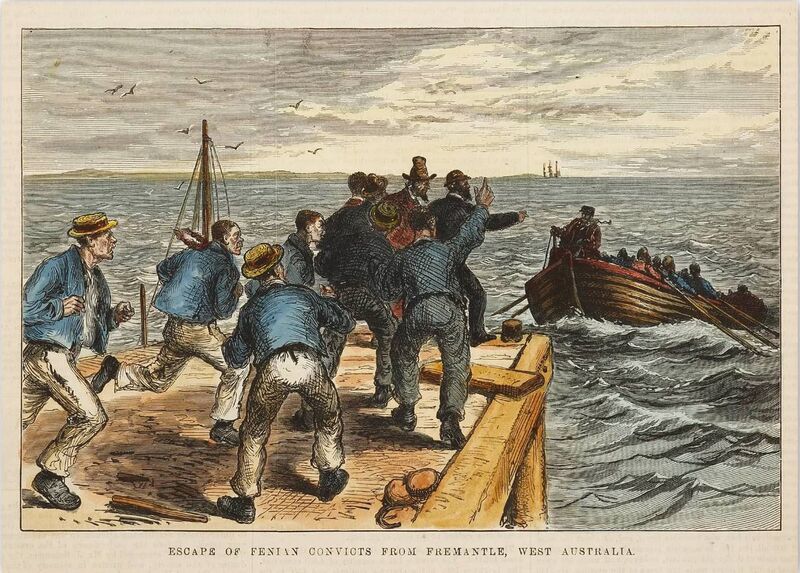
Prisoners escaping from Rockingham. Although inaccurate in detail – the escape party actually left from the beach, not a jetty – the illustration captures the urgency of the moment.

They were collected by horse-drawn vehicles and raced south towards the coast. There they transferred to a whaleboat, only for rough weather to turn the final stage into an ordeal. For a night, they remained exposed at sea, unable to reach Catalpa.

Eventually they made it.

And then came Georgette.

Even here, history supplies a detail a screenwriter might discard as implausible.

The captain of the vessel pursuing the Irish Fenians was himself Irish: Michael Grady, a young man from Limerick.

Better still, he and Anthony had already met. Barry recounts an account from Anthony’s biography in which Grady apparently gave his American counterpart a friendly wave during the pursuit.

Orders were orders.

But Ireland, apparently, remained Ireland.

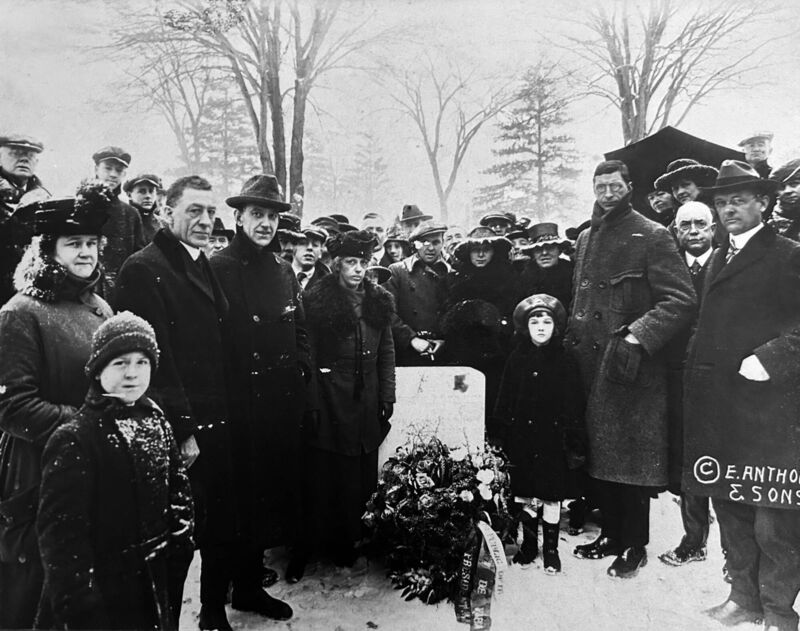
Éamon de Valera at Captain George Anthony’s grave, New Bedford, 10 February 1920. Among those present were Anthony’s daughter Mrs Leon Huggins and her seven-year-old daughter, Phoebe Huggins, who had earlier presented de Valera with a portrait of her grandfather. Picture Courtesy of James Ryan

The escapees reached New York in August 1876 to jubilation in Irish America. There were celebrations in Boston and an enormous reception when Anthony returned to New Bedford.

Britain, intriguingly, swallowed the embarrassment. Relations with Washington had already been strained by the legacy of the American Civil War and Barry found no significant diplomatic exchange over the confrontation.

Perhaps the most appealing thing about his telling, however, is that nobody emerges coated in nationalist varnish.

“These guys were no angels,” Barry reassures. One conspirator’s fondness for alcohol repeatedly caused problems. On the voyage home, the rescued prisoners themselves complained about the cramped conditions, dreadful food, and absence of drink. Tensions eventually produced what Barry describes as a mutiny of sorts.

Breslin, meanwhile, had an affair during his months in Fremantle with a young hotel chambermaid, Mary Tondut. She became pregnant. Their son would never meet his father.

“History is not black and white,” Barry says. Its heroes, he adds, are never entirely without “flaws or blemishes”.

And perhaps that makes the achievement greater.

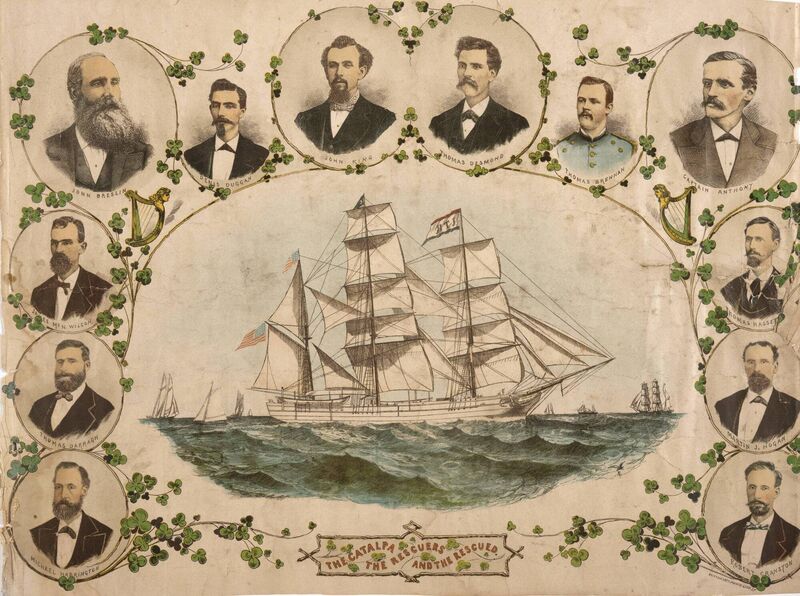
‘The Catalpa Rescuers – The Rescued and the Rescue’. This commemorative lithographic print celebrates the men involved in the daring Fenian rescue from Western Australia.

The British empire had used the enormousness of the world as punishment. Irish men were removed thousands of miles from home and effectively forgotten.

The Fenians answered with their own international network: Ireland, Britain, America, and Australia; money, ships, letters, conspirators, and diaspora. And somehow it worked.

Perhaps that is also why Catalpa sits strangely outside Ireland’s popular historical memory.

We know how to remember doomed rebellions. We know martyrs, executions, hunger strikes, last letters, and gravesides.

Catalpa offers something much rarer.

They won.

Six forgotten men at the edge of the world were remembered. A letter escaped a prison. Money was raised. A ship was bought. An American captain said yes. Agents crossed oceans. The prisoners escaped. The British pursued them. And then the British had to watch them sail away.

Towards the end of our conversation, Barry tells a quieter story. John Boyle O’Reilly had also been one of the military Fenians transported to Western Australia before making his own escape and eventually becoming a prominent journalist in Boston.

While O’Reilly was still a prisoner, a warder punished him for some minor infraction by withholding a letter that had arrived from home.

For six months.

When O’Reilly finally received it, he discovered it contained news of his mother’s death.

“Time for them was enormous,” Barry says.

Months for a letter. Years in prison. Oceans between people who did not know whether they would ever see home again. Wilson nevertheless sent his voice from the tomb out into that enormous world.

Somebody heard it.

And came to get him.

  • Catalpa: The epic story of the greatest prison rescue in Irish history, by Michael B Barry, published by Gill, is available now.


More in this section

Lifestyle

Newsletter

Eat better, live well and stay inspired with the Irish Examiner’s food, health, entertainment, travel and lifestyle coverage. Delivered to your inbox every Friday morning.

Cookie Policy Privacy Policy Brand Safety FAQ Help Contact Us Terms and Conditions

© Examiner Echo Group Limited