My Life with Muireann Walsh: 'I am a Cork mum who saw the devastation in the West Bank first hand'
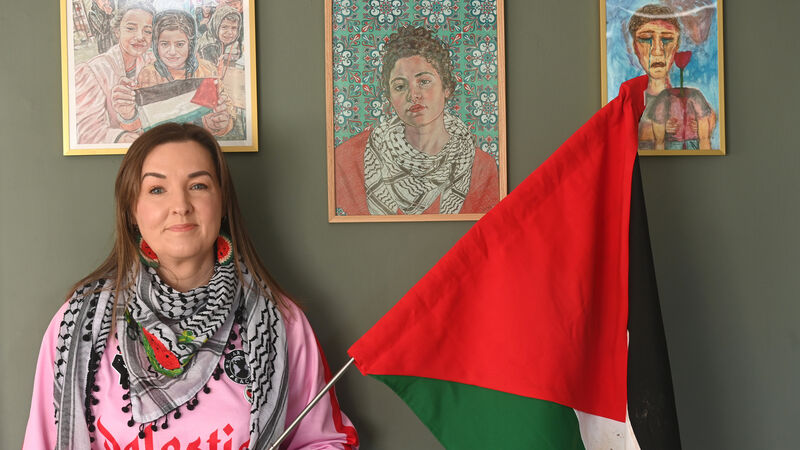
Muireann Walsh, Behind her are two images by artist Anne-Marie Farrell and a painting from the Children of Gaza exhibition. Picture: Larry Cummins
From a distance, they appear like any other homes, until you take a closer look and realise their doors have been cruelly welded shut by Israeli soldiers.
It is difficult not to become emotional when speaking about the brutal treatment of Palestinians I witnessed on a trip to the West Bank last year.
I am a mum of three from Cork who was one of a group of 16 Irish people visiting the West Bank to bear witness to the grave injustices that have been decimating lives for eight decades.
Israelis continue to regard the region — which includes areas such as Bethlehem, Nablus, and Hebron — as their ancestral homeland. This has prompted merciless calls from Israelis for the partial or complete annexation of the West Bank. It has also resulted in the occupation of these areas by rising numbers of Israeli settlers.
Our trip began with a visit to the city of Hebron, home to 35,000 Palestinians and a few hundred Israeli settlers. While settlers enjoy full protection and support from the Israeli army, Palestinian daily life is heavily tainted by the presence of checkpoints, road closures, interrogations, and the constant threat of settler attacks.
Al-Shuhada street is no exception. Once the beating heart of Hebron, its shops now lie empty and welded shut.
Palestinians have been banned from accessing this street, which meant our guide was unable to accompany us. Families unable to use their front doors have been forced to find other ways to access their properties. You see little old ladies struggling to get home with their shopping who can’t walk a few metres up the street and open their front door.
Instead, they are forced to walk this awkward route to the back of their homes and climb through narrow windows — even while laden down with bags of groceries. We visited the market in the old city of Hebron, a flashpoint between Palestinians and Israeli settlers. These settlers have been moved into homes that cast a towering shadow over Palestinian shops. They target these businesses with rocks, rubbish, nappies, items I can’t even mention. Shop owners have consequently installed a wire mesh and corrugated iron sheets overhead to protect themselves and customers.
As we were preparing to depart Hebron, another shop owner asked our guide if he could board the bus and speak with us. He begged us to do everything in our power to spread the truth about what is happening in Palestine.
Equally resilient were the families in the Aida refugee camp in Bethlehem, which was established in 1950 to provide shelter for Palestinian refugees displaced during the 1948 Nakba. The Apartheid Wall partially surrounds it and is close to Har Homa and Gilo, two large Israeli settlements which are illegal under international law.
The most tear-gassed place on Earth, this camp is known for its strong Israeli military presence. There is a jewellery shop at the front of the camp, and one of the things they sell is earrings made from tear gas cannisters. They are attacked and raided so often that a number of Palestinians decided to make jewellery out of what was left behind.
I met the brothers of a 17-year-old boy named Mohammed Ali Ezia who was injured after being shot by soldiers at the camp. They told me an ambulance wasn’t allowed into camp, so their father bundled him into a car to take him to hospital. The army stopped them on route, arresting the father and taking the boy away. When the father was released the next day, they said an army vehicle pulled up outside their home and dropped the body of their brother outside, wrapped in plastic. There is now a mural dedicated to him in the camp.
Everyone has stories of friends and families being locked away in Israeli prisons. The hotel manager of one place we stayed in told us that his brother was dragged out of bed in the middle of the night. This man’s crime had been liking a Facebook post.
The Palestinians are desperate for the truth to come out, and I think seeing Western tourists coming gives them hope. I’ll never forget bumping into a woman I know at a rally. This is an amazing person who has spent most of the last two years travelling back and forth to Gaza. It was great to see her, but there was one subtle detail that really stood out for me. Her earrings were fashioned from exactly the same tear gas material from Aida refugee camp. It reiterated to me just how indestructible hope can be, even in the face of genocide.

CONNECT WITH US TODAY



Be the first to know the latest news and updates