The Good Mood Dude: Why a Jolly outlook is crucial for children's wellbeing
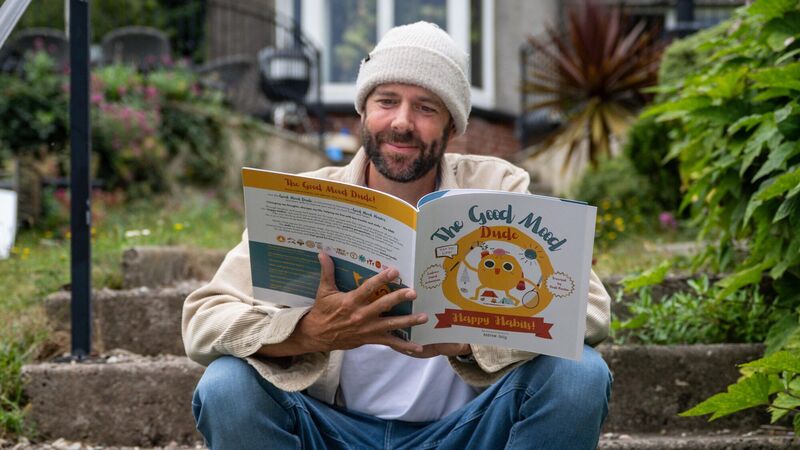
Andrew “Andy” Jolly, pictured here, has created Good Mood Dude, a self-help book designed to support children in managing their emotions. Picture Chani Anderson
Children see “the wonder in every stale thing”, a trait observed with both envy and admiration by the poet Patrick Kavanagh. Childhood is a time of wonder and innocence, when the seeds of resilience are sown. Andrew Jolly’s book The Good Mood Dude: Happy Habits reads like a manual on how to nurture those seeds and protect the joy we feel so effortlessly when we are children. The book equips children with tools to navigate life when it emotionally overwhelms.
What inspired the book? Jolly says: “For nearly 10 years, I’ve been teaching ‘happy habits’ in schools and, during assessments, I noticed that while students grasped the concepts, they struggled to articulate them.” So he began creating memorable mantras — like, ‘What you focus on, you feel’— to make the ideas stick.

“I started jotting down notes and building resources along the way.” Then, Jolly realised he needed to bring it all together. “My goal was to simplify the complex world of mental health into bite-sized, digestible nuggets.”
The book has a foreword by musician and mental-health advocate Niall Breslin. Breslin praised Jolly for giving children the language of self-care,“a language many Irish adults are only now learning”.
Jolly is a schoolteacher, surf instructor, husband, and father. The book was influenced by all of his roles. He teaches in a Cork primary school, but in summer he runs Barleycove Surf Camp and Swell Surf School. At home, his two young children, Jacob and Koa, are daily reminders that even the author of The Good Mood Dude does not always live by his own advice. He tells how five-year-old Koa reprimands him, “You are getting cranky, remember your breathing.”
Surfing has shaped his outlook. And if you afford it a moment’s thought, it’s not difficult to understand why. The aim of a surfer is to maintain balance. Jolly says, “Whether it’s catching a wave or navigating life, the same principles apply: Clear focus, embracing challenges, overcoming fear, staying present, a good balance, and trusting yourself. Awareness, hard work, rest, reflection, and solid techniques all play a role, and, above all: Practice, practice, practice. So, when I set out to learn how to be happier, I didn’t reinvent the wheel. I applied the same mindset: Treat happiness like a skill, train it with intention, and grow through experience.”
The Good Mood Dude is a cartoon guide that brings these valuable lessons to life. Jolly helps children absorb ideas that otherwise feel too abstract.
“I wrote it to help children avoid unnecessary suffering,” Jolly says. “To simplify mental health, make it more fun and accessible to kids by filtering it down to bite-sized, digestible pieces of information. I’m the Jamie Oliver of mental health,” he laughs.
Jolly is presenting the ingredients and showing how they come together to create a healthy life.
Jolly has identified 10 habits presented as everyday routines, “as ordinary as brushing your teeth”.
The 10 are: Breathing and meditation, eating the rainbow, moving joyfully, noticing thoughts, being kind to yourself, reframing challenges, facing fear, practising gratitude, connecting with others, and remembering to value. These are lofty ideas for a child, you might think. Yet, Jolly has presented them in a way that fits seamlessly into a child’s day.

When I ask about reframing happiness as a skill or making it routine, Jolly breaks it down. “We know to be fit physically, we need to do x,y, and z. The same applies to mental well-being. The happy habits are your framework, your plan of action to help you feel better and enjoy a better quality of life.” Jolly says that “if you practice activities that are scientifically proven to increase your wellbeing, they become as automatic as brushing your teeth, and the happier you are”.
Although written in rhyme and colourfully illustrated, the book is serious in purpose. It is dedicated to Conrad, a friend of Jolly’s who sadly died by suicide.
Conrad’s death highlighted to Jolly what can happen when people grow up without learning coping mechanisms. He says, “I believe there is a positive to every situation, and when Conrad passed, the only positive I found was that there was no positive.” He refers to that conclusion as a “mental buoyancy aid during dark times”.
For Jolly, it was a moment of realisation, “People don’t want to end their life, they want to end their suffering, and that is possible with the right perspectives, experiences, and wisdom.” Conrad’s death has inspired the donation from the book’s sales to Pieta House.
Jolly’s generation were taught how to tie shoelaces, how to do long division, but nobody ever offered guidance on how to navigate their way in a world that has become so messy. In his foreword, Breslin reflects that many people lose access to joy because they were never equipped with the skills to retain it and then must barter it back later in life. By valuing mental health as much as we do mathematics, we can spare children the distress many adults suffer.
Although written for children, The Good Mood Dude: Happy Habits also works beautifully as a guide for parents and teachers. Each chapter concludes with a reflective question that sparks conversation and stirs a child’s curiosity, so that they can then explore the lessons in their own time.
The clear visuals and simple, step-by-step mantras have been praised by parents of autistic children. Dr Susan Mac Conaill, clinical psychologist, describes it as, “An engaging and helpful book that uses practical, evidence-based strategies to promote positive physical and mental-health habits. Children of all abilities can benefit from its clarity and approachable style.”
To bring The Good Mood Dudes’ lessons to life in a way that is engaging, but which also feels natural, Jolly has also developed workshops, a website, and a YouTube channel.
Writing about happiness does not promise an impenetrable bubble of bliss. Jolly is refreshingly honest about the habits that are a struggle. It is this down-to-earth candour that makes the book so engaging. It doesn’t promise instant nirvana. It simply provides practical tools that help. Jolly says, “For me, the toughest habit is positive self-talk. I still find myself focusing on the negative a lot. I feel it is a hangover from living in the goal-oriented Western world, where, if you don’t get 100%, you focus on the bit you got wrong, and try to fix that, which is a nice ideal, but leaves you focusing on the negative.” He finds gratitude is the antidote, to focus on what you have, instead of what you lack.
Jolly is attempting something radical. He’s making happiness — which we so often speak of as elusive, a fleeting state that arrives unannounced — into something teachable, demystified, no longer dependent on luck.
He shines a spotlight of truth and reveals that resilience and joy are not accidents, but habits.
Perhaps Patrick Kavanagh would have considered it a way of keeping a grip on “the wonder in every stale thing”. Jolly echoes Kavanagh and emphasises that even as an adult, there is “extraordinary in the ordinary”. It’s important to remember that joy need not fade with childhood.