Last summer the EPA released its ‘Food Waste Statistics for Ireland’.
This found that in 2021, restaurants and food services — which includes hotels — generated 25% of Ireland’s total food waste. With this in mind, we asked three hotels what measures they’re taking to tackle food waste.
Zero waste cooking is all about creativity
For Rudi Liebenberg, executive head chef at The Montenotte, Cork, sustainability starts with respecting food. With a team comprising of 14 chefs, he emphasises respect for each ingredient and for all its parts.
“If we do that, we use it better, look after it better,” He finds it hard to believe chefs become chefs to only cook the beautiful loin or fillet. “We owe it to food to work with the fashionably rejected bits. I blame chefs for writing recipes badly. They’re always talking about what to do with the beautiful part of the leek, the cauliflower.
CLIMATE & SUSTAINABILITY HUB
“They never tell you what you can do with the rest. They tell you pick the parsley, but not what to do with the stalk. To me, a carrot has the same value as a prime cut of meat — we should treat both the same.”
The Montenotte values good relationships with local suppliers, ensuring best quality seasonal produce. Liebenberg’s conscious approach to cooking means thinking about the farmer who farms regeneratively — a process requiring a lot of time and care. Appreciating this, it upsets him that “a chef can take 30 seconds to disrespect an ingredient and make a mock of it”.
His enjoyment in his work comes from creatively using as much of an ingredient as possible.
“In using something, like fat, skin, stalks and roots. A world of skill comes alive with fermentation, curing, smoking, mincing, pickling, and good knife skills.”
Liebenberg arrived at The Montenotte in February 2023, having previously spent 13 years in Cape Town. His Wasted! Menu at the Belmond Mount Nelson in Cape Town incorporated every part of produce to create a five-course lunch menu.
“I create recipes in reverse. I find or create a recipe for a shunned part of an ingredient, like the rib or outer leaf of a vegetable. I use it creatively [so] chefs cannot make the recipe without the wasted product. These often include recipes like coleslaw from the rib and leaf of the cauliflower, or a pickle from the core,” says Liebenberg, who uses watermelon skins to make chutney, and carrot skins dehydrated into a seasoning powder.
Liebenberg’s recently-launched zero-waste specials at The Montenotte makes the most of the kitchen’s unused ingredients, thereby reducing food wastage. Small plates or snacks include:
*Cauliflower Pakora with leaves and ribs of the cauliflower combined with spices and chickpea flour;
*Beef Tallow with smoked and whipped rendered beef fat served with crispy bruschetta;
*Skin and Bones using crispy fish skins, fried cauliflower leaves, chicken skins, topped with whipped bone marrow with aquafaba mayonnaise.
“Once your ego’s pushed aside everything changes and is clear. Creativity in cooking is defined by what you can do with an ingredient, not by how quickly it finds the bin,” says Liebenberg.

Our charter commits to reducing food waste by 20%
Trigon Hotels launched a charter in January 2024 to reduce food waste at the Cork International Hotel and the Metropole Hotel.
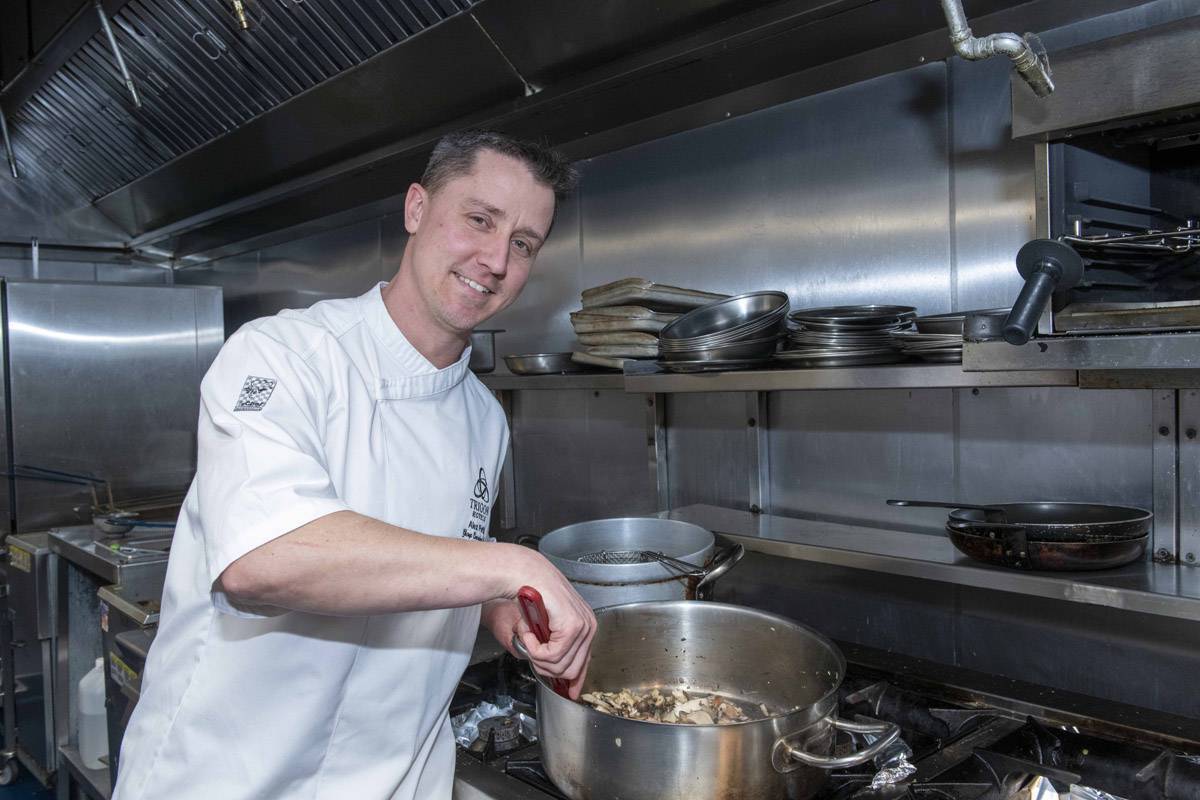
“It’s going well,” reports Trigon Hotels’ Group Executive Chef Alex Petit, who says the hospitality sector must accept it is a big source of food waste.
“So it’s important we take steps to become better, more efficient — because waste costs money, people’s time and energy, and the planet’s resources.”
It’s a process, he says, that involves education — and understanding that striving for sustainability is a journey, not like “flicking a finger and everything happens”.
The 10-point charter commits to reducing food waste by 20%. Petit explains: “We do menu-engineering, for example taking one ingredient and repeating it in a few dishes to make sure we get the most out of the ingredient.”
It also commits to introducing no-waste dishes, including the likes of lamb stew.
“We use all parts of the ingredient. Carrot peelings can make a garnish or be added to stocks, stalks of young vegetables e.g. baby turnips are nice to eat, onion skins can be used in stocks, and instead of using mashed potato we use baby potatoes with the skin on.”
In the same vein, Petit says Trigon Hotels engages with Dublin-based Cream of the Crop, a business specialising in artisan gelatos made from surplus food ingredients gathered from farmers, growers, and food producers. Other food waste-reduction measures include removing all unnecessary garnishes from plates.
“The bit of cress or the cherry tomato on top of a steak that people put to the side and that ends up in the bin. We stand over the bin, look at what comes back on the plate from the customer and see what is and isn’t necessary.”
Supporting local food suppliers to reduce carbon footprint, and prioritising seasonality, are also part of the charter. Trigon Hotels work with 25 local growers and producers — menus at both hotels include a map highlighting these — and they are always looking for new partners.
The charter commits to increasing the use of sustainable sources of protein — and to reducing energy consumption in the kitchens by 20%.
“We have meat and fish on the menu but we also offer alternatives — grains, pulses, rice,” says Petit, adding that a guide has been introduced for chefs for when to turn on and off equipment.
“When we go to change equipment, we ensure what we buy is much more efficient than what we had before.”

We use portion control, employee training, and buy locally
Muckross Park Hotel & Spa joined the Green Hospitality Programme ( greenhospitality.ie) last year and has since achieved the Silver Award in Sustainability. They also received a Certificate of Food Waste Recovery from Cliste Hospitality.
General Manager, Garret Power, highlights some of the hotel kitchen’s sustainability measures: “We’ve reduced our food waste significantly, to below five percent, using portion control and employee training on sustainability. Our menu development considers portion size, locality and wastage. Recipes often incorporate a by-product from somewhere else. For example, used coffee grounds are used to roast carrots, then used again for compost. Bones and vegetable trimmings are used to make stocks and sauce bases.”
Muckross Park Hotel is part of the iNua collection of four and five-star hotels, and the group is engaged in a pilot programme with Failte Ireland to reduce the hotels’ carbon footprint by 45% over the next five years. Recently, iNua ran a sustainable recipe competition, designed to engage chefs in thinking proactively about sustainable cooking techniques and products. Muckross Park had two wins, coming second in the commis chef section, and first in the senior chef challenge.
The hotel’s culinary team have also established an on-site vegetable and herb garden to provide fresh produce for its restaurant, The Yew Tree.
“We have 12 beds there. The poor weather set it back a little, but at the moment we have rhubarb growing. We’ve planted lavender in the walls and in time might look to having a beehive there.”
Buying locally, and reducing packaging or using biodegradable packaging are other key sustainability commitments. The hotel has also invested in new and more efficient condensing LPG boilers — to date, three out of five have been changed.


Cancel anytime
CONNECT WITH US TODAY
Be the first to know the latest news and updates