As we continue to decolonise the female body, taking back ownership of ourselves via body positivity, reclaiming menstruation and menopause, and binning uncomfortable underwear, so too has the uncovered pregnancy bump emerged to symbolise out and proud womanhood, and to take centre stage.
No more hiding under smocks. No more voluminous shapelessness – pregnancy has never been prouder. Or rounder – thanks to women like Rihanna and Beyoncé, the full lushness of the third trimester is being celebrated in public spaces in the presence of flashbulbs.
Our biological superpower – the ability to grow another person – is at last being seen for what it really is: awesome.
What used to be a talking point – Demi Moore, naked and seven months pregnant on the cover of Vanity Fair in 1991 – is now a red carpet staple.
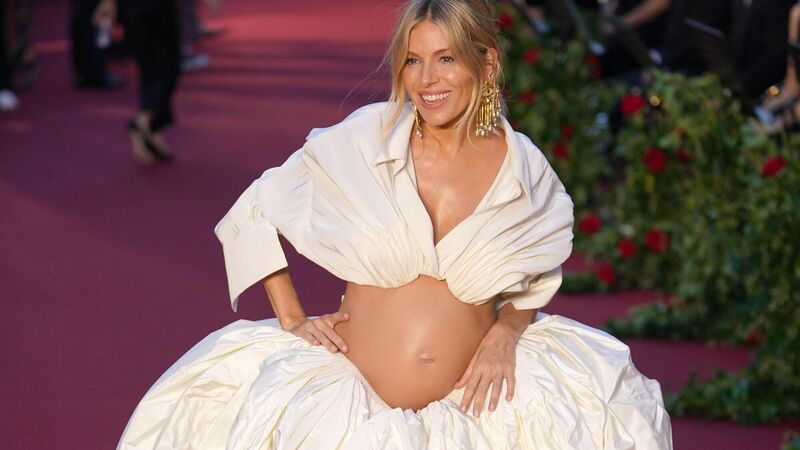
Think Sienna Miller, 41, at London Fashion Week in September, her pregnant belly upstaging her Schiaparelli two-piece (an outfit which admittedly looked like she’d nicked a hotel duvet) as she appeared at the Vogue World Show.
Already the parent of an 11-year-old daughter with actor Tom Sturridge, 37, Miller went the egg-freezing route at 40, and is now having her second child with actor Oli Green, 26.
Schiaparelli creative director Daniel Roseberry applauded her out-and-proud belly, dismissing old thinking around how pregnant women should present – that is, conceal themselves – in public.
Another antiquated ‘rule’ to consider, question, and in this case, disregard entirely.
“Her choice is our honour,” he told Vogue.
Preceding Miller in the naked-bump-on-the-red-carpet look is Brazilian model Adriana Lima, who wore a black Balmain gown with the belly cut out at Cannes in 2020, although Miller is arguably more high profile.
What would infamous fattist Karl Lagerfeld say?
The queen of red carpet pregnancy remains, however, Rihanna.
The mother of two baby boys with her partner, rapper A$AP Rocky, she has embodied pregnancy pride from the Met Gala to the front row, via award ceremonies and Vogue shoots, lush and curvy and belly-out in a series of fabulous costumes.
Her pregnancies – couture and glamorous backdrops notwithstanding – reflect the actual bodily reality of pregnancy. Extra flesh, curvature, expansion.
She wore hipster trousers and a metallic head-dress at Gucci’s A/W show, a naked black lace dress at Dior, a pink leather mini dress at Off White, and sweeping Alaia leather gown at the Oscars, with a transparent panel over her bump.
A Vogue shoot in her third trimester, photographed by Annie Liebowitz, made her the belly-beautiful poster gal of pregnancy.
Only Beyoncé’s Vogue shots in 2017, where she was veiled and pregnant with her twins, and looking like a Botticelli goddess, come close.
In a 2020 paper , Pregnancy Bump – The New Social Visibility, academic Angela Biscaldi from the University of Milan, notes how pregnancy pride is “flipping the stigma of the pregnant women who, by imbuing the belly with new meaning, exhibits that which for centuries was hidden, hushed up, and feared. [It is] almost a provocation: a visible symbol of women’s liberation from the fate of forced motherhood.”
Much of this visibility is happening online. On Instagram, out and proud pregnancy is displayed by hundreds – thousands – of women, known and unknown, the more famous including Jessie J, Cardi B, Katy Perry, Kate Hudson, Serena Williams, Gigi Hadid, Stacey Solomon, various Kardashians, and Rihanna.
Rhianna has also launched a maternity range, SavageX Fenty via her own Fenty fashion label, which includes nursing bras illustrated by a shot of her feeding her older baby son, RZA (her second son, Riot Rose, arrived in August).
“Not ur mama’s maternity bras…designed by @badgalriri, approved by baby RZA #SavageXMaternity,” reads the caption. Sizing is typically inclusive, from XXS to 4XL.
Pregnancy, as anyone who has ever experienced it knows, is a whole-body experience. From hair and nails to nipples, connective tissue to emotional response, it’s a lot more than just a bump.
And that’s before you consider how the world reacts to you, from hands-on bump touching to unsolicited baby care advice; you cease to be a private individual, attracting opinion like a magnet attracts iron filings.
Thanks to medical misogyny, it was regarded almost as an illness. Something to be got through, discreetly, before bouncing back, slim and bright-eyed.
Until very recently, women in the public eye were applauded for the quick loss of pregnancy weight; only a generation ago, it was the norm for celebrities like Liz Hurley and Victoria Beckham to remove themselves from the public eye, work privately to shed their baby fat then re-emerge to be praised by so-called women’s magazines for their rapid weight loss.
Today, the cultural tide – thanks to superstars like Rihanna and Beyoncé – has been resolutely turning. Pregnancy has never been more public or performative. And real.
We remain in debt not just to the uncovered bump-bearers of today, with their smartphones and social media followers, but to the first woman whose bump went public seventy-one years ago.
In 1952, Lucille Ball was already breaking new ground with the establishment of the classic three-camera sit-com format in her show I Love Lucy, plus casting a Cuban lead as her romantic partner (her real-life husband, the band leader Desi Arnaz).
Expecting their second baby, Ball pioneered public pregnancy in an era where depictions of on-air pregnancy were banned by the US Code of Practices for Television Broadcasters, because it meant that sex had happened.
(Sex, according to poet Philip Larkin, was not invented until 1963 “Between the end of the Chatterley ban / And the Beatles’ first LP.”)
Lucille Ball challenged this, negotiating with producers so that on the day she gave birth to her real-life son, her TV character would do the same.
Although the word ‘pregnant’ was never uttered on air, Lucille Ball – via her onscreen persona Lucy Ricardo – broke viewing records, made headlines, and was inundated with gifts from well-wishers.
Ball, who died in 1989, paved the way for this century’s attitude to joyful public pregnancy.
We’ve come a long way, baby.
CONNECT WITH US TODAY
Be the first to know the latest news and updates