Princess, movie star, or pauper — history told through three centuries of wedding dresses
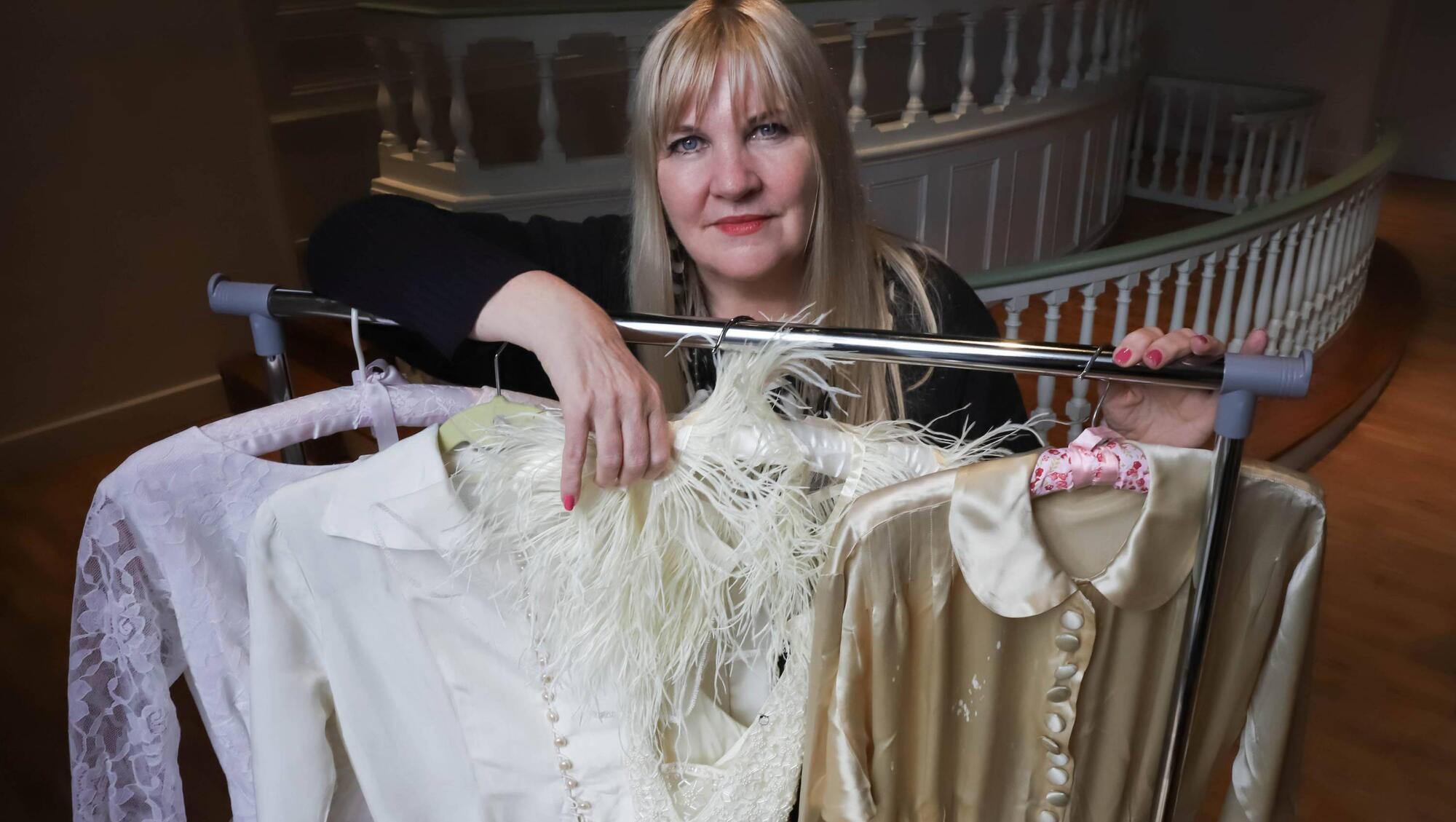
Gwen Mc Guirk with a selection of dresses. Picture: Victoria Mannix Photography
Sharon Tate wore hers five inches above the knee in 1968; Queen Victoria began the trend for white wedding dresses; and in the 1940s women wore a practical tailored suit on their big day. Just some of the fascinating details that will emerge at an event set to take place in Dunmanway in early December telling the story of the wedding dress from 1840 right into the 21st century.
The Dress — Three Centuries of Weddings is the result of a collaboration between two West Cork-based women — one passionate about history, the other about fashion. History consultant Michelle O’Mahony and couturier/film costumier Gwen Mc Guirk have organised the event as a fundraiser for Dunmanway Historical Association (DHA).
Showcasing dresses from bygone eras, along with more contemporary styles, the three-day event will feature talks on the history of the wedding dress and on trends over three centuries. It was inspired by the DHA’s pre-Covid publication of two wedding photo pictorials with images donated by people in the Dunmanway hinterland.
“The pictorials are like a census in pictures of families from Dunmanway,” says O’Mahony, adding that the December event will answer many “wedding-themed history enquiries” received by the DHA.
“The wedding dress is a great communicator of society’s norms and its various class structures through the generations — and that’s true whether women were baring their bosom or covering their arms,” says O’Mahony, citing the example of what happened to wedding dresses when women became emancipated.
“Out went restrictive bustles and to some extent corsets. And in came the more fluid styles of the late Edwardian era and the flapper style of the roaring ‘20s, when it became socially acceptable to have shorter hemlines and dance more.”

Mc Guirk — passionate about couture and costume in film, TV and theatre — has won awards for her work on films such as (2019) and (2015). She was an assistant milliner in the hats and headdress department for .
Among the antique wedding dresses from her own personal collection that she’ll exhibit next month is an 1860s dress sourced in the South of England, which Mc Guirk initially found difficult to date: “It’s made from very fine cotton, like voile or muslin, so delicate it’s like a cobweb, which made me think the fabric was older than the dress. I thought it might be from the Jane Austen era but its style is a bit later.”
The dress shows the work of two seamstresses — “there’s really find handwork that I don’t think any human could do today” — and it would originally have been in two pieces.
“In that time the bodice and skirt were made separately. There’d be a bodice with long sleeves made for the church and a second bodice in the same fabric with short sleeves, more low-cut or off-the-shoulder for the evening. You can see that somebody later joined the bodice and skirt together with rougher stitching.”
Quite flat in the front, all gathered in the back and pooling on the floor, Mc Guirk says the style was popular around 1860 when more emphasis was put on the back of the dress.

A second dress she’ll exhibit is from around 1934, when people flocked to the cinema and Hollywood led the way in glamour. The fabric of the dress — “very hugging to the figure, very long, with long sleeves and all these tiny buttons down the front” — holds the story of how less well-off women could hope to emulate a Hollywood diva on their big day.
“The fabric isn’t silk satin but a very beautiful synthetic, one of the early synthetics, rayon satin. It was quite popular with brides — it meant working girls could buy a satin-look fabric or an off-the-peg dress in a department store at a fraction of the cost. In Ireland too, people went to the cinema and were influenced by the fashion of the stars,” says Mc Guirk, who’ll also show one of her own creations — a Tudor-style dress and headdress.
In contrast to the many elaborate styles of earlier eras, the 1940s brought rationing and textile scarcity. “In Ireland during World War 2 and up to the 1950s, women didn’t wear a dress — they wore a suit. The bride-to-be went to a local dressmaker and had a wool or tweed suit made. My grandmother was a dressmaker and she called it a ‘costume’ — it was very practical and used afterwards for Sunday best.”
O’Mahony, who loves all history but particularly that of the 19th and early 20th centuries, has her own fund of fascinating wedding stories. Author of — first published in 2005, she hopes to relaunch it shortly — she says marriages took place within Cork Union Workhouse during the Famine, even though men and women were segregated.
“Some marriages were out of love — the woman was already in love with the man before entering the workhouse — and some were out of necessity. People entered the workhouse because they were destitute and if they wanted to leave, the bureaucracy looked more kindly on a couple who wanted to make their way in the world. It was easier for them to seek their fortune elsewhere — whereas a single person leaving could fall into vagrancy.”

O’Mahony explains that despite segregation, opportunities arose for men and women to meet, at church and — particularly during overcrowded Famine conditions — in the dining room.
And the wedding dress? “It was the workhouse uniform, basically a prison uniform, unique to each workhouse — a tunic top and bottom worn by men and women.”
Some of the dresses that will be on display in Dunmanway’s Atkins Hall — a former Methodist church featured in the DHA pictorials.
“They’re from the 1960s,” says O’Mahony, who’s getting calls every week: “people asking if we’ve enough dresses and ‘seeing as Mum’s dress featured in the pictorial, would you like to display it?'.”
O’Mahony says it’s hard to quantify the appeal of the wedding dress: “The wedding is a big event and the bride needs to stand out. Every woman is looking for a unique dress, that stand-out dress.”
For Mc Guirk, a wedding dress is more than a ball gown: “It’s that special dress that a woman can wear once in her life.”
And yet, no matter how unique, the wedding dress also reflects the trends of an era, whether that’s the 'meringue' dress made popular by Queen Victoria’s daughter-in-law in 1863, or a fashion for hip bustles and large crinoline skirts that demanded more elbow room at the table.
From the straight, dropped-waist dresses of the 1920s to Grace Kelly’s iconic 1956 wedding dress; from the puffy sleeves, lace flounces and 25-feet long train of Princess Diana’s 1981 dress to Cindy Crawford’s simple short slip dress in the Bahamas in 1998, the wedding dress has always been a talking point.
- The Dress — Three Centuries of Weddings, Atkins Hall, Dunmanway; Friday, December 1 (5-9pm) and December 2 and 3 (noon-5pm); admission €5
- Showcasing antique and more contemporary styles, it will include talks on wedding dress history, make-up since Victorian times and dining and etiquette since the Victorian era; also a ‘mini wedding fair’ with wedding-themed stalls from local exhibitors.
- Contact: info@omhistoryconsultant.ie