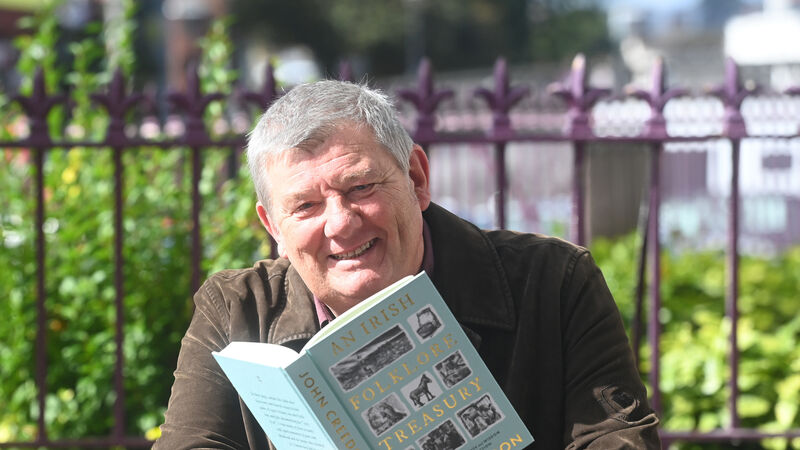
John Creedon can’t help telling stories. It’s why he became an author. “What do you call a gathering of Creedons?” he asks, when I meet him on a sunny Thursday lunchtime.
The question’s an invitation into a story, and the answer comes at the end.
“The way our household was when I was growing up — there were all these conversations happening at different levels,” says the RTÉ broadcaster, who grew up one of 12 children. “The amount of words
exchanged in our kitchen in an hour was absolutely frightening. There were often five conversations going on at once.”
And the collective noun for a gathering of Creedons? “A cacophony of Creedons.”
He doesn’t mean it to sound grand — he still finds it weird to see ‘author’ next to his name — but he feels it was always his destiny to commit words to paper. “I’m interested in the unseen,” he says. It bears out in his book projects. His first book, That Place We Call Home, digs beneath the surface of familiar place names. His latest offering, An Irish Folklore Treasury, is just out.
“I’m constantly happily walking in graveyards. I read the headstones. I go along a different row each time.”
Just the day before we meet, he was in Saint Fin Barre’s Cemetery, where he saw a “beautiful example of love” in an inscription on a Victorian-era headstone. “His wife died very young, aged 29, and the words were to the effect ‘you must go forth my dear/but please wait for me/and I will come and join you later’.”
And on another headstone — a woman’s — a phrase that made him smile: ‘They said I looked lovely’.
It doesn’t make him sad. “These were real people, who had a toothache on a wet Tuesday, who had ambition, who lost the head. And there are millions of them and so few of us. I don’t find that one bit frightening.
“When I leave a cemetery, I’m absolutely grounded for seven minutes. I realise the ESB bill, the person who barked at me or patronised me, that it is inconsequential in the greater scheme of things. This feeling reverberates — and dissipates when I’m back in traffic and somebody annoys me.”

Spend an hour in Creedon’s company and you sense that the impulse to read the past — and the urge to conjure stories about it — is deep in his DNA. Visiting the Capela dos Ossos (Chapel of Bones) in Évora, Portugal — where interior walls are decorated with human bones and skulls — Creedon found himself creating the stories.
“When I saw those skulls, I was thinking: ‘over there may have been the butcher who was mean over five pence’ and ‘here may have been the jealous sister-in-law’. And I thought: does it matter, the stuff we fight or argue about, all this stuff we call
difference? At the bottom of it all, we’re just folks. It’s why I’m drawn to cemeteries and folklore.”
Creedon, at age 10, was writing stories and sending them to the newspaper. From the late 1970s — newly emerged from his teens — he has a black folder with “self-indulgent” poetry he was writing back then. When he quit college — and his English and philosophy degree — aged 20 because he was “charged with supporting a family”, he looked to make a living by any means. He worked in factories and on building sites, in Cork City Library and on pirate radio.
“I was always scribbling something — doodling scripts for radio, writing comedy for The Gerry Ryan Show and Republic of Telly. It was always sketches, always short pieces.”
Ask how he became an author, and Creedon straightaway thinks of the people who encouraged him — a trio of names in particular.
“Irene Feighan of the Irish Examiner contacted me about 30 years ago to write a weekly column for the paper. I was really excited, but thought I wouldn’t have the wherewithal. Irene said: ‘Why don’t you try for six weeks, and if it’s bad I’ll let you know’. I’d write it longhand and send it by fax. That six weeks turned into two years. She saw something in me that I didn’t see in myself.”
And then there was Deirdre Nolan, then with Gill Books, who “contacted me several times over the last six years saying she felt there was a writer in me”.
And way back at the beginning was a teacher, Humphrey Twomey, who praised an essay Creedon wrote when he was 13.
A big challenge that came with putting a book together lay in what was a bit of a gear-change for Creedon.
“Up to this, I’d been writing very short pieces, where you can get in very easy with a screwdriver.
With the process of a book, it’s more about throwing it up on the page as fast as you can, whereas I’m always drawn to fixing the word I’ve just left.”
This Saturday night, Creedon will be in conversation with Irish Examiner’s Esther McCarthy at Words by Water — Kinsale Literary Festival. In anticipation of that, he talks about a section in An Irish Folklore Treasury that refers to traditional cures. Ballinspittle, in the Kinsale area, is Béal Átha an Spidéil in Irish, which Creedon explains means “mouth of the river of the hospital”.
“It was a holding place for people who were infected, as was Leopardstown in Dublin and Lover’s Walk in Cork. Isolation was the only safeguard against infectious disease in those days. Ballinspittle is dotted with holy wells. So I went with Luke O’Neill to see if there was any science to back up the superstitions.
“Luke tested the water in the holy wells. One was high in copper, thought to boost the immune system, and another was high in iron, which is very good for fatigue and anaemia.”
The stories Creedon introduces in An Irish Folklore Treasury are from the Schools’ Collection, old stories collected by schoolchildren as part of a
nationwide project set up in the 1930s to preserve Irish folklore. “I dedicated the book to my 11 siblings, because in this book, children are the stars. And because we were all children once.”
While researching the Schools’ Collection, he found two of his aunts from Adrigole — his mother’s sisters. “I got a lump in the throat. It was just wonderful to read their handwriting.” The account of old ways and wisdom that his aunts had contributed had been told to them by their ‘father, aged 57’.
“That was my grandfather, whom I never met,” says Creedon. “And there he was, a real man, on a real day, helping his daughters by telling them folklore.”
When you broadcast your words or stories — put them out on radio or TV — you can’t physically hold them. Much less physically bring them close to your heart. But you can with a book. And, as we come to the end of our conversation, this is what Creedon does with An Irish Folklore Treasury.
He brings the book to his heart, and says: “Some kid’s going to read this in 28 years’ time when he’s bored, home from school with measles. And this gets me. Because these people lived.”
- John Creedon will be in conversation with Esther McCarthy in the Trident Hotel, Kinsale, on Saturday night, as part of Words by Water - Kinsale Literary Festival (September 29-October 3). https://www.wordsbywater.ie/event/john-creedon-in-conversation-with-esther-mccarthy/

Subscribe to access all of the Irish Examiner.
Try unlimited access from only €1.50 a week
Already a subscriber? Sign in
CONNECT WITH US TODAY
Be the first to know the latest news and updates