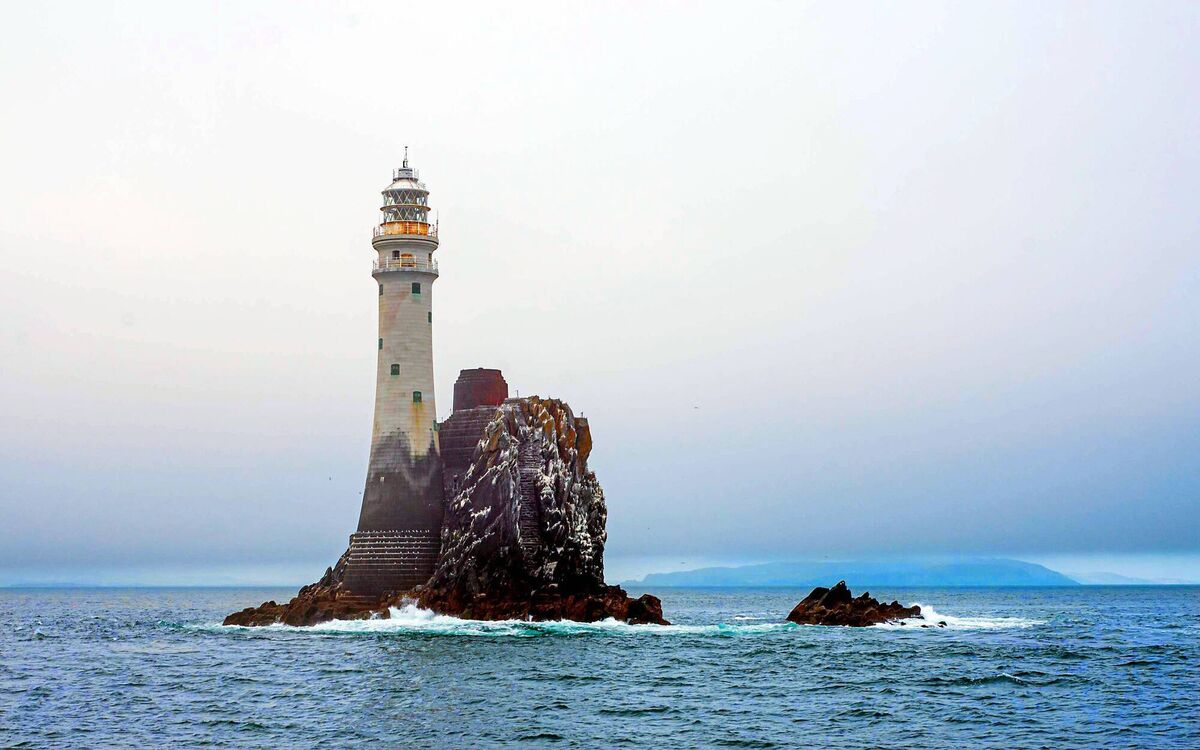
It could be the most tranquil day on the Atlantic ocean, with the Fastnet Lighthouse framed against a blue horizon and barely a wisp of a cloud in sight.
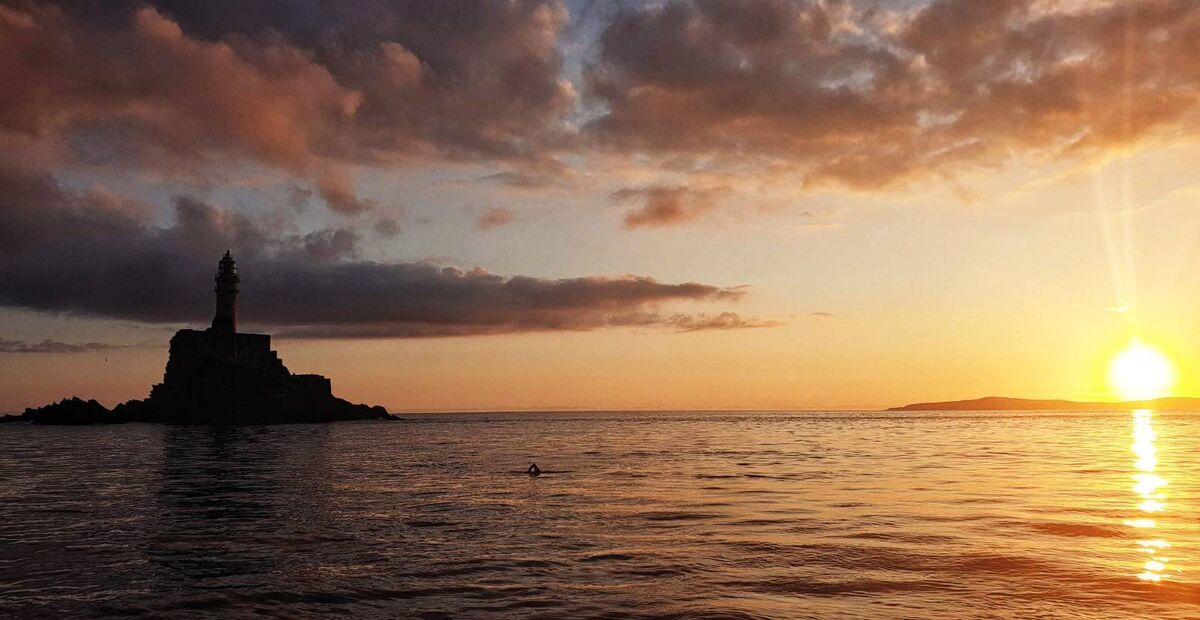
Despite that, Irish Lights maintenance team member Paul Barron never flies out to the spectacular rock 6km southwest of Cape Clear island without extra supplies – whatever the forecast may be.
“There are emergency rations on Fastnet, but steak and kidney pie, Ambrosia tinned rice, and freeze-dried soup isn’t really my cup of tea,” he says.
“Anyway, if you have your own food, there are great cooking facilities, and it is like eating in the best restaurant in the world with the finest views.”
Barron was the man with the smartphone video skills when he and his colleagues, Ronnie O’Driscoll, Dave Purdy, and Malcolm Gillies were delayed on Fastnet during Storm Barra last December.
His 360-degree scan of the surging ocean, filmed from the lantern room at the top of the tower, made it on to many news outlets, including Sky News. He remembers being contacted by several French and Spanish weather stations.
The swell was about 9m, or 30ft, and wind speeds were up to 90 knots, or 166km/h. Spume from the sea whipped up in a typhoon-like swirl around the 45m (147ft) tower.
Waves repeatedly swept over the helipad. There would be no question of the helicopter landing to bring the men ashore for several days.
“That particular day, December 7, 2021, was probably the worst I had experienced, but we were well used to it, having been out there in many storms,” Barron says.
“I was in the merchant navy for some years, so I never felt in danger,” he points out.
“You wouldn’t feel any vibration, given the thickness of the granite stone in the tower, but you wouldn’t want to stay up in the lantern room too long in case the windows would smash,” he says.
The fact that the four maintenance crew were so relaxed during Storm Barra was yet another reminder of the superb designing skills of William Douglass back in the late 1890s.

Douglass was engineer-in-chief with the Commissioners of Irish Lights, the authority charged with responsibility for maintaining lighthouses and navigation marks around the island of Ireland.
The perilous rock off the southwest coast with its named derived from Norse for “sharp tooth isle” – also know as Carraig Aonair, or “lone rock” in Irish – had been marked with a cast iron structure designed by George Halpin, engineer to the Port of Dublin Corporation from 1853.
As James Morrissey recounts in his recently republished book, A History of the Fastnet Lighthouse, vessels off the West Cork coast had long relied on the light located on the southern side of Cape Clear island for guidance.
However, mariners who felt the light was too high above sea level and too far inshore were proved right when the North American steam packet, the Stephen Whitney, foundered off Crookhaven in 1847, with the loss of over 90 lives.
A reporter for this paper was told by survivors how “a brief moment only ensued, and one terrific crash followed, which instantly consigned numbers of souls to eternity”.
It took almost six years to complete the first light on Fastnet, at a cost of £17,390 (GBP), and the Cape Clear light was extinguished. However, on November 26, 1881 a hurricane struck and “gigantic” waves smashed the Fastnet lantern.
A similar cast iron tower designed by George Halpin on Calf Rock, nearby, was carried away by the high seas. It took another decade for Irish Lights headquarters to decide that Fastnet needed to be replaced.
Work began on building the new granite tower in 1896, and the leadership of foreman James Kavanagh, a Wicklowman, was crucial to the seven-year project. Living conditions were tough for the men employed to lay the stone in an intricate system of “dovetail joggles”, which had been devised by Douglass’s father, Nicholas, while working on the Guernsey Lighthouse project.

The “dovetail joggle” system “bonds the entire structure into a virtual monolith, as no stone can possibly be extracted until every stone above it has been removed”, according to one of Douglass’s colleagues, CW Scott.
In a sense, the lighthouse was built twice, as each stone taken from Cornwall was first inspected there before being shipped to Rock island in Crookhaven harbour, the shore depot for all Fastnet construction work.
The workers, who were paid two shillings and sixpence per day for a nine-hour shift, were given an extra shilling per day for this posting. Their conditions were so cramped that they sometimes shared three to a bunk, and began their shift at 5am.
As Scott recorded, the first task was to ensure each man washed himself thoroughly. All bedding was taken out for airing if weather was fine, and the barracks was scrubbed. As a result, “very little sickness occurred”. There were no fatalities recorded, but two men lost an eye and one man broke a leg.
A total of 89 courses of 2,074 stones were put in place, with little of the technology available on construction sites. Kavanagh, in white jacket, was a charismatic foreman who never left his workplace.
Sadly, he was taken ill in June 1903, having put the 89th and last granite course of the tower in place. He was brought ashore to Crookhaven, where he died.
On June 27, 1904, the new light was exhibited for the first time, marking, as Irish Lights put it, “a pinnacle of modern masonry engineering”. Few lightkeepers were that keen on Fastnet postings, however, given that the hazardous approach to the rock involved a boat journey in gathering swell, and a perilous winch ashore by “bosun’s chair” swung from a derrick.
The “long slow winch over boiling seas to a platform high on the rock” was described by Richard Taylor, a former lighthouse technician, in his book The Lighthouses of Ireland: A Personal History. He wrote of how skills in tolerance and understanding were very evident on the rock, where the tower could “become something of a tomb” in bad weather.
Within the next decade, Fastnet was the focus for piloting new aids to navigation, such as “submarine bells”, using submerged mechanical systems to transmit sound through water to warn passing ships of hazards. The First World War brought that sort of testing to a halt. Many staff were reservists, and were called up or volunteered for active service – although a number of applications to leave were refused by Irish Lights.
The Anglo-Irish War of 1919-1921 presented further challenges, particularly when British forces opted to use offshore lighthouses to store supplies of explosives. Keepers were often reluctant to report a theft, as they could be viewed as informers.
On June 20, 1921, one daring raid was made on Fastnet, as recorded in a witness account in the Bureau of Military History, given by Seán O’Driscoll, officer commanding the Schull battalion of the IRA’s 3rd Cork brigade. The group got away with it, taking about a tonne of gun cotton which was used to make mines.
Over the decades, prior to the development of commercial flight, Fastnet became known as the “Ireland’s teardrop” – as in the last view of the island for emigrants en route to North America. When helicopters were introduced in the lighthouse service, Fastnet became the first designated for scheduled staff relief from 1969.
In 1979, keepers Gerard Butler, Reggie Sugrue, and Louis Cronin played a key role in recording sail numbers and transmitting the information to Mizen Head when a summer storm tore across the Atlantic from Newfoundland. The tempest hit almost 3,000 sailors at sea competing in, or following, the Fastnet yacht race.
“The sea was rising to within 5m of the lighthouse balcony at times. We had the doors and windows all barricaded,” Butler recalled.
When the storm subsided, the official death toll of 15 sailors rose to 19, as four spectators also lost lives.
Ten years later, Fastnet became “unwatched” for the first time under the lighthouse automation programme. In his book, Morrissey records the landing he made on the Fastnet with photographer Michael McSweeney, where they were welcomed by former principal keeper Dick O’Driscoll.
Over an evening meal, O’Driscoll told them how keepers stationed there and on the Bull Rock would have played chess using the beam of Morse code signal lamps against low-lying cloud.
There have been further technological developments at Fastnet, not always popular. When Irish Lights opted to install an LED light in place of the rotating optic lens floating in mercury in 2018, a public meeting was held. Serious concerns were expressed by tourism interests on the West Cork mainland about reducing the beam from 27 to 18 nautical miles.
Maritime lawyer Michael Kingston appealed unsuccessfully to then Taoiseach, Leo Varadkar, and Irish Lights to retain the long sweep of the beam as a “symbol of hope for the Irish diaspora”.
According to Kingston, the Fastnet’s associations with saving many lives emphasised its special status as “part of the fabric of Ireland, her past, and therefore her future, not just in Ireland but for Irish people all over the world.”
- A History of the Fastnet Lighthouse by James Morrissey, with an introduction by Michael Holland, is published by CrannĂłg Books.
CONNECT WITH US TODAY
Be the first to know the latest news and updates