‘We are broken inside’: How Cork communities are welcoming Ukraine's refugees
Six weeks after the first Ukrainian refugees arrived on Irish soil, communities around Cork have been galvanising to welcome them, writes Mary Cate Smith
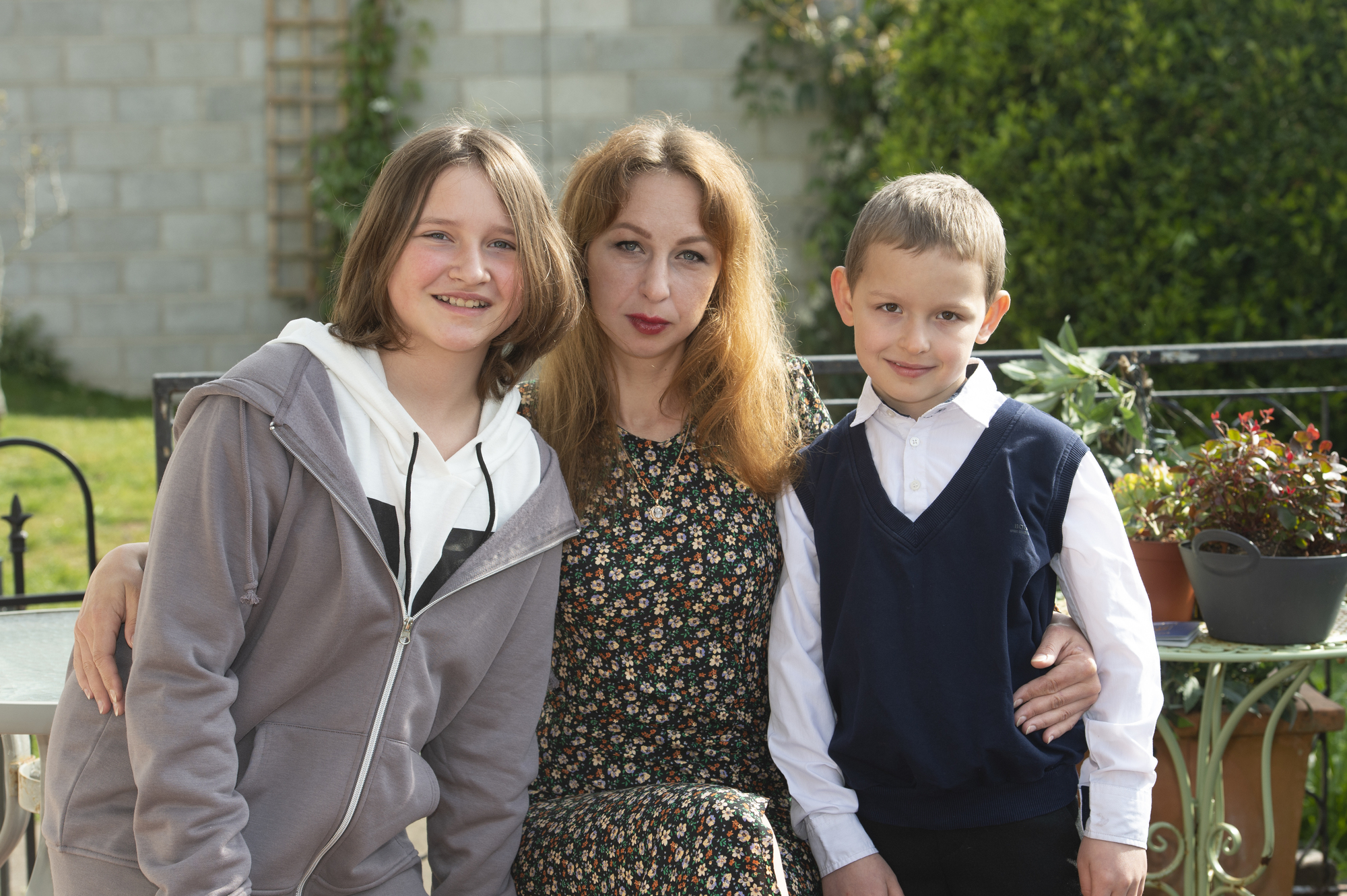
Ukrainian Svetlana Solntseva and her children Maria and Andrii, were staying with a host family in Glanmire but have recently found temporary accommodation in the city centre. Svetlana hopes she can find a school for her children. Picture: Dan Linehan

Ukrainian Svetlana Solntseva and her children Maria and Andrii, were staying with a host family in Glanmire but have recently found temporary accommodation in the city centre. Svetlana hopes she can find a school for her children. Picture: Dan Linehan

During Covid-19, we saw wildflowers curiously sprout through cracks in the pavements of urban dwellings. An inkling of hope injecting much-needed life into the otherwise bleak landscape of the global pandemic, it signified a small scale re-wilding of our cities. These new, living, breathing things were pushing through in spite of the mass destruction caused by the virus.

While the circumstances were undeniably bleak, the healing process, on a natural level at least, had begun. It seemed that maybe, something good was coming from something very, very bad.

An organic connection born from tragedy happened on a very human level between two like-minded Blarney residents, Valerie Kirby and Kate Durrant. At just 15, Valerie’s son Cian suffered an aneurysm and died. Kate was one of the first responders on site. The next day, she returned to the house with a lily of the valley plant and continues to lay flowers on his grave every year on his anniversary.

It was this extraordinary gesture of kindness that allied the two women — that and a desire to re-ignite the strong community spirit that they knew already existed in their local village. The pair worked together as part of the Meals on Wheels team during the pandemic, delivering over 90 meals a week to incapacitated or elderly neighbours. Many of the existing team of drivers were over 70 years old, thus falling into the vulnerable category.

Along with a strong team of volunteers, the pair got to know people “they never would have known”.

Delivering food and medicine, and dropping people to appointments, they “started making friends again through tragedy”, says Valerie.

When news broke of the invasion of Ukraine, the Blarney Community First Responders/Meals on Wheels crew re-grouped with the aim of making the transition to Irish life as seamless as possible for the Ukrainian nationals.

Kate Durrant and Valerie Kirby collect hot meals for Blarney Meals On Wheels recipients from chefs Margaret Carroll and Margaret Spillane, who prepared the meals at Blarney Castle Hotel. Picture: Denis Minihane

Kate is no stranger to accolades — she previously won the title of Cork person of the month as well as inspirational person of the year — but she is utterly self-deprecating and humble.

“We’re all only playing the hand that we were dealt. I’m a white, Anglo-Saxon protestant that can feel welcome anywhere I go in the world,” she says. “There’s no hierarchy in our group. You clean the loo, you pack the clothes, you run the errands.”

“Initially it’s hard work,” says Valerie but “we don’t see it as work. It’s just basic humanity.”

The commandeering of volunteers in Blarney is a testament to what can we do in this country with the sheer force of people power.

Kate and Valerie, with support from others in the community including GAA Healthy Club Project secretary Jim McEvoy, set up a Facebook account called Welcome to Blarney. On it, they made a clarion call for donations of clothes and essential items such as tampons, underwear, phones, and writing materials. All the clothes donated were brand new with the tags still on.

“This is not charity,” says Kate. 

Everything here is set up to allow them to have their dignity.

Not only did the volunteers create a shopping boutique experience in the local GAA grounds, they also rounded up psychologists with expertise in migration issues; therapists who deal with childhood and trauma; two doctors, including local Fianna Fáil councillor Dr John Sheehan; creche facilitators; hairdressers; and more — all willing to offer their services for free.

Izabella Zgeir didn’t expect to have her birthday in Cork. Aged just 13, she was visiting her paternal aunts in Baghdad when the war broke out in her home country of Ukraine. Tech-savvy and artistic to boot, she was awaiting the results of a tourism-themed art competition for which she drew a picture on her iPad of a person adventuring through the African jungle with only a backpack. The results of this art competition, one that she had high hopes of doing well in, never came.

Just a few weeks ago, Izabella, whose mother describes her as “fearless”, was on a rollercoaster in Iraq completely oblivious of what was to come.

Mariia, Yas, Izabella and Muammel Zgeir who have arrived in the Cork area from Ukraine. Picture Denis Minihane.

Izabella is the daughter of Maria, 39, and Yas, 44, who left his war-torn home of Iraq to forge a better life in Ukraine. The couple was running a thriving business, supplying kitchen equipment and utensils to hotels and directly to consumers at stalls in their home of Odessa. Together with Izabella and her brother, nine-year-old Muammel, they enjoyed their lives in Odessa.

The Russian-speaking port city they called home borders the Black Sea and is located approximately 180 miles (290 km) west of the Crimean peninsula that was annexed by Russia in 2014. The fear expressed by its natives is that a takeover would allow Russia to control movement of imports and exports through its port.

As recently as April 3, there was an explosion at an oil refinery in the city as the Russian army appeared to pull back from the north. The citizens of Odessa include Maria’s 74-year-old mother, who cannot use a smartphone, and her brother’s mother-in-law, who lives on the fifth floor of an apartment block and is essentially trapped.

“The majority of people panicked and left the country but the elderly and the disabled, they can’t get out,” Maria says. “We are really worried about my mother and are trying to convince her to come over. There are ways but she doesn’t want to leave. She’s 75. It’s her home.”

The war has taken a serious toll on Maria’s cousin, who is taking care of elderly relatives.

“My cousin, she can’t leave. Her body had a huge reaction, a massive panic attack. She wasn’t able to walk or function for a week. I spoke to her recently and she was only regaining her speech two weeks after.”

An avid follower of social media, Maria had been following the trajectory of an Irish-based, Russian-born blogger Yana Korolewa for some time. Wanting to do her bit to help the Ukrainians, Yana made a video about how to travel safely to Ireland, providing comprehensive details about the right to education, medical, and social assistance.

Maria contacted Yana, who put her in touch with Anzhelika Samuilova, lawyer and managing director of Time to Move Ireland, an agency that helps people relocate to this country.

Mariia Zgeir who has arrived in the Cork area from Ukraine. Picture Denis Minihane.

Maria was also introduced to a resident of Cloyne, Anastasia Christoforova. Latvian-born, Lithuanian-raised and Russian-speaking, she translated some of our interview.

While Anastasia is very proud of what the community has done to support the Ukrainian people, she says it’s important not to “other” the Russian identity and portray its people as aggressors. When the war broke out, her two children were worried that their Russian heritage would influence their classmates’ opinions of them and they stayed at home for a week.

Managing director of Allfresh fruit and vegetable wholesaler, Barra Sweetnam heard about Maria and offered her a vacant house for her family of four. While browsing the boutique set up by volunteers at Blarney, she was asked what she really needed, to which she replied almost instantaneously: “A sewing machine.”

Previous to running a business with her husband, Maria had studied fashion design and worked at several prestigious companies including menswear apparel firm Gregory Arber.

“I have a sewing machine by my side at all times,” she tells me. “It’s my whole life.”

Anastasia set up a GoFundMe page for Maria to start her own tailoring business and just last week she had her first client, a young girl with down’s syndrome about to make her holy communion.

For now, she has been making dolls with sheets from Barra’s house.

“Don’t tell him,” she laughs, “but I’ll use anything I can get my hands on.”

Collections in Barney for Ukrainian Refugees

When I first meet Svetlana Solntseva, a mother of two, she is encouraging her daughter Maria to play me a Korean pop song she likes on YouTube.

Younger brother Andrii, a nimble-looking creature with exceptionally glossy skin, shakes his hips as his sister shows me her pitch-perfect version of the routine. Meanwhile, I eradicate any previous hints of coolness by looking like I’m having a seizure standing up. The kids are bemused and it’s a good ice-breaker.

Svetlana and the children were living in Glounthaune, Cork, with Peter Dennehy and his family at the time of our interview but when we last spoke she was moving into temporary accommodation in the city centre. Maria, 11, and Andrii, 7, don’t speak much English and at the time of writing they had not yet found a school that could accommodate them but were hopeful that would change in the near future.

A 33-year-old divorcee from Kyiv, Svetlana describes her journey to Ireland as “terrible, just terrible”.

Her instincts kicked in almost immediately after the news of war broke and she knew she wanted to get her children out of the country. She didn’t know where but she wanted them to be “as far away as possible”.

After a short delay, owing to a lack of transport, she finally made it to the train station with two suitcases — one of which was subsequently lost — filled mainly with clothes for her children.

“In the train station, there was no place to sit. So we found a car and paid the driver. When we got going, the car broke and Ukrainian soldiers evacuated us. I’m standing in the road with two kids, the snow is falling. It felt like we were without help,” Svetlana said.

The soldiers drove her and the children to the train station at the next city, Bila Tserkva. They stayed there overnight, lying on the freezing floor with nothing but bags underneath them as temperatures plummeted to -14C. Despite sleeping there, they didn’t make it on to any of the trains the next morning.

Collections in Blarney for Ukrainian Refugees

Deciding to try for a taxi again, Svetlana and her family went out on to the street only for a rocket to fall about a kilometre from where they were standing, destroying entire buildings and everything in sight.

Recalling this moment is especially painful for her and we stop the interview for a while to have some Madeira cake and tea, she likes hers cold, she tells me.

While Svetlana wishes her parents would come to Ireland, she feels the journey would be too much for them. To get here, she took a bus for 26 hours and a boat for 18, with lots of walking and false starts in between.

Crying, she clutches her phone. She was speaking to her father last night. She contemplates the possibility that it could have been the last time she will ever hear his voice.

“I don’t want to cry. I never cry because the children are looking at me all the time. 

I mustn’t cry. I must be brave but now we are broken inside. To start life all over again... I just don’t know. I am not young.

Svetlana says she believes there was never any anti-Russian sentiment felt in Kyiv and the invasion seems to have taken its citizens by surprise.

“All this is so hard to understand. We speak one language. Some Ukrainians speak Russian and some Russians speak Ukrainian. Years ago, Ukraine was with Russia, our parents were living together so we think that these two countries are friends.”

The bombing of the maternity hospital in Mariupol was a huge turning point, she says. The WHO described it as “an act of unconscionable cruelty”.

While the narrative slung by political scientists and historians vacillates from autocratic to authoritarian, Svetlana has only one word for the regime fostered by Putin — “fascist”.

“They are killing children. They come and bomb schools, hospitals. We are living in the 21st century. We have a lot of shared history. There is so much information out there. How can it happen?”

Svetlana and her children have seen first-hand the extraordinary kindness of the Irish people and although she is still running on survival mode, she says it has softened the hardness she had felt towards people since the outbreak of her country’s invasion.

“When it happens, something bad, you can see the other side. You see the people who want to help, who want to do something good. It’s beautiful to see this. We are very grateful and very thankful to Peter who is helping us.

“I hope this war will end soon because it’s really stupid. What’s it for?”

 Twenty-four-year-old Maryna Kovalenko a Ukraine citizen who was working in Russia and studying for her master's in Internation relations when the war broke out is now staying with her host family the Foster's in Carrigaline, Co Cork. She is pictured with Paul, Jan, Lachlann, Elsie and Beckett Foster. Picture: Dan Linehan 
Twenty-four-year-old Maryna Kovalenko a Ukraine citizen who was working in Russia and studying for her master's in Internation relations when the war broke out is now staying with her host family the Foster's in Carrigaline, Co Cork. She is pictured with Paul, Jan, Lachlann, Elsie and Beckett Foster. Picture: Dan Linehan 

Jan and Paul Foster have welcomed 24-year-old Maryna Kovalenko from the Ukrainian city of Chernihiv into their home in Carrigaline. Theirs is a busy household with 7-month-old Beckett, Lachlann, 6, and Elsie, 5. The Foster family also includes Nina, who tragically passed away when she was just a few days old in August 2020.

Jan was in bed breastfeeding Beckett when she first heard the news of the war. Processing the news was surreal, she says: “That in this day and age we can have such a huge-scale conflict, that one country can invade another country so obviously, on such fickle pretences.”

After losing their baby sister, Jan was worried about speaking to Elsie and Lachlann about the war, especially since the latter is a very “inquisitive, deep, and sensitive child.”

She sat the kids down and explained it as “as child-friendly as we could,” she says.

“We said, ‘Imagine if we needed to get out of our house right now. What would you bring? What’s important? What could you carry and where would we go?’ 

We explained that these people have nowhere to go and Lachlann just said, ‘Why can’t they come here?’

That innocent remark really struck a chord with the Fosters. They had a spare bedroom and Jan was still on maternity leave so they had the space and the time to accommodate someone. so they put their names down on the list of pledges with the Red Cross. However, before they heard from the organisation, they had a message on Facebook Messenger from an online acquaintance from the US who knew Maryna. She had stayed with them on a college exchange and they wanted to know if Jan and Paul could help her.

Maryna, a political journalist working in a business newspaper, was from Ukraine but living and working in Moscow. Her parents remained in their hometown of Chernihiv with her six-year-old sister and a motley crew of cats, dogs and a parrot – all beloved pets left behind by fleeing neighbours. The power was intermittent and food was scarce, Maryna told Jan. By March 7, she realised she needed to get out. She came to Ireland via Kazakhstan, unable to travel home to say goodbye to her family.

Jan believes that we need to challenge our preconceptions about refugees as “downtrodden” and admits that she has never “felt my privilege so much”.

Have Jan and Paul had to make many adjustments? Nothing major, she says, as cooking for one extra person is just as easy and it’s about “being conscious that Maryna might be in the bed in the mornings but other than that, no.”

Were there any objections in the family? Initially, Elsie was put out that she no longer has her own bathroom, Jan laughs but as soon as she got to know Maryna, she forgot all about it.

“I feel a real sense of Irish pride, that we’ve been so open as a nation,” Jan says. “We’re trying to instil a sense of gratitude in our kids. Not everyone has the toys and the garden and the opportunities they have.”

More in this section

Lifestyle

Newsletter

Eat better, live well and stay inspired with the Irish Examiner’s food, health, entertainment, travel and lifestyle coverage. Delivered to your inbox every Friday morning.

Cookie Policy Privacy Policy Brand Safety FAQ Help Contact Us Terms and Conditions

© Examiner Echo Group Limited