What's it really like to be a community garda in Cork?
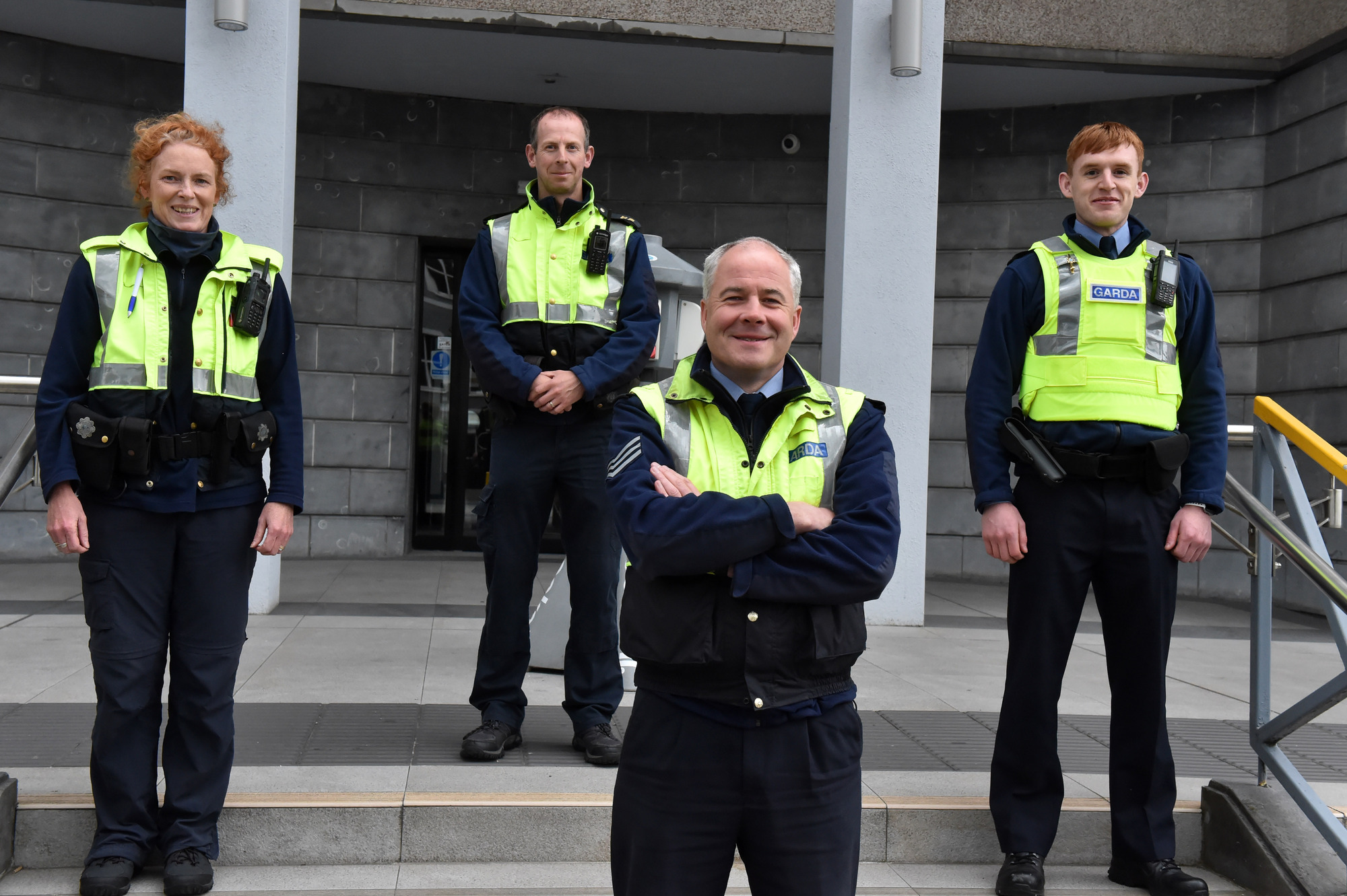
Sgt Mike O'Connell (front) with community policing gardaí Lorraine O'Donovan, Damien Desmond and Patrick Collins at Anglesea Street garda station. Picture: Eddie O'Hare
In warm afternoon sunshine, across the river from City Hall, Garda Lorraine O’Donovan is talking with a rueful-looking young man, her tone friendly, but firm. He was arrested the night before for a public order offence, and she tells him he needs to cop himself on. Agreeing to meet again later in the week, he leaves, looking happier.
“We tend to meet the same people a lot, and we get to know them,” she says, as we cross the Éamon de Valera Bridge, heading for Shalom Park.
“As community gardaí, we get to know the problems people have in their lives, and the troubles that might set them on the path that led them to us.
“We’re blessed to have the time some of our colleagues mightn’t always have, to get to know people, and to try and figure out how best to help them wherever we can.” By Hibernian Buildings a homeless man says: “Lorraine, girl, how’re things?” and she responds, calling him by his first name. He wants a word, and they talk privately.
A car pulls up, the driver saying there’s a council employee collapsed on the ground around the corner. When she gets there, O’Donovan talks with him until an ambulance arrives, and then she heads for Shalom Park to meet her colleague Garda Marie O’Neill.
Shalom Park is in an inner-city oasis in the area known as Jewtown, Cork’s historic Jewish quarter. Inside the back gate is the community garden, brimming with wildflowers and plants, alive with yellows, reds, oranges, purples and blues.
Helen Phelan, a Waterford blow-in here 20 years, claims the garden began when some seeds blew in and took root, and now fat bumblebees meander from flower to flower, spoilt for choice.
Helen says the gardaí recently tackled some minor anti-social behaviour in the park. Garda O’Neill is from Ardmore, and she and Helen delight in their love of Waterford, to O’Donovan’s pretend irritation.
From the late 1800s this was home to Lithuanian Jews fleeing pogroms, but now few Jewish people are left in Cork, and none in Jewtown. The South Terrace synagogue is closed five years, but Shalom Park still celebrates Hannukah every year, although Covid-19 forced last year’s online.
Nowadays, Helen says, Jewtown is “more like the UN”, and the diverse community gets along well. In the park, the blow-in effect appears to be at work again, with wild flowers marching along the length of the wall.
Sergeant Mick O’Connell is one of three Cork City sergeants-in-charge for community policing, supervising 37 gardaí. He says Cork is a well-policed, mostly safe city, but he rejects any suggestion that Cork might be doing things better than Dublin, which in recent months saw some street unrest as the capital came out of lockdown.
“Cork is not Dublin,” he says. “It’s much smaller in size, and we’ve a lower population level, and we’re lucky in that everybody knows each other.
“We’ve also been fortunate that resources have been made available, and we’ve been able to put more gardaí on the beat, and that’s yielded great results, with gardaí engaging with people, and people in turn feeling safer.”
He says Cork has largely avoided the sort of trouble seen in Dublin, with hundreds of young people gathering regularly to drink on Kennedy Quay without any serious incidents.
“Drinking in public spaces is illegal, but we’ve been using our discretion in the interests of public safety. It’s an open quay, and that’s a serious concern, but there are few residents there, and we’ve been policing it, and the young people have mostly been well-behaved.”
Up at Horgan’s Buildings, above UCC, local resident Maureen O’Halloran laughs at Garda O’Neill’s claim that Maureen looks after most of the people living here, saying she’s only a part of the community, the same as everyone else. Maureen reared seven children here, with her husband, who passed away five years ago.
“We’re blessed to have guards like Marie and Lorraine,” she says. “They’re always here whenever we need them.” Maureen’s son Paul, and her grandson James, come out for a chat, and James shows off his Buzz Lightyear tee-shirt. James is a handsome and friendly 17-year-old who has Down syndrome. Paul says James goes to St Paul’s school, in Cope Cork, which James loves. James shows Marie his Peppa Pig watch, and he’s delighted when she makes a fuss of him.
These are beautiful, single-storey houses, mostly now home to older people, and the shared green area on the hillside is a glorious garden, blooming with flowers in the summer sunlight, and, Paul says, there’s a lot of history here.
“This was all built a hundred years ago by the British Army. We’re just off Magazine Road, which was named after their gunpowder store.” Danny La Rue, the “grand dame of drag”, was born Danny Carroll in number 10 Horgan’s Buildings in 1927, he adds. (La Rue, for years one of Britain’s best-paid performers, once told RTÉ’s John Creedon that leaving Cork changes you: “When I left, I was just a boy. When I came back, I was a woman.”)
It’s still bright later that evening, as Gardaí Laura O’Connor and Kay Griffin attempt to mediate a dispute up by UCC. Tensions run high here perpetually, with older residents subjected to parties as young renters do what young renters always do. For the second year running, Covid has denied residents a summer respite, with students, unable to travel, staying put on pandemic pay making – as Sergeant O’Connell puts it – “College Road: the new J1”.
This time, the renters – young women having a drink in their garden – are in conflict with a neighbouring older couple expecting worse to follow.
Garda Griffin says this happens nearly every night, and she expresses sympathy for both sides.
Downtown, as crowds mill around, Garda Peter O’Riordan, four years a community garda, is minding an 18-year-old slumped on a South Mall window-sill. Abandoned by his friends, the reveller is very drunk, vomiting repeatedly. Using the young man’s phone, O’Riordan is able to get the lad’s brother to come and collect him.
Later, O’Riordan joins his colleagues on Kennedy Quay, where perhaps 400 kids are partying. There have often been several times that number here recently, and – despite the litter – again tonight gardaí say young people have been well-behaved.
During the lockdown, community gardaí did a lot of work checking in on the vulnerable and delivering food hampers to those in need, and Mick O’Connell says it’s hard to quantify the work they do, but he adds they try to serve as a direct contact for the public.
“We give our phone numbers to everyone. I often get calls during the Late Late, and while my wife mightn’t always be happy about that, it’s preferable that people know we’re always there for them.”
Community gardaí are part of their own communities, he says, and they give everyone an equal chance, something he feels can only benefit gardaí, and society as a whole.
“Respect is a two-way street, and we police by consent. If we ever lose the trust of the people, we’re lost.”

CONNECT WITH US TODAY



Be the first to know the latest news and updates