My granduncle died on IRA hunger strike
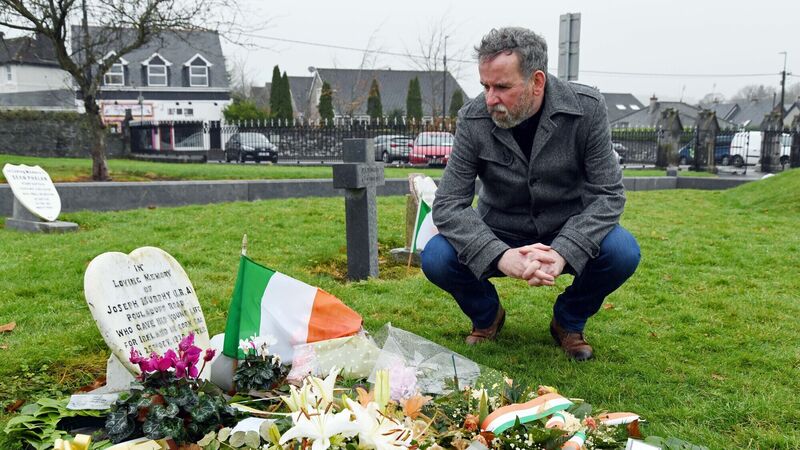
Pat Fitzpatrick wonders why his family didn't want to talk about his granduncle, Joe Murphy who died in 1920.
My granduncle died on IRA hunger strike

Pat Fitzpatrick visits the grave of his granduncle, who died on hunger strike in 1920. Picture: Denis Minihane

It was called the Joe Murphy Dinner. Whenever my mother gave us a dinner that included peas, potatoes, and carrots, she’d announce it as a ‘grand Joe Murphy dinner'. 

I’m not surprised I remember it so well — four out of five dinners in 1970s Ireland included peas, potatoes, and carrots. Pasta was for intellectuals.  This dinner was named after someone who died on hunger strike. Joe Murphy, my mother’s uncle, died just over 100 years ago in Cork Gaol, after 76 days on hunger strike. 

Arrested in July 1920, but never tried, he was one of 60 Republican prisoners who went on hunger strike in Cork in August of that year after their demands for release were ignored by the British authorities. In the end, he was one of three prisoners who died during that period, along with Michael Fitzgerald from Fermoy, and Terence MacSwiney, the Lord Mayor of Cork. 

MacSwiney’s death caught the headlines all over the world and his contentious funeral was a massive PR victory for republicans during the War of Independence. Joe Murphy died a few hours after MacSwiney and had a big enough funeral of his own, but he remains in the shadows by comparison, an almost forgotten figure in Ireland’s struggle for independence. He was largely forgotten in our house. The Joe Murphy dinner  —  peas, potatoes and carrots  —  was a reference to the green, white and gold on the tricolour. But it was the only time my mother would talk about her uncle. If anything, the word around our house was that Joe had made a mistake, giving his life for the cause. Joe wasn’t completely forgotten. 

There is a road named after him in Ballyphehane; the family home in Pouladuff is called Joe Murphy House; republicans still march from there to his grave in St Finbarr's Cemetery every year. Other branches of the family tree have been actively keeping his memory alive. A campaign urging the State to award him a posthumous service medal, dating back to 1923, ended in May 2019 , when the medal was given to his nephew, Henry Delaney. Also, Henry’s daughter, Shirley Kelleher, produced and directed a YouTube video telling Joe’s story, in collaboration with Maurice Dineen and Club Ceoil in Ballyphehane. The world is a better place because of people like Shirley Kelleher and Maurice Dineen. Their production is thoroughly-researched, informative, and entertaining. You can see for yourself if you search for ‘Joe Murphy The Boy from Pouladuff My Unsung Hero' on YouTube. 

I rang Shirley, a second cousin I’d never talked to before, and asked how they treated his legacy. 

"My father, Henry [Joe’s nephew] is the longest-serving member of Sinn Féin in Cork,"  she told me over the phone. "From an early age, I was taught about Joe Murphy. We would have gone to the commemorations, we would have walked from Joe Murphy House to St Finbarr’s Cemetery, we were reared with it. 

"And I wish when I was younger that I listened more carefully to my father, you don't appreciate the gold of the history when you're a youngster.” 

She filled me in on Joe’s brother Richard, who was arrested by the British authorities in Belfast when he arrived back from the States to see his hunger-striking brother, and sent back to America without ever seeing him again. Shirley also told me how the Black and Tans targetted the Murphy house in Pouladuff after Joe’s arrest.   When I asked my mother about this, she recalled her mother (Joe’s younger sister, Annie) telling her that the Black and Tans used to fire shots at the house as they passed by, stopping in some days to empty out the family’s large sack of flour all over the kitchen. 

My mother can also remember marching out to the republican plot for the commemoration when she was younger, so it’s not like they were completely shut off from Joe’s legacy. Why then did we never talk about him in our house when we were growing up? 

Part of this would have come from my father, who was of course not a blood relation of Joe Murphy. (I hope.) My Dad had no time for the narrow, Catholic, Gaelic republicanism that emerged in 1930s Ireland, as he was growing up. He was also a native of Kinsale, which had prospered thanks to the British barracks in the town, and then sank into a long decline when they left in 1921. None of this was going to make him sympathetic to Joe Murphy’s way of life, or death. 

A plaque was unveiled to Joe Murphy in Pouladuff, Cork, in 1960 — when ‘people knew where they stood on the national question’.

And the other thing was the context of the times. Republicanism was a dirty word in a lot of Ireland during the 1970s and 1980s, as we tucked into our Joe Murphy dinners. The IRA was at war with official Ireland; the news had pub bombings and bodies dumped on border roads; republicans were, and I heard the word often enough, a disgrace. I think my parents were also afraid I’d get involved with the IRA, even though I didn’t know any republicans. (After my Dad died, my mother told me he used to worry that I’d become a bomber. Don’t ask where he got this idea from.) My generation, born in the late 1960s to early '80s, are oddballs in Ireland. Before then, Irish people knew where they stood on the national question. 

My uncle Mattie passed on a folder of clippings relating to Joe Murphy from the Evening Echo. A lot of them are from 1970, the 50 th anniversary of his death. You can see from the language of the time that patriotism and Irish nationalism were viewed with respect, even reverence. This didn’t last. Republicans will tell you that revisionist historians dismantled the legacy of the IRA and violent nationalism, colluding with official Ireland to taint anything to do with Sinn Féin. There was a bit of that going on. 

But there was also no shortage of republican atrocities against innocent people and my generation had had enough. 

A lot of us saw the Provos in the same light as the Catholic Church and crony politicians, conspiring to drag Ireland back into the past. The Good Friday Agreement changed everything. The generation born in the '80s and '90s is more comfortable with Irish nationalism, as you can see from the youth vote for Sinn Féin, and people like podcast superstar Blindboy having an unambiguous cut at British colonialism in his podcast. 

I’ve changed my views in the last few years. Now that the upper class twit brigade are back at the helm in London, I’m grateful for the massive sacrifices that people like Joe made to get our independence. You’ll find twits in charge here too sometimes, but at least they’re our twits. 

I went out to the Republican plot in St Finbarr’s Cemetery to take a photograph to go with this article. It was my first visit to Joe Murphy’s grave. Standing there in the drizzle, I remembered someone I know telling me recently that I should be proud of my granduncle. I didn’t say anything at the time, because I didn’t know what to say. Now, by his grave, with all I know thanks to people like Shirley Kelleher, I’m still not sure if I’m proud of him. That’s my upbringing: Too much water under the bridge.

But I’m happy to tell my kids about Joe Murphy. When they ask, I’ll tell them he was fearless. Not only that — I think he was right.

Read More

More in this section

Lifestyle

Newsletter

Eat better, live well and stay inspired with the Irish Examiner’s food, health, entertainment, travel and lifestyle coverage. Delivered to your inbox every Friday morning.

Cookie Policy Privacy Policy Brand Safety FAQ Help Contact Us Terms and Conditions

© Examiner Echo Group Limited