Caring for children and elderly parents... what life is like for the 'squeezed middle'
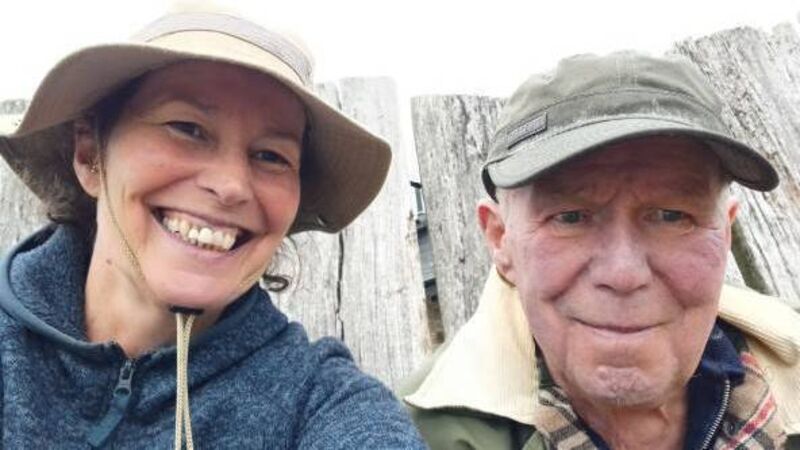
Ruth Elizabeth Powell and her dad. She lives in Dublin and travels across the sea to South Wales every six weeks to visit him.
There's a group of people we don’t talk about enough — the squeezed middle. Not squeezed by money as such but by responsibility, caught between raising children and caring for their ageing parents.
Many of us have children later in life now, so it can feel like we move straight from nappies and school runs to hospital appointments and round-the-clock worry, barely pausing for breath in between.
According to a press statement titled ’Older Persons Information Hub’ from the Central Statistics Office, the number of people aged 85 and over is expected to nearly quadruple, from about 104,300 in 2027 to 389,400 by 2057.
The old-age dependency ratio (people 65+ relative to those aged 15–64) is projected to rise from about 25% to nearly 50% over the same period.
This is, in many ways, good news for all of us who are ageing — a sign we are living longer and surviving more. But it also forces an uncomfortable question: do we really have the support and infrastructure in place to allow families and carers to manage this responsibly and sustainably, without exhaustion, guilt, or feelings of isolation creeping in?
Ruth Elizabeth Powell is a part-time, remote carer to her dad. She lives in Dublin and her dad lives in South Wales. Powell travels across the sea every six weeks to visit him.
“When I travel across the sea, I can almost spot the other women doing the same, and so many of my friends and colleagues are in similar positions," she says. "We all have jobs with responsibility, teenage children who need a very particular kind of care, our own health worries, and lives rooted in community and voluntary work.
“Yet once a month, or whenever we must, we set aside our ordinary lives and travel through a porthole into another one — the life where we co-ordinate care that can’t be outsourced: appointments, freezers, floors, care teams, GPs, council calls, and endless lists.

“If we’re lucky, we get quiet moments to tell the person we care for how much we love them, whispering apologies for not being able to do more — because there are no more hours, ferries, or trains and we can’t stretch ourselves any thinner without disappearing.”
Powell adds: “I’ve just returned to Dublin after another six nights with dad. Remote, part-time carers often sleep in childhood bedrooms, caring around the clock — a world away from a short visit with a clear beginning and end.
“And yet, somewhere between the hundredth episode of , there’s a deep calm in simply being there. If something happens, I’m present and that peace makes it worth it.
“I return to Ireland, feel at home for a night or two, and then begin planning the next journey.
Powell says looking after two homes “has challenges, and trying to stay on top of two sets of bills and cleaning and heating”.
She adds: “It’s all a little too much at times, and of course, I am so lucky and I know that. There are billions of people in this world who would swap places with me in the blink of an eye.
“Still, sometimes, I wonder if I could make it easier for myself.”
Dara Kiernan is a customer service and leadership consultant and author based in Wexford, with a background in public-sector transformation and customer experience. He shares his own experience of caring for his parents in mid-life.
“Becoming a father at 55 sharpened my focus on leadership, care, and responsibility — not just at work, but in life — as I balance raising a young son and supporting my mother, who needs me in a very different way.
“This isn’t about neglecting one role for another — it’s about prioritising time, knowing that life, work, and responsibility all have to coexist in the same limited space.
“My father died three years ago at 94 after almost a decade with dementia, while my mother, now 92, lives alone in the family home, sharp-minded but physically frailer.
“My sisters, brother, and I share the load, and the carers help with the practical things, But we know that what she needs most now isn’t just care, but presence, time, conversation, and simply being with her.”
Steve Newman is a travel writer and has a similar situation, but is slightly older than the typical mid-life age bracket. He has been a carer in his 70s to his partner of 35 years, who now resides in a care home after a fall resulting in a traumatic brain injury. This led to cerebral vascular disease, developing into dementia.
“For two years, I changed the beds every morning as my partner was unable to control her bladder,” he says. “The stress of having to watch her 24 hours a day in case she wandered off on to main roads or fell downstairs again was unbearable.”
He says: “This, along with the ever increasing guilt, resulted in me having to get counselling.
“My partner has been in a care home now for five years and the guilt still has not disappeared.
“The worst part is coming to terms with the fact that the woman I have adored for over 40 years does not exist anymore.”
As Newman points out: “More and more older people are becoming carers, and as people are living longer, it could be for some time.”
Mother of two Susan shares honestly about the challenges she faces.
“I’m coming up to 60, living in the middle of nowhere and working full-time. Some days, I just want to scream because illness takes up so much space — it seeps into everything and quietly wears you down.
“I’m the primary carer for my 84-year-old mother. She’s always cried wolf about aches and pains, but now she’s really unwell, which makes the guilt sharper.
“Last Sunday, I spent eight hours in A&E on top of additional hospital appointments, scans, waiting rooms, and not once am I asked how I am.
“I’m fit, I mind myself, I still want things, but being squeezed in every direction makes it impossible and the guilt hits hardest.”
As the numbers and pressures grow, it’s clear this isn’t just a personal challenge — it’s a societal one.
We need to start talking openly about the squeezed middle, about the choices, compromises, and quiet sacrifices that families and carers make every day. Because without proper support, the joys of living longer risk being overshadowed by stress and strain, and no one should have to navigate that alone.
CONNECT WITH US TODAY



Be the first to know the latest news and updates