CHILD PSYCHOTHERAPIST
AS we venture into week two of 2023, our new year’s resolutions may already be starting to show some cracks. Whether it’s our intermittent fasting diet or Dry January, we may be resigning ourselves to the fact that the task we had taken on was ‘too hard’ or that we are ‘not strong enough’. As a result, many of us will return to our previous level of functioning and re-engage with our old habits, leaving a significant dent in our self-confidence.
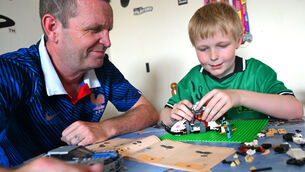
The cycle of new year’s self-improvement is largely an adult phenomenon, but what impact do these actions have on our children? We know from social learning theory that children and teens closely watch what adults and parents do, including how we manage our emotions. Children’s only template for coping mechanisms is their parents’ strategies. This ‘learned behaviour’ is understandable when we consider the degree of influence parents have over their children. What is less discussed is that children are more likely to mimic their parent’s actions than adhere to their advice, especially if there is a contradiction between them.
As parents, we need to ‘practise what we preach’ rather than implementing a ‘do as I say, not as I do’ approach, which is destined to fail. Be under no illusion, even when we think they aren’t paying attention, children are listening, observing, and learning from us as parents in good and not-so-good ways. For this reason, we must be aware of our impact on our children as they observe our approaches to the new year’s drive for self-improvement.
Drastic change
It is difficult not to get caught up in the push for drastic change at this time of year. In the last two weeks of December, we were told to give in to our desires and not self-regulate. The mantra of ‘sure it’s Christmas’ permits us to eat that extra mince pie, have another alcoholic drink, or spend additional money on ourselves or our loved ones. However, no sooner have we got into the habit of succumbing to these desires than the message changes.
Overnight, from January 1, we are told that we need to do the exact opposite of what we have been encouraged to do, with the message changing from hedonism to abstinence. We are told that we are ‘not fit enough’, ‘not thin enough’, ‘not organised enough’, or ‘not ambitious enough’, which can trigger a frenzy of self-improvement, driven mainly by guilt.
Our social media algorithms will monitor our interest in advertisements and direct our attention to more prompts on ways to change our lives dramatically. I have noticed my algorithms working overtime as my timelines are awash with ab toning belts, fat-burning pills, and a tsunami of leisure wear options.
Even as a well-informed adult, I find it hard not to be seduced by these quick-fix strategies. At times I inevitably fail because the ease with which change is promised is just too alluring. I have an ab-roller and a smoothie maker in the attic to prove it, both January purchases over the years. Although bought with the best intentions and the promise of six-pack abs, these items are now dust gatherers. But in recent years I have become more aware of what message I am sending my children as they watch my frenzied flight into wellness.
False promises
I still hear my father’s wise words in my head, ‘if it seems too good to be true, it most likely is’, and I try similarly to warn my children against these false promises. I’m aware they look to me as a role model and if they see me tucking into a tub of Quality Street one week and drinking detox smoothies while wearing an ab toner belt the following week, I am not demonstrating a balanced approach to life.
A more realistic message we need to give our children is that change is hard, but that’s OK. There are no shortcuts to long-term change — it simply takes time.
It is a fantasy to expect immediate results from our short-term efforts, but this immature desire for a quick change steers us towards taking extreme and intense measures. But the intensity is not sustainable over a long period.
Author and motivational speaker Simon Sinek famously talks about the importance of consistency over intensity when he describes how we can go to the gym for nine hours in one day, but will not notice any difference in our bodies. However, if we use the gym for 30 minutes three times a week over a six-month period, we will eventually notice a change. Similarly, we can brush our teeth for two hours in one go, but it will not affect our longer-term dental health because we still need to brush our teeth every day.
Most parents promote consistency over intensity when talking to their children, but do we exercise the same principles in our lives?
Teenagers tend to go all out a couple of times a year and clean their room, usually when a parent insists on it. They might make a great effort, leaving the room spotless, but within a week, it’s like a bomb site again. As parents, we encourage our teenagers to do a little tidying more often, which will keep the room relatively tidy over the whole year. The consistency of this commitment seems too much for teenagers.
The same can be said for limits and sanctions. Parents can be guilty of letting minor behavioural misdemeanours go unsanctioned for long periods, then coming down hard and delivering unreasonable sanctions for innocuous behaviour. We will threaten our children, saying they are grounded for a year, or threaten to remove their X-box for six months. These unreasonable outburst sanctions are examples of intensity, not consistency, and will have little impact on the child’s ongoing behaviour. Instead, they are more likely to fuel confusion and encourage more erratic behaviour. If we were rel-iably managing their behaviour over the longer term, and exercising consistency, then the outbursts of intensity will not be required.
Consistency over intensity
Parents need to role model consistency over intensity. How we act out our values will be how our children integrate them into their lives. If we accept change is hard and at times laborious, but invest time in achieving our goals, our children will pick up on this value system and learn from it. Equally, if we engage in extreme methods of behavioural change, our children will pick up this value system and perhaps use it as a coping strategy.
If you want to go fast, go with intensity, but if you want to go far, go with consistency. Quick and extreme gains may be attractive and even appear to work in the short term, but they are impossible to maintain and inevitably end in failure. Nothing deflates progress like a lack of self-belief and setting unrealistic goals which fail only confirms our belief that we are not good enough. However, success fuels motivation and by setting smaller, more achievable goals we are more likely to believe we can do it, enhancing our self-belief and in turn our chances of longer-term success.
As hard as it may be to resist the quick fixes, we need to be aware of the message we send to our children about managing change. Perhaps a goal of role modelling consistent strategies for change might be the most effective new year’s resolution for 2023.
Dr Colman Noctor is a child psychotherapist

Subscribe to access all of the Irish Examiner.
Try unlimited access from only €1.50 a week
Already a subscriber? Sign in
CONNECT WITH US TODAY
Be the first to know the latest news and updates