Humpback whales take more mature approach to mating
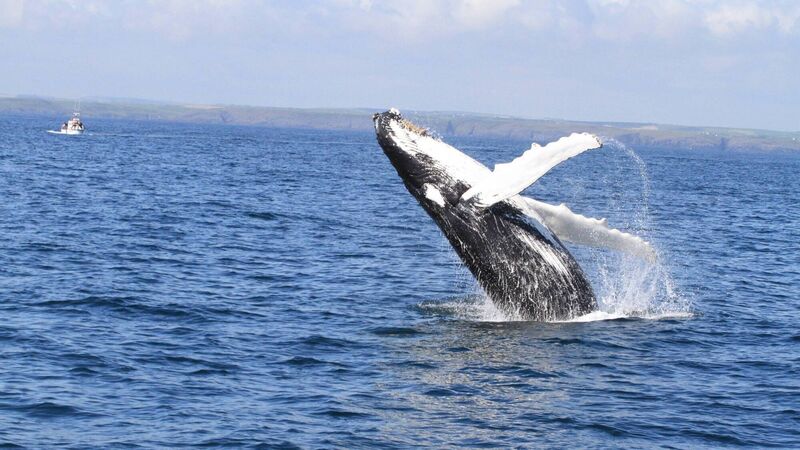
Male humpbacks use singing and elaborate breaching to impress females.
-
Wild ‘maids’ seldom heed the message of the popular song. They tend to choose mature males, rather than younger ones, as sexual partners. That makes good sense. Older individuals have better credentials. They will have endured ‘the slings and arrows of outrageous Fortune’, and survived. Their genes offer a better catch.
‘Acquired characteristic’ can’t be inherited, so the knowledge and experience gained in life’s ups and downs isn’t passed on to an offspring. The blacksmith’s son won’t have extra powerful arm muscles. However, an older mating partner will have ‘good’ genes which helped him, or her, survive and prosper. Having a fling with such a lover doesn’t guarantee healthier or more gifted babies but, on balance, it offers better prospects for the future.
The humpback whale’s breaching display is one the great sights of the natural world and its mysterious half-hour-long song has few equals in the animal kingdom. During the era of industrial whaling, however, humpbacks, like all the great whales, were hunted mercilessly for their oil. Only 5,000 humpbacks remained by the 1960s but, with worldwide protection, their numbers began to increase. There are about 135,000 humpbacks alive today. Found throughout the oceans, they have become relatively relative common visitors to Irish waters.
Human sexual mores changed during the two world wars. In those dangerous times, traditional behaviour patterns were undermined. Fears for what might lie ahead encouraged an ‘eat drink and make merry for tomorrow we may die’ attitude to life. Did a similar change in the behaviour of whales occur during their appalling massacre? A paper just published suggests that it did.
In normal times, females can afford to be choosy about who gets to mate with them. Older well-endowed males usually get to father more offspring than younger aspirants. But in a decimated population, with reduced competition, the rules are different. With few potential partners available, ‘any port is haven’, competition is reduced and even young bucks may succeed in the mating game. But is this also true for whales?
In a paper just published researchers, led by Franca Eichenberger of the University of St. Andrew, compared mating selection in humpbacks during the era of persecution and following the moratorium. They examined humpback data collected over two decades.
The composition of a whale’s skin changes with age, so chemical analysis of a skin sample enables a whale’s age to be determined. Humpback samples were obtained using crossbows to collect skin samples from arrow heads. The team analysed 485 samples from males in New Caledonia in the South Pacific.
The mating of humpbacks has never been observed, but males can be seen escorting and guarding females. Fifty-six fathers were identified. According to Dr. Ellen Garland, senior author of the study, ‘there were more older males than expected singing and escorting females and successfully fathering calves, compared to younger ones’. Humpbacks, clearly, exhibit ‘age-related sexual selection’.
Males use singing and elaborate breaching to impress females. These improve with age. Practice makes perfect. As the proportion of mature males increases, younger ones lose out in competition.
- Franca Eichenberger et al. Changes in age-related sexual selection in a humpback whale population recovering from exploitation. . 2026.


CONNECT WITH US TODAY



Be the first to know the latest news and updates