A sound we don’t remember
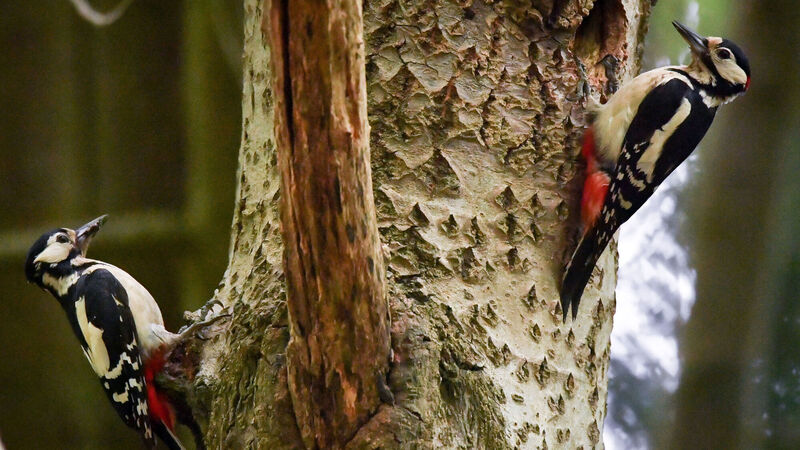
A mating pair of great spotted woodpeckers arrive at the nest at the same time while they continuously feed their chick inside a tree trunk. Picture: Ben Birchall/PA Wire
Walking through Ballyannan Woods recently, I was stopped in my tracks by a sound that felt oddly out of place. A sharp, rapid rat-tat-tat echoed through the trees. It was too rhythmic for falling branches, too deliberate for chance. For a moment, I wondered if someone had brought a flat-pack shed into the woods and was assembling it with enthusiasm. Then it clicked. Or rather, it drummed.
What I was hearing was the unmistakable percussion of the great spotted woodpecker. A bird that many people still believe doesn’t belong in Ireland at all. And in fairness, that belief isn’t entirely unreasonable. For most of recorded history, Ireland appeared to be woodpecker-free. The truth, however, is less clear-cut and far more interesting.
Ask whether woodpeckers are native to Ireland and you’ll often get a confident answer, no. That certainty comes from centuries of silence. Unlike the UK and continental Europe, where multiple woodpecker species have long been part of everyday woodland life, Ireland lacked them within living memory. Over time, absence hardened into assumption. But archaeology complicates that tidy narrative.
Two woodpecker femur bones recovered from a cave in County Clare suggest that woodpeckers may have lived in Ireland thousands of years ago, likely during the Bronze Age. The bones are consistent with great spotted woodpecker, and they’re taken seriously by ornithologists. Yet the evidence is sparse. There are only two bones. They haven’t been directly radiocarbon dated. They don’t tell us how widespread woodpeckers were, or how long they persisted.
In scientific terms, this is suggestive, not definitive evidence. Enough to raise eyebrows. Not enough to close the case.
If woodpeckers did once live in Ireland, they appear to have vanished long before written history. Their disappearance is usually linked to extensive woodland loss. Woodpeckers are woodland specialists, dependent on mature trees and, crucially, dead and decaying wood. Remove that structure, and the birds disappear with it.
Because this extinction likely occurred thousands of years ago, there are no medieval descriptions, no folklore references, no continuity of memory. By the time naturalists began cataloguing Irish wildlife, woodpeckers were already absent. Ireland may have lost them and then forgot them.
For centuries, Great Spotted Woodpeckers appeared in Ireland only as occasional vagrants, lone birds blown across the Irish Sea, sometimes ending up preserved in museum collections. They didn’t stay. They didn’t breed. That changed in the early 2000s.
In 2007, breeding was confirmed in Ireland. Since then, sightings and breeding records have increased steadily. Today, the species has been recorded in every county, with established breeding populations in multiple woodlands. This wasn’t a release programme or a reintroduction. The birds arrived on their own.
One of the strongest pieces of evidence for how this happened comes from a 2011 genetic study published in Bird Study. Researchers analysed mitochondrial DNA from Irish, British and continental European Great Spotted Woodpeckers, including historic museum specimens.
Their conclusion was that the modern Irish populations are genetically most similar to UK birds, indicating natural dispersal from Britain, rather than long-distance irruptions from Scandinavia or human introduction. The study also suggested that different Irish breeding populations may have originated from multiple parts of Britain, bringing with them a useful degree of genetic diversity.
Importantly, the authors were explicit about limitations. Sample sizes were small. More data would refine the picture. But taken together, the evidence strongly supports natural colonisation. Not an ecological accident, but a response to changing conditions.
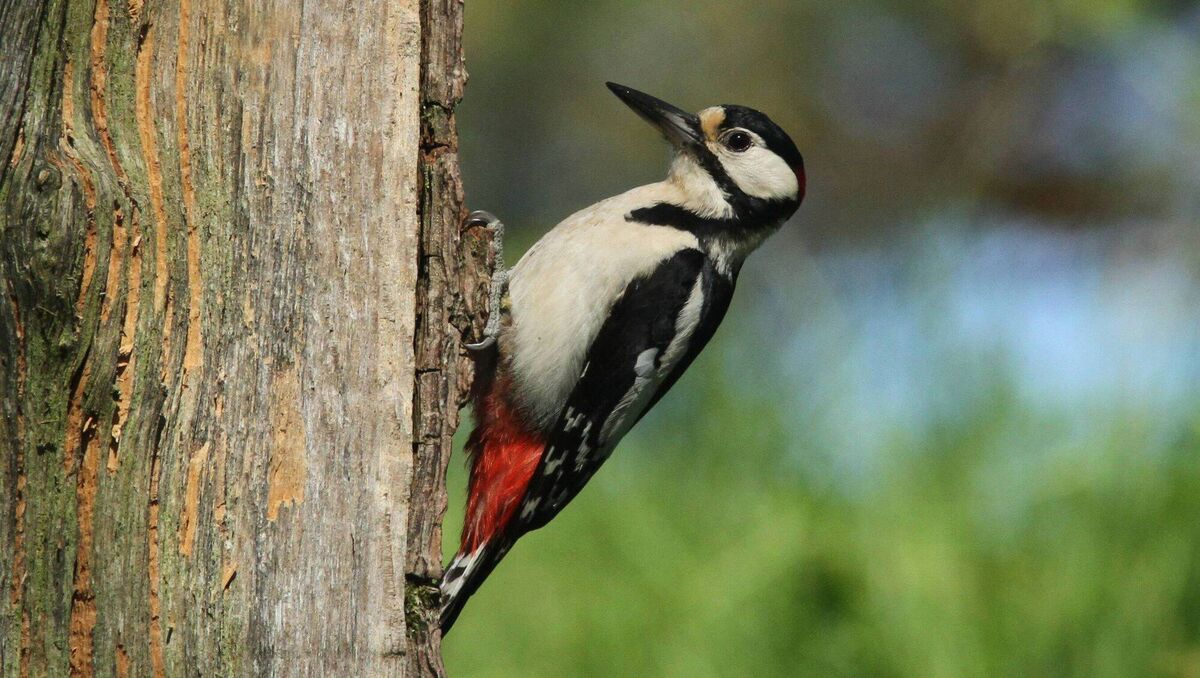
The sound that stopped me in Ballyannan Woods wasn’t feeding behaviour. The loud, rapid drumming most people notice is a form of communication. Woodpeckers don’t sing in the conventional sense; they drum. Drumming advertises territory and attracts mates. Birds select resonant surfaces such as hollow trunks, dead branches, sometimes even wooden poles. They strike them at extraordinary speed, often exceeding 20 beats per second. Their skulls are specially adapted to absorb these impacts, with shock-absorbing bone, specialised muscles and a beak designed to distribute force safely away from the brain. It’s one of nature’s more elegant engineering solutions.
Whether woodpeckers were once widespread in Ireland or only marginally present, their current role is clear. They are classic keystone species. By excavating nest cavities, they create habitat later used by blue tits, treecreepers, bats and other species. Their foraging helps regulate insects hidden beneath bark. Where woodpeckers thrive, woodland biodiversity tends to follow.
They also tell us something about woodland quality. Deadwood, which is often removed in the name of tidiness, is essential. Without it, woodpeckers struggle. With it, ecosystems become richer, noisier and more complex.
So why are woodpeckers here now, after such a long absence? The answer seems to be gradual change. Woodland cover in Ireland, while still low, has increased from historic lows. Trees planted decades ago are finally maturing. Management practices are slowly becoming more ecologically informed. Milder winters may also help survival and boost insect prey. This doesn’t look like an invasion. It looks like a delayed response. A species testing whether the conditions that once excluded it have finally shifted.
The woodpecker’s place in Ireland isn’t a closed chapter with a neat conclusion. It’s an unfinished story. One written in fragments of bone, cautious genetic evidence, and a bird that has decided, for now, to stay. So, if you hear that sharp knocking in a woodland near you, pause before assuming development is creeping closer. You may be hearing a species claiming or reclaiming a role. Not because history guarantees it belongs, but because the landscape is finally offering the possibility. In Ballannann Woods, the drums are playing. And like all good science-based stories, they come with rhythm, evidence, and a little uncertainty.

CONNECT WITH US TODAY



Be the first to know the latest news and updates