Summing up our swan squad successes
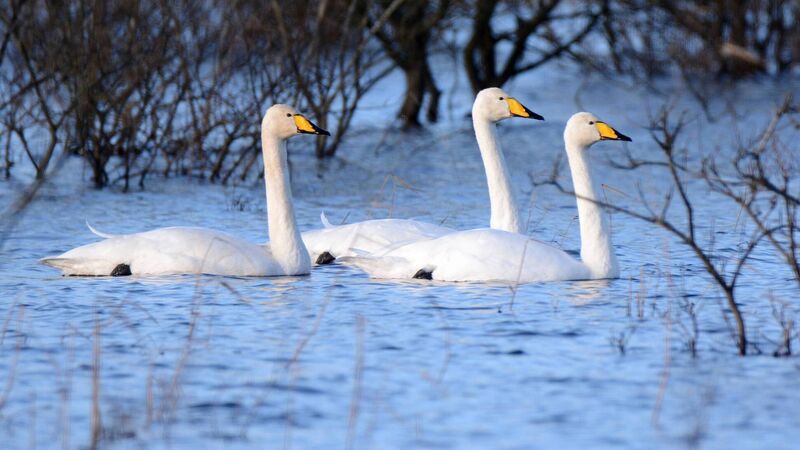
Whooper Swans on the River Suck in Roscommon. The International Swan Census took place last weekend and hundreds of Whooper Swans were recorded across Ireland by staff of BirdWatch Ireland, the National Parks and Wildlife Service, and by volunteer birdwatchers
Some sounds feel as though they can transport us back in time. Listening to whooper swans calling out over a wetland at the break of day, I imagine the same chorus of loud, trumpeting calls echoing out over wild marshes and coastal wetlands thousands of years ago. Sounds, though, leave no trace in the fossil record.
Each year, for longer than we can know, wild swans have been casting the soundtrack to winter days across Irish wetlands. Their calls are deeply resonant and carry far. Apparently, these whooper swans are even more vocal during breeding season, though I’m quite content with the spine-tingling voluptuous calls we can listen out for right here in Ireland. In spring, they will journey back to their Icelandic breeding grounds, travelling, as they always do, in family groups.
To monitor the population and their distribution, the International Swan Census takes place every six years. Last weekend, I was lucky enough to get to tag along. Just as first light brightened the January sky, I met with Dick Coombes of BirdWatch Ireland, who has been monitoring swans and other wetland birds along the Wicklow coast since the 1970s. Dick knows instantly the difference in gait between mute swans and whooper swans, though to the untrained eye, differences can be hard to spot, especially from a distance.

Mute swans are the familiar ones we see all year round, gracing lakes, canals, and coastal waters. They have a big hump on the upper part of their bill, and are fairly accustomed to human company. During the summer months, resident pairs nest and raise their cygnets, often along canals and in urban areas. Mute swans are thought to be the descendants of domesticated swans, prized for their meat through the Middle Ages. Each and every mute swan was legally declared to be the property of the British crown.
Wild swans, on the other hand, are much more shy of human company and only spend the winter months here. These were the swans I was eager to listen to and see on the coastal wetlands of County Wicklow as I looked in on the process of the Swan Census. About half of the entire population of Whooper Swans, around 20,000 pairs, winter in Ireland, with most arriving in October and leaving by March. The remainder spend winter in Scotland, England and Wales. A small proportion stay in Iceland all year round, skipping the traditional migration entirely.

This is the kind of information gathered by volunteer ornithologists for the International Swan Census, coordinated by Birdwatch Ireland here, The Wildfowl and Wetlands Trust in Northern Ireland, and the British Trust for Ornithology across Britain, with support from relevant state agencies. The survey takes place over just one weekend, carefully coordinated to count all the swans across their range. Surveyors take note of whether the swans they count are juvenile or mature birds, helping to monitor the breeding success of the population overall, changing habitat preferences and distribution, and to keep track of the growing numbers of Whooper Swans returning each winter from breeding rounds in Iceland.
Come March, whooper swans will brave the long journey north again, returning to wide expanses of their Arctic breeding grounds. Whooper swans are one of the only ‘success stories’ of Ireland’s waterbirds — their population is growing steadily, while other wild waterbirds are plummeting in both the range and population size.
Another species of swan, the Bewick’s swan, also known as Tundra swan, is a far less common sight now in Ireland. Just 50 years ago, several hundred used to overwinter here. In 1900, Bewick’s swans were more numerous and widespread than whooper swans in Ireland, but by 1950 the reverse was the case.
Now only a handful of Bewick’s swans make the journey from their breeding grounds in Siberia. Because of milder winters resulting from global heating, migratory Bewick’s swans are able to find suitable wintering sites in Germany, the Netherlands and Britain, negating the need to need to fly as far west as Ireland.
Following the food is the main reason why these enormous birds make such epic journeys. In shallow lakes and wetlands, swans use their long necks to reach into the water, pulling up vegetation growing from the bottom.

Swans, like their close cousins the geese, are vegetarian. Apart from bugs and tiny water snails that might get accidentally gobbled as they graze, they survive on aquatic plants.
But cellulose, the main component of green pants, is impossible for animals to digest. These avian grazers rely on a community of microbes in the chambers of the gut to digest their food for them. Like us, the nutrition is only available after the grasses and leaves have been fermented by these gut bacteria. The original leafy matter is undigestible; the products of bacterial fermentation are not. However, sometime in the 1990s, Whooper swans began to diversify their diet. They started to venture out from wetland areas to graze among arable farmland. They began to eat potatoes and beet.
Now, to support these wild swans, some landowners are supported to leave ‘sacrificial crops’ that the swans can feed on in safety. The success of the whooper swan is certainly something to celebrate and support.