The invisible carbon in Ireland’s waters
Dissolved organic carbon may be one of the most underestimated pressures on Irish waters. About 20% of our land area is covered by peat and peaty soils, which are among the most carbon-rich ecosystems on Earth. That makes Ireland uniquely vulnerable to large losses of carbon from land to water
The invisible carbon in Ireland’s waters

Leaves, roots, mosses and microbes all contain carbon. When they decay, some of that carbon doesn’t become a gas, it becomes a tea-coloured solution that flows from land into streams and lakes

Most of us think about carbon as something in the air, like carbon dioxide and methane. But a huge amount of carbon is also moving quietly through our landscapes, seeping through soils, and flowing into our rivers and lakes. This form of carbon is called dissolved organic carbon, or DOC. And it may be one of the most underestimated pressures on Irish waters.

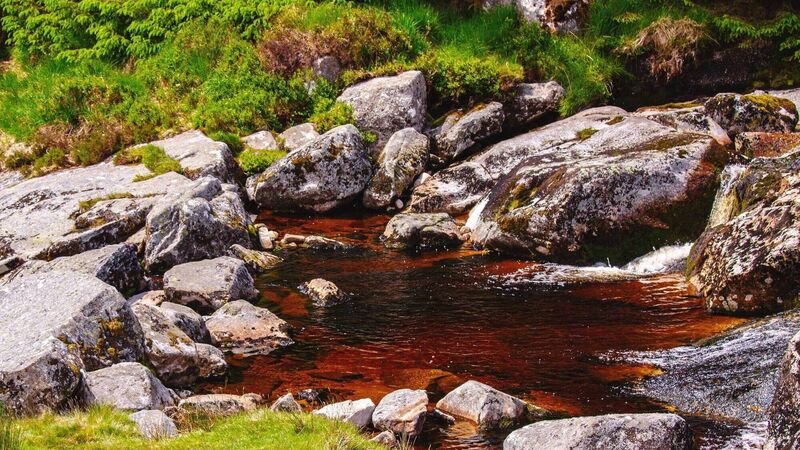
DOC is exactly what it sounds like: carbon from plants, soils and peat that has dissolved into water. Leaves, roots, mosses and microbes all contain carbon. When they decay, some of that carbon doesn’t become a gas, it becomes a tea-coloured solution that flows from land into streams and lakes. If you’ve ever seen a bog pool that looks like strong cup of Barry’s tea, you’ve seen DOC in action.


Ireland, with its peatlands, wet soils, forestry and high rainfall, has all the ingredients to be a DOC powerhouse. About 20% of our land area is covered by peat and peaty soils, which are among the most carbon-rich ecosystems on Earth. That makes Ireland uniquely vulnerable to large losses of carbon from land to water. And those losses are growing.

Across the northern hemisphere, rivers and lakes have been getting steadily browner; a phenomenon known as brownification. This increase in DOC has been linked to climate change, warmer temperatures, altered rainfall patterns, and decades of land drainage and forestry. In Ireland, where extreme rainfall events are becoming more common, run-off of DOC is highly likely. But why should we care about carbon in water?

When too much carbon becomes a problem

DOC isn’t pollution in the traditional sense. It’s natural. But too much of it in the wrong place causes real problems. In lakes, DOC darkens the water, blocking sunlight, which reduces photosynthesis. In rivers, certain types of DOC can lower pH and bind with metals, creating conditions that could be stressful or toxic for invertebrates and fish. Some forms of DOC fuel bacterial growth, which can strip oxygen from the water, creating conditions that resemble nutrient pollution, even when phosphorus and nitrogen are low.

Then there’s drinking water. When water rich in organic content is treated with chlorine, it can form disinfection by-products such as trihalomethanes (THMs), which are potentially carcinogenic. Ireland has had some of the highest rates of THM exceedances in the EU, particularly in peat-dominated catchments. Treating DOC-rich water requires expensive filtration systems, driving up costs for water utilities.

DOC also matters for climate. When carbon leaves soils and peatlands in dissolved form, it is no longer being stored on land. Some of it is released back to the atmosphere as CO₂ from rivers and lakes. Some ends up in sediments or the ocean. These hidden aquatic carbon pathways are largely missing from climate accounting, even though they are significant.

The great DOC knowledge gap

Despite the importance of DOC, we do not know how much DOC Ireland is losing, where it is coming from, or what 'normal' even looks like.

Unlike nutrients such as nitrogen or phosphorus, DOC has no clear baseline. Is today’s river browner than it was in 1850? 1950? Before widespread drainage, forestry and peat cutting? We simply don’t know because no one was measuring it.

DOC is also chemically complex. Some DOC is easily broken down by microbes. Some is acidic. Some binds metals. Some is almost inert. We also don’t know if DOC flows steadily or moves in bursts, driven by rainfall after droughts. Could a single storm release more carbon than weeks of normal flow?

That combination of chemical complexity, potential hydrological pulses, and missing baselines is why DOC remains one of the least understood pressures on our waters. Which is where the EPA funded C-UISCE comes in.

C-UISCE Project is an EPA funded, multidisciplinary project aiming to quantify the magnitude of carbon loss from land to water and the potential impacts of dissolved organic carbon (DOC) export on water quality and aquatic ecology

What is C-UISCE?

C-UISCE (Carbon and Catchments — Understanding the Impacts and Sources of Carbon Export from Land to Water) is a four-year, EPA-funded research project designed to finally bring DOC out of the shadows. Led by University College Cork, with partners at University College Dublin, TU Dublin and the University of Galway, the project brings together hydrologists, peatland scientists, freshwater ecologists and modellers to answer three big questions: How much DOC is leaving Irish catchments? Where is it coming from? What does it mean for ecosystems and drinking water?

Why this matters

DOC sits at the crossroads of climate, biodiversity, water quality and public health. Yet it hasn’t been visible in environmental monitoring. C-UISCE is changing that. By revealing where carbon is leaking from land into water, and why, the project will help guide forestry management, agriculture and drinking water protection. It will also help Ireland prepare for a future where climate-driven extremes make carbon pulses more frequent and more severe.

In a changing climate, it’s no longer enough to ask how much carbon we emit into the air. We must also ask how much we are losing into our waters, silently, invisibly. DOC may be dissolved. But its impacts may not be.

x

CLIMATE & SUSTAINABILITY HUB

More in this section

Revoiced

Newsletter

Sign up to the best reads of the week from irishexaminer.com selected just for you.

Cookie Policy Privacy Policy Brand Safety FAQ Help Contact Us Terms and Conditions

© Examiner Echo Group Limited