'Testing the waters’ when forming new relationships
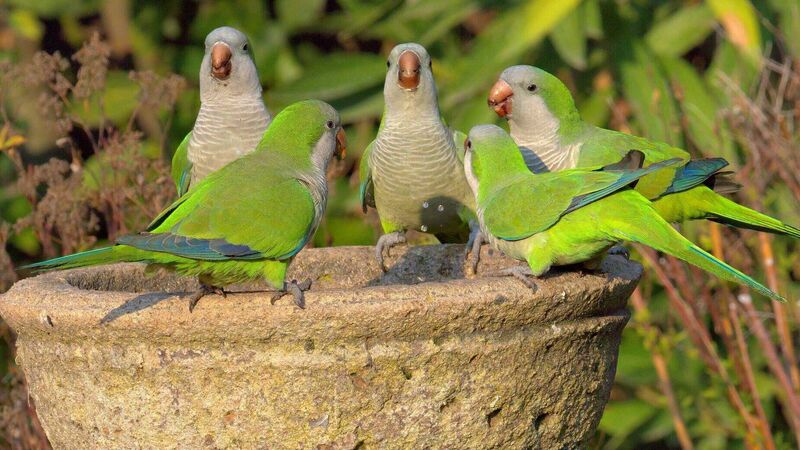
Monk parakeets don’t rush into friendships. They gradually escalate interactions, starting from safe, low-risk behaviours and moving toward more intimate acts only when trust is established
'Testing the waters’ when forming new relationships

Five Monk parakeets (Myiopsitta monachus), or 'Loro' to the locals, a widespread and common Chilean species, perch on a garden fountain in a suburban Santiago garden. Originally centred on the plains of Argentina, this species has become more widespread in South America and, through the pet-trade, managed to colonise parts of North America and Europe

In 1650 George Fox, founder of the Religious Society of friends, told a judge to "quake before the word of the Lord". ‘Quaker’ entered the lexicon as a derogatory nickname but Fox’s followers accepted it.

A species of South American parrot, first introduced to Science by the Comte de Buffon, bobs up and down. It ‘quakes’. Being relatively plain and ‘monkish’, the ‘quaker parrot’ is also known as the ‘monk parakeet’.


In a research paper just published, zoologist Claire O’Connell of the University of Cincinnati claims that this is a socially sophisticated creature. It even ‘tests the waters’ before approaching a parrot that it doesn’t already know.

Thrush-sized, and long-tailed, the quaker is slightly smaller than the familiar ring-necked parakeet, which has colonised cities in Europe. Like the ring-necked, it became a hit with the pet trade. Birds were taken from South America to Europe. In due course, some of them escaped from their cages and began nesting in the wild. Colonies were established in Italy, Slovakia, and the Canary Islands.

Escapees also set up shop in London and in the English ’home counties’. Vagrants are recorded occasionally in Ireland.

Although monogamous, quaker parrots build large high-rise apartment-style nests of sticks. There are numerous chambers and pairs nest in close proximity to each other. Their architectural skills, however, get them into trouble; the bulky nests are often located on electricity pylons and mobile-phone masts, where they cause power outages when it rains.

A paired parrot likes to groom its partner. Unpaired ones, however, will perch close to another but keep a discrete distance between them.

Claire O'Connell, PhD student in the Hobson Lab at the University of Cincinnati studying the relationship between affiliation and social structure in monk parakeets. Picture: @clairakeet

O’Connell’s team took quakers from the wild and kept them in a large outdoor aviary. To study their social interactions and early pair formation, four groups of parrots, unfamiliar to each other, were brought together to form a community. There were 14 males and eight females.

How would they behave on encountering strangers? Would they pair up readily and mate with them?

Most wild creatures don’t beat about the bush when trying to secure mating partners. ‘Faint heart never won fair lady’ is the general rule. To pass on its genes to the next generation, a would-be suitor must ‘seize the day’ and, to quote Samuel Beckett, ‘strike before the iron freezes’.

Intensive monitoring of the Cincinnati birds showed that quaker parrots do things differently. Despite being colonial nesters, tolerant of neighbours, they proved to be very cautious when forming bonds. Deferring gratification, they began making overtures to prospective partners only very gingerly. Their motto, it seems, is ‘fools rush in where angels fear to tread’.

Such behaviour is unusual among animals, with few exceptions. Vampire bats, however, exercise similar caution; males offer a blood-meal to a prospective partner before attempting to groom her. Like vampire bats’ teeth, parrot bills are fearsome weapons; they evolved to crack open the hard shells of nuts. A bite sustained during an unwanted encounter could be lethal, so caution is advised.

This parrot species is appropriately named. "Our life is love, peace, tenderness and bearing one with another" says the book Quaker Faith and Practice.

x

More in this section

Revoiced

Newsletter

Sign up to the best reads of the week from irishexaminer.com selected just for you.

Cookie Policy Privacy Policy Brand Safety FAQ Help Contact Us Terms and Conditions

© Examiner Echo Group Limited