Aquatic habitats in such poor condition even adaptable species like herons may struggle
Since the start of this millennium, Ireland has lost around half a million waterbirds — almost 40% of the total population
Aquatic habitats in such poor condition even adaptable species like herons may struggle

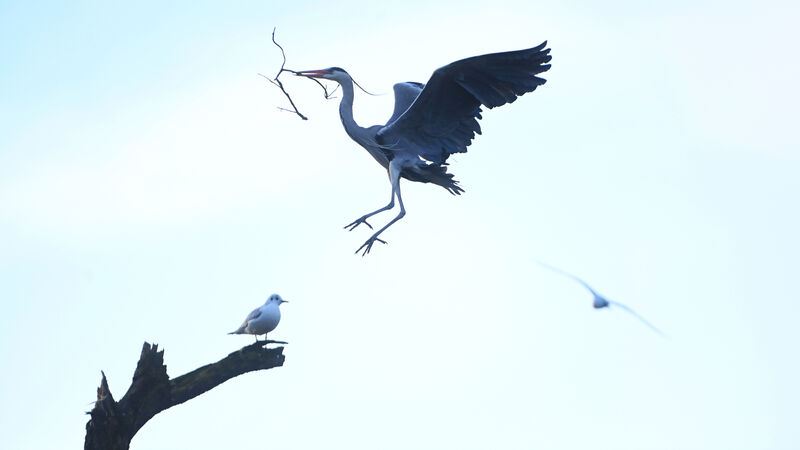
A grey heron bird with a twig in its beak flies to a nest on the island at Atlantic Pond at The Marina, Cork beside Páirc Uí Chaoimh. There is a heronry high in the trees at the pond. Picture: Larry Cummins 

Wherever there are fish, there will be herons.

Known also as corr réisc, and referred to as cranes in parts of the country, herons are Ireland’s tallest bird and a most elegant aquatic hunter. With a long shapely neck and lanky legs, solitary herons are often seen standing motionless by the water’s edge, waiting. Black head crest giving an air of exotic flamboyance, grey and white plumage blending with their watery hunting grounds — river, canal, pond, lake or coastal estuary.


Stalking the water for potential prey, in their stillness they are assessing the likelihood of each passing fish becoming dinner. Though herons aren’t fussy. As well as salmon, trout and eel, they will eat almost anything: crabs, crayfish, beetles, frogs, end even the occasional rodent.

A heron plays with his lunch — a freshly caught slippery eel. Picture: Chani Anderson

While watching over the water, herons are likely observing the speed and direction of moving prey, allowing for refraction of the water, patiently assessing the exact right moment to jab with their long dagger-like bill. With such long legs and hosepipe-like long neck, herons can reach in for fish from without even having to get their feathers wet. Gripping the slippery fish with their toothed bill, before swallowing them whole on the spot.

It’s a good thing herons are so adaptable, it is one of the characteristics that makes these stunning birds ubiquitous. Now that Irish populations of eel and salmon — their favourite prey —are critically endangered, herons seem able to make do with other aquatic animals.

A male heron performs an enthusiastic mating dance on the banks of the Lee. Picture: Chani Anderson

Latest population estimates for Ireland suggest that there are more than 3,000 breeding pairs in Ireland and that the population is stable. But heron populations here and in Britain tend toward ‘boom and bust’ population dynamics. While currently classified as ‘green’ conservation status, there are concerns. The majority of our aquatic habitats are in such poor condition; ornithologists fear that even adaptable species such as herons may struggle. Data showing a current reduction in their breeding numbers in Britain is cause for concern, and researchers there fear that herons may be heading for the amber list on the Birds of Conservation Concern. While the population of herons is considered stable in Ireland at present, we cannot take this for granted.

It is often the case that wild species we assume to adaptable and thus resilient to habitat degradation, do indeed decline over time. I remember in 2020 being stunned to learn that mallard — a duck so familiar to everyone that it is often overlooked — has declined by more than 40% in just 20 years. Other waterbirds, such as tufted duck, goldeneye and pochard, aren’t faring well either.

Even the more adaptable species cannot withstand the combined pressures of water pollution, habitat loss and climate change. Since the start of the new millennium, Ireland has lost around half a million waterbirds, almost 40% of the total population.

A heron in flight at The Glen River Park, Cork city. Picture: Larry Cummins

This is just one of the myriad reasons to clean up our act on water quality. Dippers, for example, depend on healthy upland rivers in which ample dissolved oxygen allows a rich array of invertebrates to thrive. Dippers walk along the stony substrate of fast flowing rivers, gripping stones with their feet so that they don’t get washed away with the current while they rummage for benthic invertebrates in the riverbed.

We even have an endemic subspecies of dipper in Ireland, which occurs nowhere else in the world.

Grey wagtails also live exclusively by freshwater, picking off aerial invertebrates in flight. Kingfishers nest in the banks of rivers and feed themselves and their nestlings on small freshwater fish.

At the base of their food webs are the small invertebrates whose abundance is determined by the health of the aquatic environment. Without the natural diversity and abundance of the mayfly, stonefly, caddisfly, myriad variety of worms and beetles and nymphs of many species, all these more recognisable and charismatic aquatic animals will continue to decline.

As long as our political representatives continue to stubbornly refuse to do what is necessary to restore good water quality to our rivers and lakes, ecosystems will continue to unravel. Having just negotiated another extension to the nitrates derogation, the Government is refusing to act according to the science... and nutrient pollution is set to continue make life impossible for many of our most treasures wild species.

The good news is that we know what needs to be done and we are in the fortunate position of having ample means to implement solutions. The scientific understanding of nutrient pollution pathways is well established.

Dredging is another activity that destroy instream habitats, and to stop dredging will also help rivers recover. Improving the performance of wastewater treatment plants can be prioritised too. Ireland has ample resources and capacity. And most of all, we have the will of the people.

Almost everyone — across every sector and age group of the Irish population, rural and urban — cares about healthy rivers, lakes and estuaries and the wildlife that they contain. A recent poll indicates that heathy waterways are ‘very important’ to 82% of people in Ireland

Herons may be adaptable, but they are not invincible. I’m sure that my father’s generation assumed that wild salmon would always be abundant in Irish rivers and lakes too. For herons, kingfishers, dippers, otters, and other charismatic inhabitants of waterways, there is much at stake. Their continued presence depends on healthy aquatic food webs. And this in turn, requires that we act to effectively protect waters from pollution.

The possibility of recovering the health of Ireland’s rivers and lakes is in our hands.

x

More in this section

Revoiced

Newsletter

Sign up to the best reads of the week from irishexaminer.com selected just for you.

Cookie Policy Privacy Policy Brand Safety FAQ Help Contact Us Terms and Conditions

© Examiner Echo Group Limited