'If you see me, weep': What Ireland's dry spell can learn from history's dry past
When to enjoy a sunny spell and when to worry about prolonged drought...
'If you see me, weep': What Ireland's dry spell can learn from history's dry past

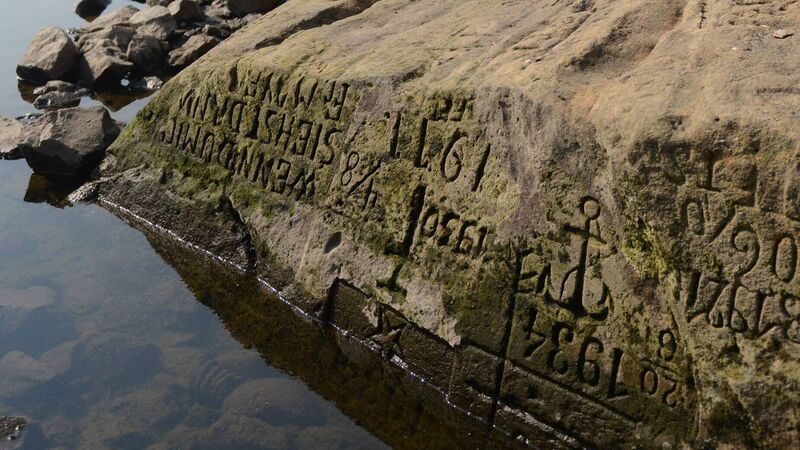
'Hunger Stone' at Decin, Czech Republic revealed by the low water level of the Elbe river — seen here in August 2018. Picture: Michal Cizek /AFP via Getty Images

Let’s face it, we’re not known for scorching summers (or springs). A few days of sunshine and suddenly the lawn is scorched, the dog is panting, and half the country is panic-buying paddling pools like they’re PPE in the pandemic.

But as May 2025 brings prolonged dry weather, with water restrictions looming, our green island is showing signs of thirst. History warns us to take it seriously. Droughts have reshaped civilisations across the world — and Ireland, despite its rainy reputation, isn’t immune.


A parched present

As of May 2025, Ireland may be facing one of its driest springs in decades. While I’m writing this article, more than a dozen areas across the country are being monitored for drought conditions. Uisce Éireann is urging communities across Donegal to conserve water and reduce water usage. Meanwhile, long-term forecasts suggest the current high-pressure system isn't shifting anytime soon.

It’s tempting to enjoy this Mediterranean interlude and dismiss it as 'a good spell'. And it is glorious. But when history starts rearing its thirsty head, we’d do well to pay attention. Because prolonged droughts have left watermarks on human history in the past, and it certainly will in the future.

Hunger stones: echoes of hardship

In Central Europe, the Elbe River hides 'hunger stones'... ancient markers submerged during normal flows. When water levels drop, they emerge, bearing warnings such as 'Wenn du mich siehst, dann weine' ('If you see me, weep'). Dating back to the 15th–19th centuries, these stones marked droughts that brought failed harvests, famine, and suffering. They reappeared in 2018 and 2022, grim reminders of climate’s power.

These stones weren’t just morbid graffiti. They were practical warnings to future generations. For people in pre-industrial societies, water wasn’t just important — it was survival.

'Hunger Stone' at Decin, Czech Republic revealed by the low water level of the Elbe river. Once an ominous harbinger of low water and hard times the carved stone has in the past been exposed by drought spanning much of Europe — seen here in August 2018. Picture: Michal Cizek /AFP via Getty Images

When civilisations ran dry

The Maya offer one of history’s clearest cautionary tales. They were astronomers, architects, mathematicians — a people of immense knowledge and cultural sophistication. But around 1,200 years ago, many of their great city-states began to decline. Palaeoenvironmental climate data and archaeological evidence, point to repeated droughts as a key trigger. With less rainfall, crops failed, social structures weakened, and internal conflict flared. In the end, water (or the lack of it) helped bring down one of the most remarkable cultures of the ancient world.

Thousands of years earlier, the Akkadian Empire in Mesopotamia, which is widely considered the world’s first empire, collapsed after a dramatic drying event around 2200 BCE. This so-called '4.2k event' triggered widespread aridification across the Middle East. Archaeological records reveal how canals silted up, cities were abandoned, and people migrated in droves. Climate, it seems, has always had the final say.

The Indus Valley Civilisation, too, one of the great cradles of human urban development, dwindled not because of war or invasion, but because the monsoon rhythm changed. The rivers they relied upon — the lifeblood of their cities — dried and shifted. Shifts in trade and social order compounded the crisis, leading to gradual decline.

A boat passes by the ruins of the ancient Roman Neronian bridge, usually submerged by the Tiber, in Rome, in June 2022. Picture: AP Photo/Alessandra Tarantino

A rainy island on dry alert

These ancient collapses might seem distant, but they hit close to home in 2025. Ireland is currently experiencing one of its driest springs in recent memory. The European Drought Observatory has placed us under a 'drought watch', and some counties are likely facing full water restrictions. Reservoirs are running low and water tables are dropping. This isn’t an isolated event. Climate change is rewriting Ireland’s weather playbook. We’re likely to see more extremes: wetter winters followed by longer, hotter, drier summers. These shifts strain ecosystems, challenge infrastructure, and test our capacity to adapt.

Not just a 'problem for farmers'

Drought doesn’t just impact agriculture — though that’s certainly one of the first and hardest-hit sectors. It also reduces river flows, threatening freshwater habitats and fish populations. It weakens peatlands, which can dry and crack, releasing carbon into the atmosphere instead of storing it safely in the soil. It even makes our drinking water more vulnerable to pollution and algal blooms.

Urban areas aren’t immune either. Leaky pipes, ageing infrastructure, and growing populations place huge pressure on supply. And despite our love for talking about the rain, Ireland still loses around 40–50% of treated water through leaks in the public network.

Heeding the warnings beneath our feet

Of course, we’re not the Maya. We have irrigation systems and weather apps. But we also have rising global temperatures, stressed water infrastructure, and a growing disconnect from the natural systems we rely upon. If we’re not careful, we may find ourselves facing modern versions of hunger stones — not carved into granite but typed into official reports on water shortages and food insecurity.

So, what can we do. For starters, we can learn from history. Civilisations that survived climate shocks were often those that adapted early — managing water wisely, changing farming practices, and making their cities more resilient. That means investing in water infrastructure, fixing leaks (currently one of the biggest sources of water loss in Ireland), restoring wetlands, and promoting water-saving behaviours before bans are necessary.

We also need to treat drought as a real and present threat and not just a freak event, but part of a changing baseline. History’s survivors adapted early, and Ireland can too.

Sunshine with a side of perspective

So, enjoy the barbecue weather. Have your 99 in peace. Bask in the sun. But while you’re at it, maybe fix that dripping tap. Skip watering the lawn. Install that water butt after all. Because even here in our famously wet and windy corner of Europe, the warnings are becoming harder to ignore. And the hunger stones would agree — it’s better to act now than weep later.


x

Check out the Irish Examiner's WEATHER CENTRE for regularly updated short and long range forecasts wherever you are.

More in this section

Revoiced

Newsletter

Sign up to the best reads of the week from irishexaminer.com selected just for you.

Cookie Policy Privacy Policy Brand Safety FAQ Help Contact Us Terms and Conditions

© Examiner Echo Group Limited