Being a passenger on a sailing ship doesn't mean you're a 'sailor' — so is Katy Perry an 'astronaut'?
Contrary to what might seem obvious, 'space' is not defined by the height at which you become weightless. Near-weightlessness can be achieved on one of those fairground experiences which drop you vertically: being 'weightless' is not the same thing as 'being an astronaut'
Being a passenger on a sailing ship doesn't mean you're a 'sailor' — so is Katy Perry an 'astronaut'?

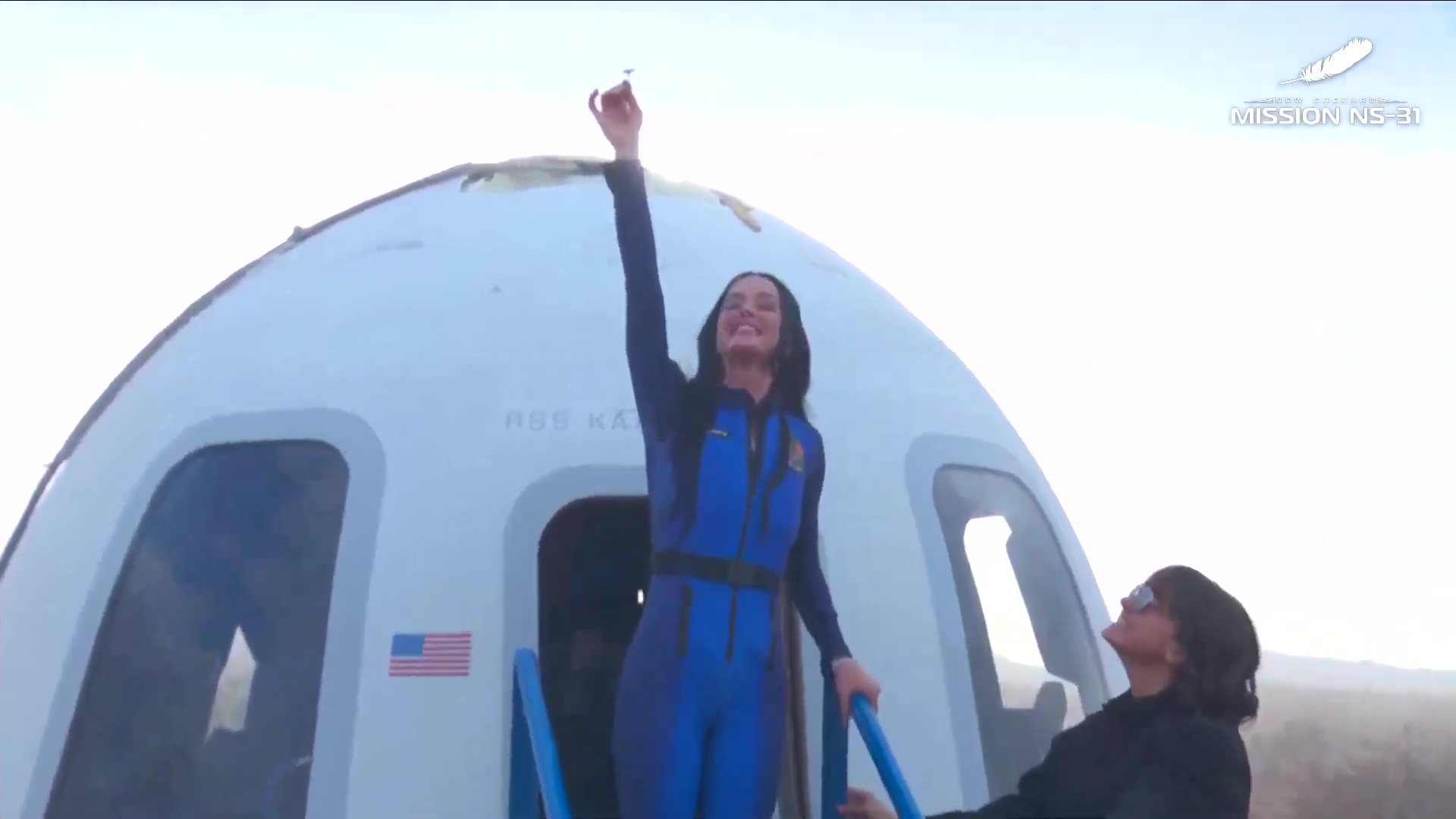
singer Katy Perry after her flight in Blue Origin's New Shepard NS-31 spaceship. The 40-year-old US pop star was part of a six-woman crew on Jeff Bezos's New Shepard NS-31 mission, organised by his partner, journalist Lauren Sanchez. Picture: Blue Origin/YouTube/PA Wire

The question of 'when is an astronaut an astronaut?' has received much attention with the most recent flight by the space company Blue Origin that included a number of high-profile individuals. 

While the question appears to be a simple one, the answer turns out not to be so. 

It depends both on how 'being in space' is defined, as well as the role of a person referred to as an 'astronaut' might best be considered to be.

Looking first at the definition of 'space'. At higher altitudes the atmosphere becomes increasingly thinner, but there’s no height at which it suddenly disappears. It’s a gradual thing...

At around 100 kilometres up its density has become so low that it is no longer possible for a conventional type of aircraft to fly. For example, commercial aircraft fly at altitudes of around 10 kilometres and rely on the 'lift' they get from the air rushing over their wings to remain airborne.

At around 100 kilometres altitude there simply isn’t enough air to provide lift, no matter what the speed, and wings become effectively irrelevant. So, it makes sense to consider a 'spacecraft' as a vehicle which doesn’t, indeed cannot, rely on the atmosphere to keep it aloft.

If we now assume that a spacecraft reaches a height of around 150 kilometres, then when the rocket engines are shut off it begins to fall back to Earth, but 'misses' it. 

Such a spacecraft has gone into 'orbit'. It will continue to circumnavigate the planet without the further need for engines.

For some people, myself included, this seems like a more reasonable definition of 'being in space' than a definition which relies on the aerodynamic properties of a spacecraft. Hence, flights which reach no more than about 100 kilometres challenge reasonable definitions of being in space.

Contrary to what might seem obvious, 'space' is not defined by the height at which you become weightless. Near-weightlessness can be achieved on one of those fairground experiences which drop you vertically, or on an adapted aircraft following a particular flight path called a parabola which provides around 20-25 seconds of zero gravity each time it does so. Being 'weightless' is not the same thing as 'being an astronaut'.

In the case of flights by Blue Origin (or its rival, Virgin Galactic) the maximum height reached is close to 100 kilometres. At this altitude the rocket engines have shut down and the spacecraft gradually slows under the influence of the earth’s gravity and begins to fall back to Earth. For a period of 4 – 6 minutes, people on board experience weightlessness.

That brings us to the question of what constitutes an 'astronaut', as distinct from a 'passenger'. 

This is a sensitive issue. Just as being a passenger on a sailing ship does not automatically infer the title of 'sailor', so passengers on a spacecraft that is fully autonomous (such as those used by Blue Origin and Virgin Galactic) might feel more comfortable choosing another title to 'astronaut'. This should not be considered a negative.

Putting aside the huge costs of launching humans into space and the environmental impact for questionable returns from 4-6 minutes of weightlessness, the fact that it is now possible to send people of all ages with little or no training or expertise to a height of 100 kilometres attests to how far our technological prowess has come since Yuri Gagarin became the first person to orbit the Earth on April 12, 1961. 

Far from needing to adhere to the moniker applied to the Apollo astronauts of being made from 'the right stuff' it is now possible to be launched to 100 kilometres even if made from 'the ordinary stuff'. 

Ultimately, that represents astonishing progress which should inspire new generations to consider space as part of their future, and not a domain reserved for 'astronauts.

  • Dr Niall Smith is head of research/ head of Blackrock Castle Observatory, Munster Technological University, Cork

More in this section

Revoiced

Newsletter

Sign up to the best reads of the week from irishexaminer.com selected just for you.

Cookie Policy Privacy Policy Brand Safety FAQ Help Contact Us Terms and Conditions

© Examiner Echo Group Limited