Islands of Ireland: No long face thanks to the inspirational beauty of Kerry's Horse Island
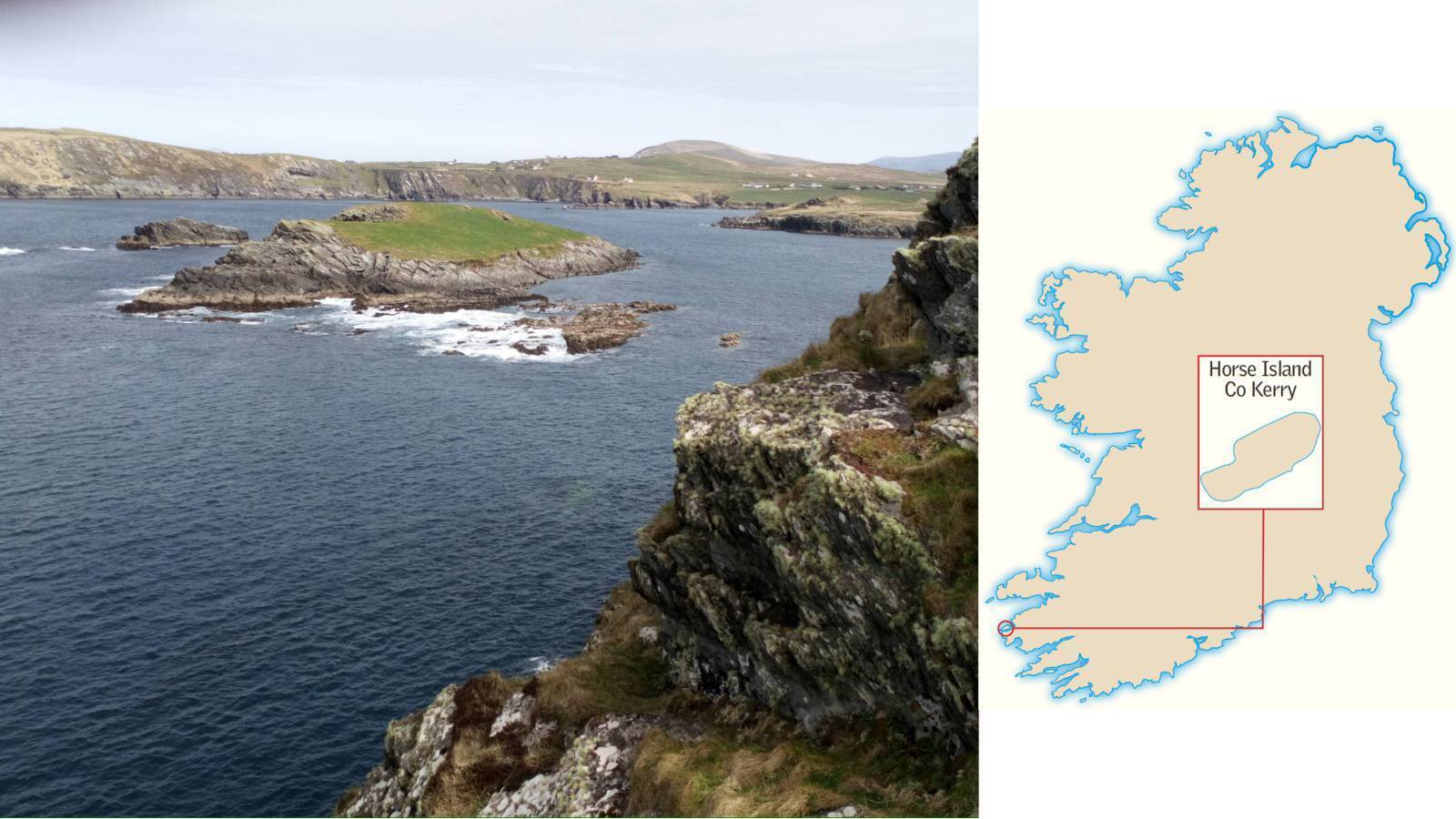
Horse Island, near Valentia Island, County Kerry. Picture: Dan MacCarthy
The passage between Valentia Island, County Kerry, and the mainland at Portmagee is a major strategic point offering safe passage to seafarers from the often mountainous seas towards calmer waters. The Irish for the island is Dairbhre, or ‘Oak Isle’ but the English name often causes confusion with the Spanish city — to which there is no connection. Cuan Bhéil Inse (Harbour Mouth of the Island) mutated to Ballentia before ultimately changing into Valentia. It is one of our largest islands, coming in in fifth place. Illaunloughan is the tiny island opposite with an early medieval church whose ecclesiastical remains has major echoes 12km out to sea at Skellig Michael.
At the mouth of the channel lie a few islands with uninspiring names but definitely with inspiring beauty: Horse, Long and Short, and a little further to the south, Lamb Island. Long Island (which previously appeared on this page) is the biggest of the quartet, with Short, a diminutive afterthought. Horse Island is the most northerly of the set, right at the mouth of the channel. While Long Island shows a burial ground on the archaeological record, nothing shows up for Horse Island. Long Island also has remnants of the Iron Age promontory forts which date from 500BC to 400AD. These are small islands with steep cliffs and grass on top and may once have provided enough resources for people to scrape an existence.
The Milesians are generally considered the first race of people to have populated Ireland after two previous races failed to establish themselves in the mists of time — circa 8,000 years ago. Whether in fact or in myth, the story goes that the Milesians came to an agreement with the Tuath Dé Danann that they would rule the land and the latter, the Otherworld.
Setting sun on Lative, Portmagee: Valentia Bridge @wildatlanticway @WAWHour @SkelligSix18 pic.twitter.com/PLw2riYo0U
— Patsy Lynch (@patsylynch) April 2, 2024
The Iberian race is thought to have landed at Ballinskelligs Bay around the corner from Horse Island but it is entirely possible that they came through the Valentia Sea Passage and landed at Horse Island. One of their number, Amergin, recorded in verse the attempts of the Milesians to gain Ireland from the Tuath Dé Danann. The poet Paddy Bushe writes in that: “Amergin’s poem makes the most direct possible kind of imaginative appropriation: that of the poet, seer and lawmaker, Amergin stepping ashore and chanting the poem as he sets his right foot on the land.”
“I am the wind on the sea;/ I am the wave of the sea;/ I am the stag of seven battles;/ I am the eagle on the rock/ I am a flash from the sun."
It is a poem that the poet Robert Graves says should be foremost in the canon of western mythological writing ahead of the Book of Genesis, and .
“I am the most beautiful of plants/ I am a strong wild boar/ I am a salmon in the water/ I am a lake in the plain/ I am the word of knowledge/ I am the head of the spear in battle.”
Above Lamb Island. and affording a magnificent view of the islands as well as the Skelligs are a spectacular array of cliffs rising from the sea like some giant curtain.
“For the passerby, the island marks a convenient landing and camping beach on the mainland directly beside it,” writes David Walsh in .
The kayaking supremo advises a best landing can be made facing the mainland or Long Island. The curiously named Deaf Rocks are a reef running alongside the island, he writes.
There are many Horse Islands in the country and too many to mention here. Prominent ones include those at Roaringwater Bay and at Ballinskelligs Bay.
Final word to Amergin and his elemental vision: “I am the god that puts fire in the head/ Who spreads light in the gathering on the hills/ Who can tell the ages of the moon/ Who can tell the place where the sun rests.”
: No ferry. Kayak from a small beach just to the east of Horse Island.
: Archaeology.ie; logainm.ie; , Cork University Press; , David Walsh, Pesda Press

CONNECT WITH US TODAY



Be the first to know the latest news and updates