Richard Collins: Grackles are learning to become streetwise city slickers

Animals can live alongside humans if they are risk-analysis experts. This is according to a new study in @eLife by Alexis J Breen
The COVID-19 lockdowns didn’t put a stop to environmental destruction. They did, however, provide some respite for wild creatures. Wolves were seen wandering the deserted streets of European towns, wild boar visited Italian cities, and feral goats raided gardens in Mulranny
But how did the temporary reprieve affect wild creatures generally?
To answer that question, 220 researchers, from 161 institutions worldwide, compared data gathered prior to lockdown with observations made during it. More than 5,000 camera-traps were deployed.
Contrary to popular expectations, "we did not see an overall pattern of wildlife running free while humans sheltered", says Dr Cole Burton of the University of British Columbia who analysed the results. Canadian carnivores, such as wolves, wolverines, and cougars, "were generally less active when human activity was higher"; they know not to trust people. Large herbivores, such as red deer and moose, however, "often increased their activity but became more nocturnal with the presence of more humans".
Lockdown is not new to wild creatures; some love us, others shun us. Mallards and mute swans, for example, have thrown their lot in with us, nesting even in towns and cities, but two other Irish swans, the whooper and the Bewick’s, give people a wide berth. They breed in Iceland and Siberia, where there is permanent 'lockdown', and spend the winter in our remote wetlands.
Gulls, once known as ‘seagulls’, were once exclusively coastal. Then, like the Gaelic chieftains bowing to Richard II, they made an uneasy peace with us. Offal and waste from trawlers was the initial inducement. Next, they began following the plough, gorging on creepy-crawlies. Town dumps provided a further bonanza. Now they nest on roofs and snatch people’s lunches in city parks.
Boat tailed Grackle has company on my bird feeder camera #solarpower #birdwatching #birds #birdlovers #fightingoverfood
— Tammy (@tammywjones) March 28, 2024
My Bird camera here https://t.co/KkjiF6QaRA pic.twitter.com/gmol0kjLCN
Magpies also sold out; they first bred in Dublin city in 1952. Even the sly fox and the proud ‘no surrender’ peregrine have come in from the cold.
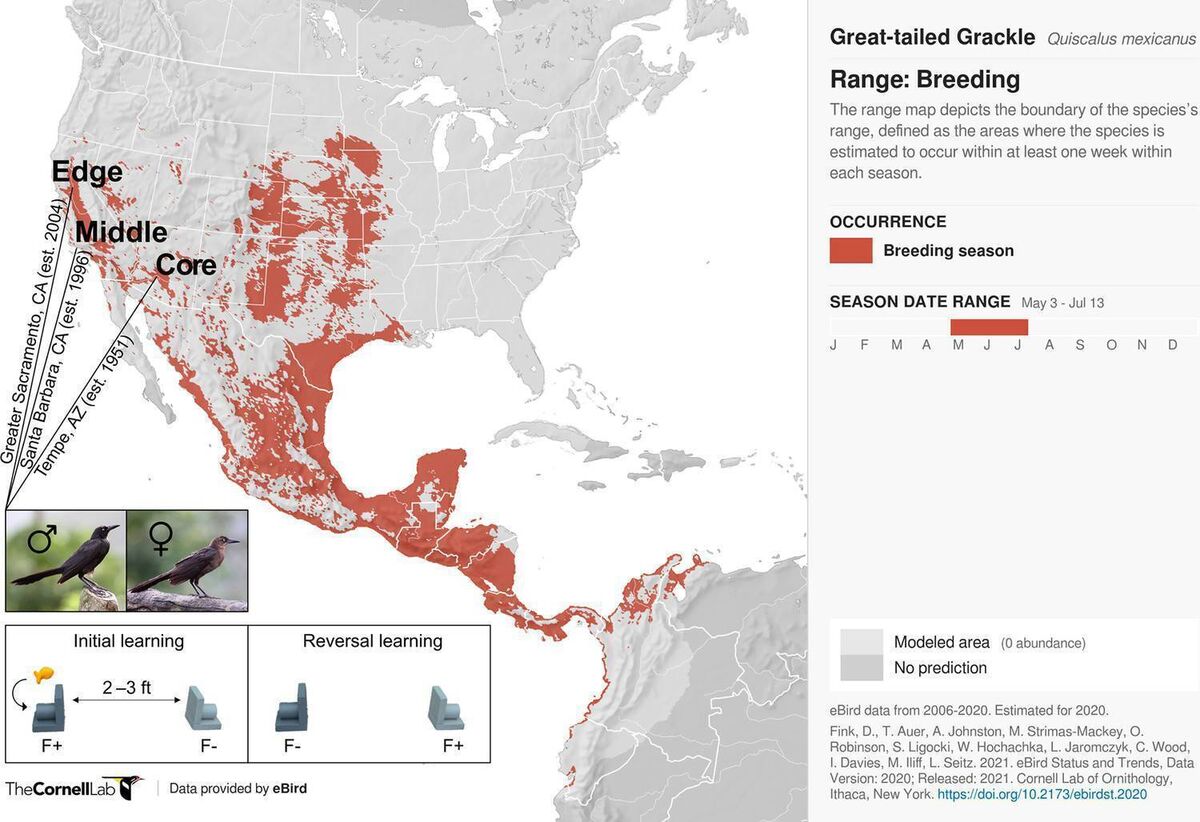
But making the transition to tameness and civilisation isn’t easy, as research just published shows. Alex Breen and Daniel Deffner, of the Max Planck Institute, studied the Pauline conversion of the boat-tailed grackle — a bird of the US shoreline and coastal marshes. The all-black male resembles a crow with a long paddle-shaped tail.
This Boat-tailed Grackle has snatched someone’s Pop-Tart. Grackles are expert thieves and will eat anything. Tybee Island, Georgia. pic.twitter.com/6bVHR6herG
— incidental naturalist (@IncNaturalist) November 11, 2019
Grackles were traditionally shy birds but, attracted by urban food waste, they are moving cautiously into towns. Built-up areas, however, are dangerous places, full of unpredictable people vehicles, and dogs. To survive in a concrete jungle, a grackle must be very careful, but they are learning to become streetwise city slickers.

The researchers hid food at three separate urban locations where there were grackle populations. The birds had to search for the food. Then, to see how long it would take the grackles to re-discover it, the food was switched to different locations. Surprisingly, it was the male grackles which searched out and found the relocated food. The females then followed the males to the feast. "Male grackles finish relearning faster" both in the wild and in laboratory tests.
Animals can live alongside humans if they are risk-analysis experts. This is according to a new study in @eLife by @alexisjbreen @MPI_EVA_Leipzig & @dominik_deffner @mpib_berlin. More: https://t.co/tB1xrycaY6 & https://t.co/EDlre80U7S pic.twitter.com/eUSZnSsCG8
— MPI-EVA Leipzig (@MPI_EVA_Leipzig) April 2, 2024
The crucial factor, the researchers believe, is the ability to assess risk. It seems that male grackles are better at this than females.


CONNECT WITH US TODAY



Be the first to know the latest news and updates