Islands of Ireland: MacCarthy’s Island in Kerry — set in a little piece of heaven
The lake is surrounded by mountains and woods... Tomies, Purple, and Shehy Mountain stand on the northside while Torc, Mangerton, and Peakeen form the southern part of what is in effect a giant bowl
Islands of Ireland: MacCarthy’s Island in Kerry — set in a little piece of heaven

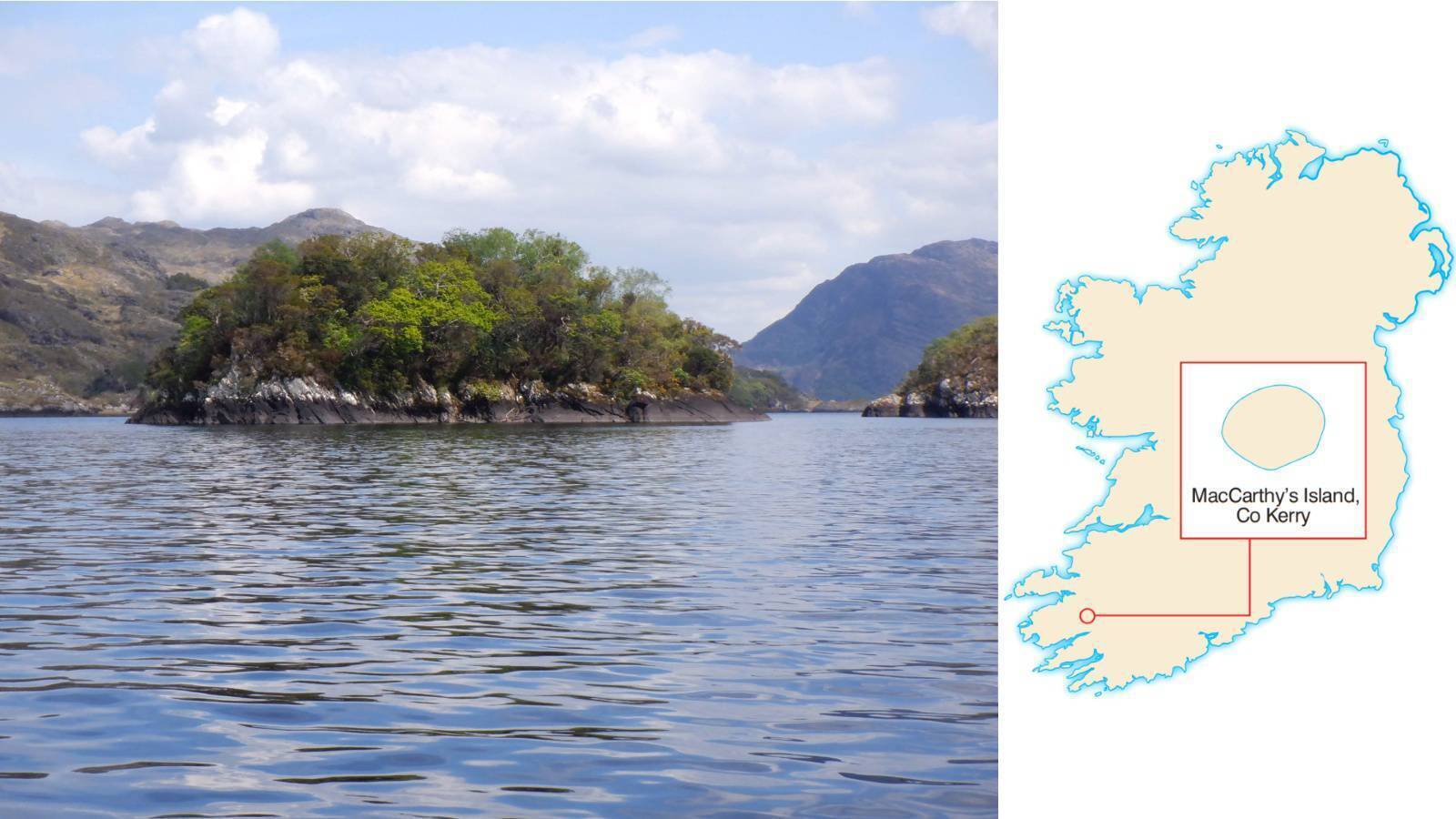
MacCarthy's Island, Upper Lake, Killarney, County Kerry. Picture: Dan MacCarthy

On the Upper Lake of Killarney, County Kerry lies a group of islands among which is one of the last remnants of a mighty Gaelic kingdom which once dominated the southwest of the country. MacCarthy’s Island is the westernmost of a cluster of five islands: Juniper, Ronayne’s, Duck, and Eagle [link below].

The lake is surrounded by mountains and woods including Derrycunihy Wood on the south of the lake. Tomies, Purple, and Shehy Mountain stand on the northside while Torc, Mangerton, and Peakeen form the southern part of what is in effect a giant bowl. The lake is filled by numerous rivers cascading down from higher ground. To describe this place as a little piece of heaven is to do it an injustice.


MacCarthy’s Island is on the small side, just about a half acre in size. Like its immediate neighbours it has a dense canopy of trees including holly, and Ireland’s native evergreens — yew, arbutus, and Scot’s pine. Its steep sides make landing very difficult but just about doable. While landing on these islands is possible it is discouraged owing to the very sensitive nature of the habitats.

The kingdom in question here is of course that of the MacCarthy Mór (or More) which prevailed in Kerry until the demise of the old Gaelic order in the late 16th century. The island is one natural remnant of the clan... while there is a physical one in the form of a ruined castle at Castlelough to the east of Ross Castle on Lough Leane itself.

This is described as a ‘fragmentary ivy-clad remains of a tower’. “ Castlelough Castle (or Poolcastle) was once a substantial tower house erected by the MacCarthy More in the 15th/16th century. The castle was reduced to its present state when razed by parliamentary forces in 1652,” states archaeology.ie

The castle came into MacCarthy possession in the 13th century when the Norman de Roches, who built it, were defeated in battle. Having rebuilt the castle the MacCarthys then ruled south Kerry from this castle and two others at Pallas and Ballycarbery. As to which member of the MacCarthy More dynasty the island in the Upper Lake is named after is anyone’s guess, though it is likely that it was just named for the clan itself. One of the clan’s early leaders was Dónal Óg McCarthy, who died at the castle in 1390, and is a candidate. Other possibilities are his son Tadhg, mentioned in the Book of Innisfallen as having reigned “38 years, and of the foreigners and the Gaedil of his time, he was the best for wine-drinking”.

Another possibility for the naming of the island is the last MaCarthy More chieftain, Donal, who vacillated between support for his own clan and Queen Elizabeth I as when he accepted the invented title of Earl of Clancarthy.

The chieftain’s interest in the island must have been merely nominal as nothing of strategic interest pertains to it. Then again, chieftains liked to amass possessions. Did any of the above men actually set foot on the island that bore the clan’s name? Entirely possible.

This MacCarthy’s island is the only one in the country and there are in fact very few islands named after a surname. However, the MacCarthy surname can be found globally at a number of island locations where the clan left its mark.

Timothy McCarthy from Kinsale had an island at South Georgia named after him on Ernest Shackleton’s South Pole expedition on the Endurance (1914 to 1917). There is also a MacCarthy Island in Burma, the naming of which has stumped this columnist.

And there are others in the River Elbe near Hamburg in Germany and in Vancouver, Canada. Perhaps the most famous is the one in Gambia, west Africa which was named after a British governor Charles MacCarthy who was decapitated by the Ashanti in the early 19th century. Prior to that severance he had been active in the anti-slavery movement. The best laid plans…

How to get there: gapofdunloetraditionalboattours.com/boat-tours

killarneylaketours.ie

Kayaking permits available from killarneynationalpark.ie but powerhose kayaks in advance to stop the spread of invasive species.

Other: Archaeology.ie; The Iveragh Peninsula: A Cultural Atlas of the Ring of Kerry, Cork University Press

x

More in this section

Revoiced

Newsletter

Sign up to the best reads of the week from irishexaminer.com selected just for you.

Cookie Policy Privacy Policy Brand Safety FAQ Help Contact Us Terms and Conditions

© Examiner Echo Group Limited