Sigginstown Island — uninhabited but supremely rich in birdlife
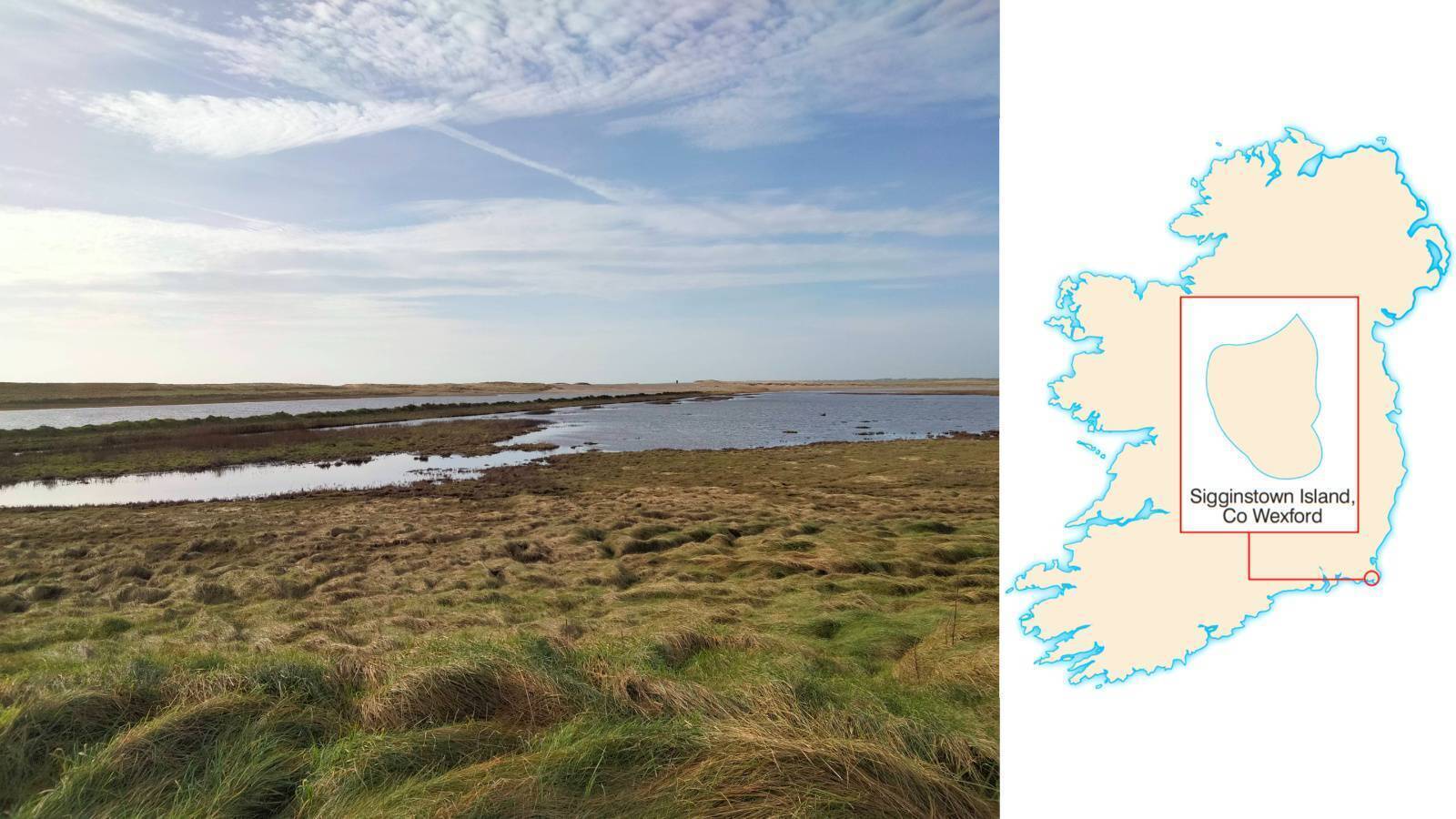
Islands of Ireland: Sigginstown Island, Tacumshin Lake, County Wexford. Picture: Dan MacCarthy
Where the west coast has an embarrassment of riches when it comes to islands, they are few and far between in the east of the country. However, many of the ones in the east are havens for a variety of bird species, with the standout Saltee Island Great known for the second-largest colony of gannets in the country. Otherwise, the tiny Keeragh Islands are associated with a shipwreck, and Tuskar Rock has a well-known lighthouse. There were other islands along the Wexford coast but most have been reclaimed and incorporated into the mainland (Begerin Island, Breast Island, Big Island).
There are numerous sea barriers along the southeast coast — these are known as ‘burrows’ and are a kind of naturally-occurring Maginot Line. They are giant sand dunes bound together with marram grass which protect the low-lying interior from the influx of the sea.
Nightfall and the view from Inish Island to Tacumshin Lake and beyond to Kilmore and Saltee #Wexford pic.twitter.com/VQd3PEWvHE
— Tony Mullen Photography (@TonyMullenPhoto) January 1, 2024
A 4-km stretch at Tramore, County Waterford has created a stunning beach with a lagoon behind it. Further east at Kilmore Quay is the Ballyteige Burrow, again with a lagoon nestled in behind it in which the solitary, blink-and-you-miss it, Cull Island sits. A little along the coast is Grogan Burrow with another associated water body, Tacumshin Lake, in which the sizeable Sigginstown Island is located. And finally, just before the famous Carnsore Point, near Rosslare, at the extreme southeasterly point in the country, there is Rostonstown Burrow — behind which is Lady’s Island Lake which has a couple of more islands.
These areas are supremely rich in birdlife and not just for the myriad regular customers you would expect: black-tailed godwit, gannets, gulls, kittiwake, razorbill, terns, whooper swan, and many more, but for the less seen or rarely-seen avian visitor: Arctic skua, avocet, baird’s sandpiper, bearded reedling, glossy ibis, grey Phalarope, hoopoe, ivory gull, purple heron, and scaup. Tacumshin Lake is regarded as one of the best bird-watching sites in the entire country.
The future success of this area as a place of outstanding natural beauty would seem to have been affirmed with the recent designation of 305,000 hectares in the ‘Seas off County Wexford’ as a special protection area. BirdWatch Ireland has urged that “for such a designation to be as effective as it can be, it is crucial that strong and effective conservation objectives and management plans are ambitious and that stakeholders are consulted throughout the process”.
Some wet feet but very happy birders experiencing the magic of Tacumshin Lake today….@SwarovskiOptik @ConnsCameras @NatureRTE pic.twitter.com/r4wBV7naxz
— Birds Ireland (@EricTheBirdman) September 22, 2023
Sigginstown Island and its little brother, Sigginstown Island Little are uninhabited and probably always have been. However, an oddity appears on the archaeological record in the shape of a construction. What mitigated against dwellings here was surrounding marshy land and probable lack of fresh water... yet some sort of construction remains. The archaeological record states: “Whatever feature might be visible on vertical aerial photographs from 1973 is not visible on other images and cannot be confirmed as an antiquity.” Today, a rudimentary causeway allows farm machinery to be brought to the island at low water and the island is subdivided into six monotonous-looking fields. The smaller island is separated by a low channel and has pretty much been absorbed into its big brother’s mass.
Sigginstown comes from the Anglo-Norman settler family of de Sygan who are thought to have built the nearby tower in the 16th century. Tacumshin derives from ‘Teach Coimseáin’ or ‘’House of Seán.
Grogan Burrow (formerly Windysheard) is unrelated to the surname and derives from ‘gruagán’ 'land producing long grass or sedge’. An earlier name was ‘Connyger’ which also appears at Dungarvan, County Waterford (Cunnigar) for the massive sand spit which almost crosses the bay there. It also appears in Norfolk, England, as ‘Connyger Eau’ reflecting the Norman origins of the word. And yet again, the Irish word nails the topography as the flat terrain, which in places has allowed for the ingress of saline water, is characterised by wide swathes of reeds and rushes. As these areas expand they encroach on the shallow waters of the lake and reduce it in size. Are Sigginstown’s Island’s days numbered?
: Visitors would agitate the birds and visiting is not advised. The island can be seen from the edge of Tacumshin Lake.
CONNECT WITH US TODAY



Be the first to know the latest news and updates