Anja Murray: Dozens of whales spotted along the Waterford coast this year
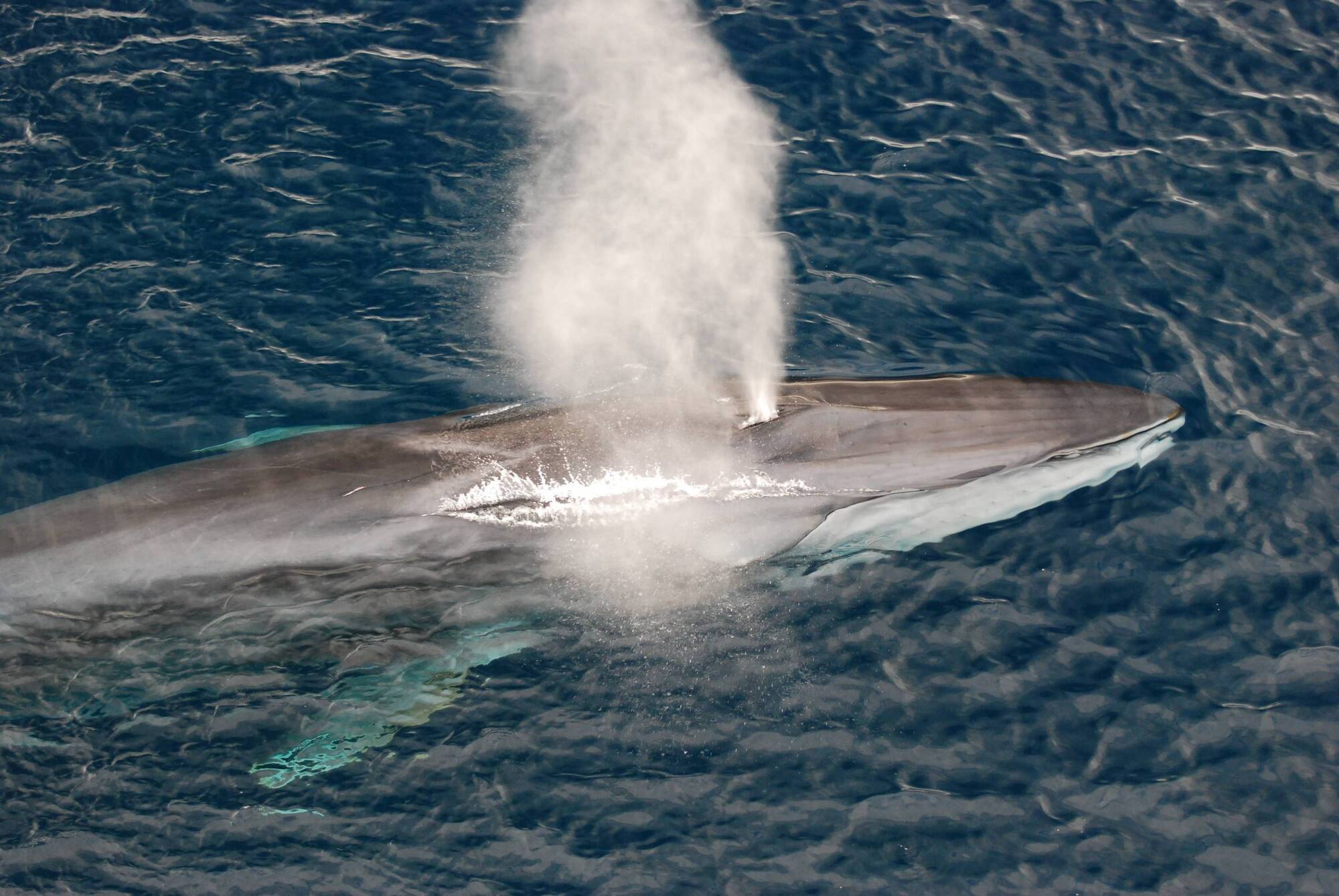
Fin whales are an extremely large and streamlined whale — they feed on krill, sprat, and herring
Fin whales are the second biggest animals ever to have lived on earth — smaller only than blue whales. The majority of their population was wiped out by industrial whaling in the 20th century. The Arranmore Whaling Company and the Blacksod Whaling Company between them caught 895 whales in the years from 1910 to 1922. Two-thirds of the catch consisted of fin whales. These enormous creatures are still an endangered species, though fortunately, our attitudes toward them and our understanding of their ecology have changed a great deal in the 100 years since then. Scientists are hopeful that the genetic diversity in the remaining population is sufficient that current and future conservation measures could be enough to help the population rebound and thrive.
This winter, there has been a surge of sightings off the coast of Waterford, so much so that the Waterford coastline is now seen as a hot spot for whale watching. Since November, dozens of fin whales and humpback whales have been spotted along the Waterford coast from Helvick Head to Dunmore East and Hook Head. These are not random sightings, but rather the reward for whale-watching enthusiasts who spend long hours watching out for them from headlands and collating the sightings to help deepen our understanding of these animals and their movements.

And just as though to secure its growing fame as hub of cetacean activity right now, Waterford seems especially popular with common dolphins. In recent weeks, dolphins have been active in the Waterford Estuary, even swimming up the River Suir well inland from Waterford City. In just one month, from mid-November to mid–December, more than 30 reports have been filed with research and conservation organisation, the Irish Whale and Dolphin Group (IWDG). In several reports, there have been as many as 100 dolphins swimming in the Suir estuary! On one occasion, more than 150 dolphins were seen together, heading down the mouth of the Suir on the ebb, registered by the operator of the ferry between Ballyhack and Passage East.
I was especially surprised to hear the humpback whale numbers. The IWDG has confirmed 84 sightings of this species off Irish coasts in the past six months, since the start of June 2023. Each sighting potentially yields valuable information, as individual humpback whales can be identified by unique patterns on their fluke. If photographs of the tail fluke are good enough, researchers can match Humpback Whales seen in Ireland with those recorded in the Cabo Verde archipelago off West Africa and the Caribbean. In January 2024, a connection was made between an individual humpback whale that had been photographed off Hook Head in County Wexford and other sightings of the same individual off Newfoundland in Canada and Bermuda near the Caribbean. This adds to our knowledge about humpback whales who feed off Irish waters and then travel more than 5,000 km to Caribbean and Newfoundland breeding grounds.

Both fin and humpback whales emit deep sounds, the frequencies of which are so low that they can travel many hundreds of kilometres through the ocean. Because of poor light levels in the deep ocean, cetaceans (whales and dolphins) have evolved to use sound for navigation (like bats use echolocation) as well as for communication, hunting, and attracting a mate. Their dependence on sound is also what makes them so vulnerable to anthropogenic sound pollution in the sea. When military operations create a sonic boom, or when sound blasts are used to map the seafloor, the volume and intensity of these sounds can be so disturbing as to disorientate the whales, disabling both navigation and communication, preventing them from finding food or a mate, and even causing them to become stranded.
At the end of January, a mature, female fin whale was washed up dead on a on a beach in Mayo. An upsetting sight, several people reported it to the IWDG, who were able to coordinate volunteers to attend the scene. This fin whale was just over 20 metres long and was subsequently found to be severely emaciated. The reason it had not eaten for so long is unknown.
Last year more than 350 cetaceans were stranded on coasts around Ireland, some alive and successfully rehabilitated, some dead. Common dolphins and harbour porpoises are the most commonly stranded species. A few weeks ago, I came across the body of a bottlenose dolphin washed up on a rocky shore of Connemara. After taking some essential measurements, using the measuring tool on my smart phone, I logged the finding online with the Irish Whale and Dolphin Group, who receive and catalogue both live and dead strandings which add to their database and our knowledge.
Whales and dolphins are still a relatively mysterious group of animals, and there is much we need to learn about their movements and their ecology if we are to protect them from human activities out at sea. In the majority of stranding cases, the reason for their death is unknown.
Whales play a key role in sustaining healthy oceans, and even help boost fisheries and sink atmospheric carbon dioxide to the deep sea. To allow them to recover from the near-complete annihilation they suffered at the hands of historic whaling, and now with naval and other sound pollution in the sea, enormous conservation efforts are still very much needed.
If you ever come across a stranded whale or dolphin, dead or alive, the best course of action is to photograph it, dropping a pin to mark the location and submit the sighting here.
- The Irish Whale and Dolphin Group will be running residential weekend whale-watching courses in west Cork in May and September this year.