Islands of Ireland: Trasnagh na dtonnta to this County Down island
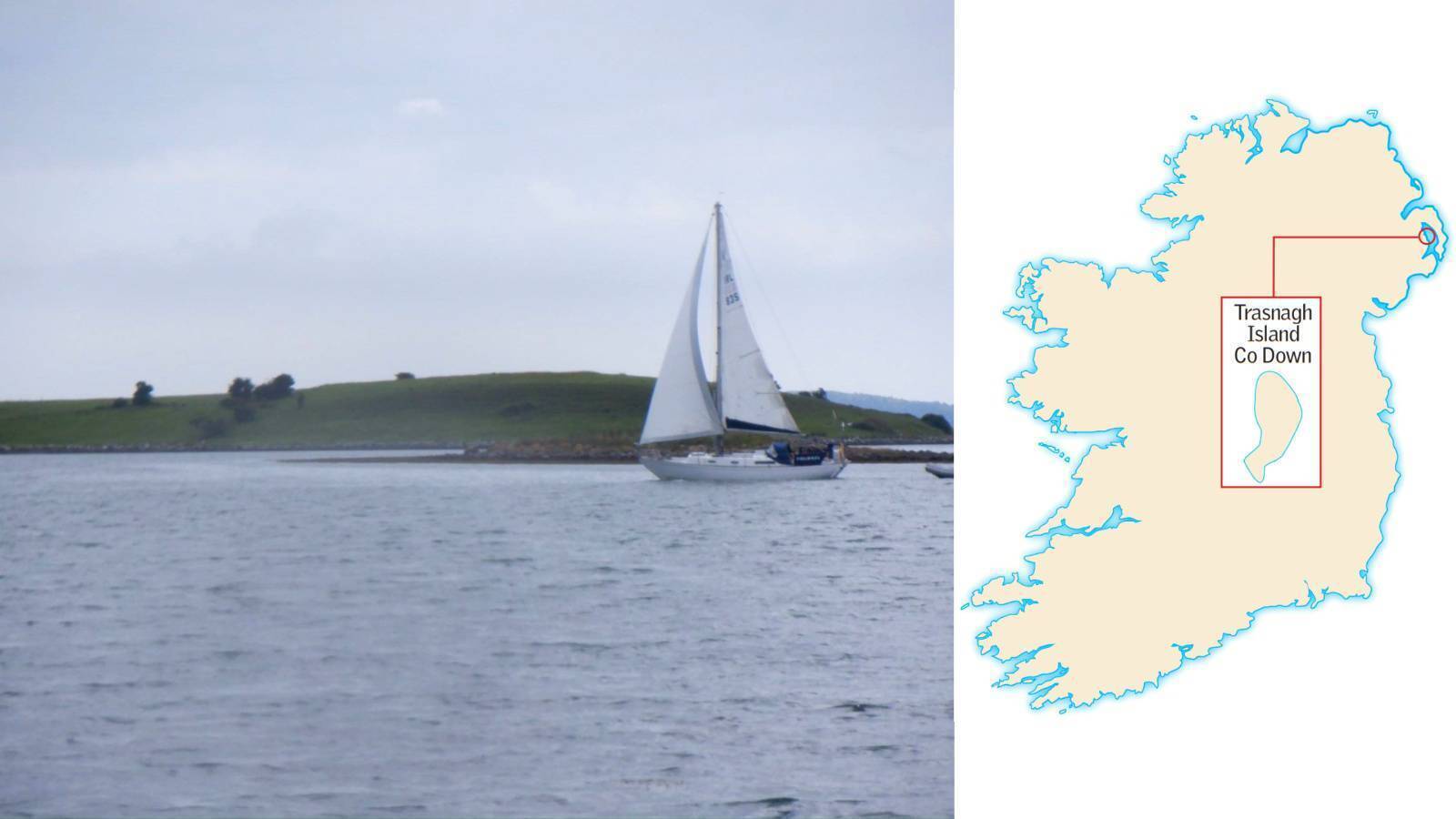
Trasnagh Island, Strangford Lough, County Down. Picture: Dan MacCarthy
The Annals of the Four Masters has a much more colourful explanation for the geographic origins of Strangford Lough in the North than the prosaic geological textbooks inform us. The latter are correct, of course: the lough’s supposed 366 island (an exaggeration that merits comparison with Clew Bay’s similar claim) were formed by retreating glaciers at the end of the last ice age about 12,000 years ago. And like Clew Bay in County Mayo, they left behind hundreds of islands peeping above the surface comprised of their stony deposits, and sometimes storied deposits.
The medieval manuscript on the other hand relates how at Loch Cuan (original Irish name) in 1654BC “an inundation of the sea over the land at Brena which was the seventh lake eruption that occurred in the time of Parthalon and this is named Loch Cuan”. This did not occur any more than the Earth being formed in 4,004 BC did as surmised by the 17th century Bishop of Armagh James Ussher according to his interpretation of the Book of Genesis.
However, it is likely that some sort of inundation did occur around 1,654 BC which formed the basis of the Strangford Lough theory. The name Strangford relates to the Viking word for ‘fjord of the strong current’, Strangfjörthr.
Cattle Move to Trasnagh Island on Strangford Lough https://t.co/560E2UEilK pic.twitter.com/4V1wvVFYo9
— AfloatMagazine (@AfloatMagazine) January 19, 2020
Trasnagh Island is located near the western shore of the lough just above the midway point near the village of Killinchy. At 24 acres it is one of the largest islands on the lough, though there are several much larger ones. It has about a dozen near neighbours including Bradock Island, Inishanier, and Drummond Island where population over the years has always been almost non-existent.
Trasnagh is virtually treeless and possesses a fairly flat topography which generations of shelduck are known to frequent and are a standout avian feature there.
The island is uninhabited today but once supported a family of 13 people who occupied a house that can be seen on the old Ordnance Survey maps. By the 1840s, with the arrival of the Famine, the Patton family was dispersed with some emigrating to New Zealand. The name is prominent in New Zealand to this day with many businesses of the name trading.
A project commenced four years ago saw a small herd of Scottish Highland cattle brought to Trasnagh Island. It was the first time cattle had been grazed on the island in more than 70 years. The cattle were brought ashore to Trasnagh to avail of the ample grazing there in a project supported by the National Trust. A carpet of luscious green grass awaited them.
An video shows the animals curiously disembarking the cattle carrier before being dispersed along the shoreline towards the pasture. The island’s owner John McCann told afloat.ie at the time that the Scottish Highland cattle were joining 10 Highland cattle, 50 ewes, four Suffolk ewes with baby lambs, and two goats. Hay storage barns and other buildings were also built as part of the project.
Like dozens of other islands, Trasnagh went through myriad changes to its name. First recorded in the 12th century as Trasne it mutated through Trashnagh-iland, Tranagh, Irasnagh, and Transnaugh according to the Northern Ireland Placename Project which is the corresponding body to logainm.ie here. Its Irish name is Oileán Trasna. Transverse Island or Cross Island indicating it may have been a staging post for fishermen or others intending to cross to the eastern shores of Strangford Lough.
In company with several islands around the coast such as Sandycove Island, near Kinsale, County Cork, Trasnagh is a focal point for swimmers who frequently circle its shores from Whiterock just outside Killinchy and less than a kilometre from the island.
And also in common with many islands, Trasnagh is a focal point for local regattas which have taken place in its waters for more than a century. And finally, in a West Cork connection, Lough Trasnagh is the Irish name for Roaringwater Bay.
: Kayak from Whiterock Bay, just east of Killinchy, County Down.
Seek permission to land as Trasnagh is privately owned.
The Irish Naturalist, 1893
CONNECT WITH US TODAY



Be the first to know the latest news and updates