Islands of Ireland: Kerry's muddy Derrymore is very valuable on a global scale
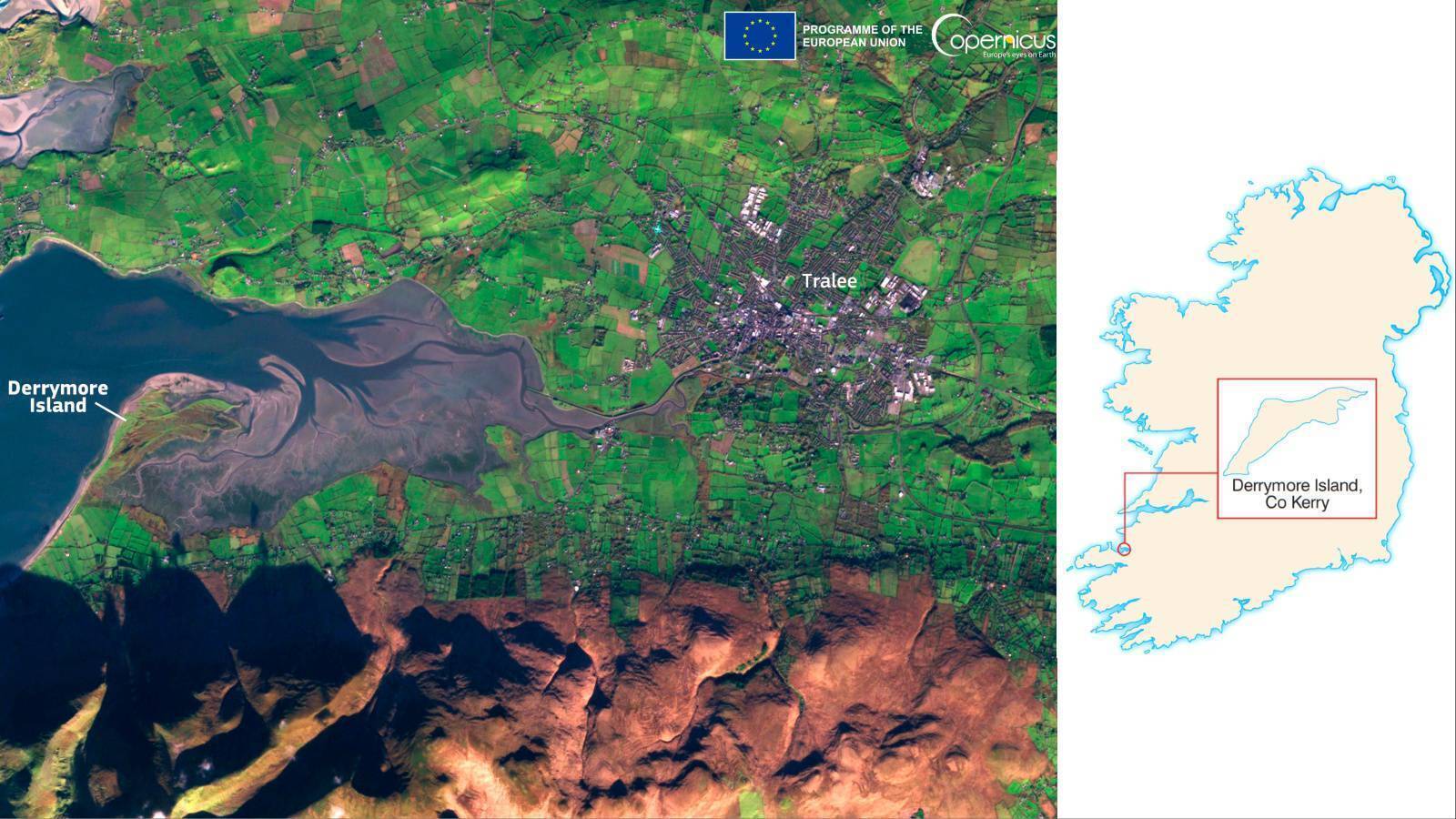
Islands of Ireland: Derrymore Island, Tralee Bay, Co Kerry. Picture: European Union, Copernicus Sentinel-2 imagery
At first, it seems a fairly inconsequential sight: an extensive island defined by its flatness more than anything else. This is Derrymore Island, just west of Tralee in County Kerry. There are better-known islands in the vicinity of Tralee Bay — most notably Samphire Island Little with its beautiful lighthouse, and Fenit Island with its fabulous walks.
On the road west past Blennerville, Derrymore Island, about 1.5km in length, barely merits a look, so unappealing does it seem at first glance. It lies well below the main road adjacent to the eponymous townland. ‘Derrymore’ translates as ‘Big Oak Wood’ and evokes an era of plentiful native woodland thronged with birdlife. Now just a few patches of the mighty wood remain.
Derrymore Island on a recent visit was awash with flamboyant pops of colour from the likes of Sedum acre (Biting stonecrop), Thymus polytrichus (Wild Thyme) & Galium verum (Lady's bedstraw) & many other fantastic coastal/salt marsh sp. @BSBI_Ireland @BSBIbotany #wildflowerhour pic.twitter.com/IYkOwjt0n6
— Jessica Hamilton (@Jessica_Ham92) July 7, 2019
However, bereft of trees as it may be, the island is still a significant player in the ecological life of the area. There is a degree of connection via saltmarshes to the mainland; and here again we find a topographical clue to the terrain as that place is named Bealathaleen Creek (Béal a tSáilín, the Mouth of the Little Creek). The island presents a long flank to the western part of the bay and is much scraggier to the east where tidal movements and streams have created a fractured network of mud islands: some decreasing, some growing as the tidal whims dictate.
The island comprises part of Tralee Bay Nature Reserve and according to the National Parks and Wildlife Service is a haven for pale-bellied Brent geese which feed on the eelgrass and green seaweeds from October to April. A range of species spotted thereabouts including turnstone, ringed plover, dunlin, redshank, bar-tailed godwit, golden plover, and curlew.
Derrymore Island recently came to the attention of the EU’s Copernicus programme which is a component part of the European Union’s Space programme which studies the planet with a view to benefiting all European citizens. Copernicus focuses on global areas and gives a snapshot of ecological and topographical conditions. Two weeks ago it looked at Derrymore Island. Previous studies have been of the Horn of Africa; Antarctica and the Bay of Bengal.
#ImageOfTheDay
— Copernicus EU (@CopernicusEU) November 30, 2023
Coastal wetlands could be an ally in the fight against #ClimateChange
This #Sentinel2 image shows the salt marshes of Derrymore Island 🇮🇪, where scientists from @ucddublin are studying the mechanism by which this valuable habitat removes #CO2 from the atmosphere pic.twitter.com/201M7bdySC
In the light of the recent Cop28 summit in Dubai with the focus on global warming it was a timely reminder of the value of such wetlands. Copernicus stated: “In the fight against climate change, the emphasis often falls on the significance of planting trees, yet coastal wetlands also play a vital role in carbon capture, outperforming even tropical forests. Derrymore Island marshes, nestled amidst the Atlantic waves in Ireland, stand as a natural carbon sink — a subject of intense scrutiny by a team from UCD.”
The EU body went on to state how the marshes have a unique quality where their grasses which are saturated by saline water have a reduced chance of decomposition therefore retaining captured carbon within the soil.
"Salt marshes are a tidally inundated habitat, so they're low-lying, and the plants that live here need to be able to tolerate the salty conditions and also the waterlogged conditions, that actually make salt marshes good at storing carbon," UCD coastal wetland ecologist Grace Cott, told Copernicus.
Ireland has 100km sq of saltmarsh habitats which based on estimates could store up to 2.5m tonnes of carbon with about 21,000 tonnes of carbon being sequestered every year. These rates are conservative estimates and given their particular characteristics, it is possible that Irish saltmarshes store significantly more carbon, making them potential hotspots for carbon storage, said Cott.
Related projects to the UCD-led wetlands initiative including peatland rewetting in the Netherlands and a seagrass lagoon development in Venice showing that previously neglected regions can make a huge contribution towards reducing greenhouse gases. The knock-on effects of enhanced wildlife habitats are also huge.
High above the coastline where Derrymore Island lies two huge mountains loom: Baurtregaum at 819m and Caherconreen at 835m which are the highest mountain in the Slieve Mish range. The Derrymore River rises here before carving its way to the sea at the island.
: 6km outside Blennerville, County Kerry. Can be walked to at low tide.

CONNECT WITH US TODAY



Be the first to know the latest news and updates