Richard Collins: 22 wildcats released in Scotland and 60 more planned
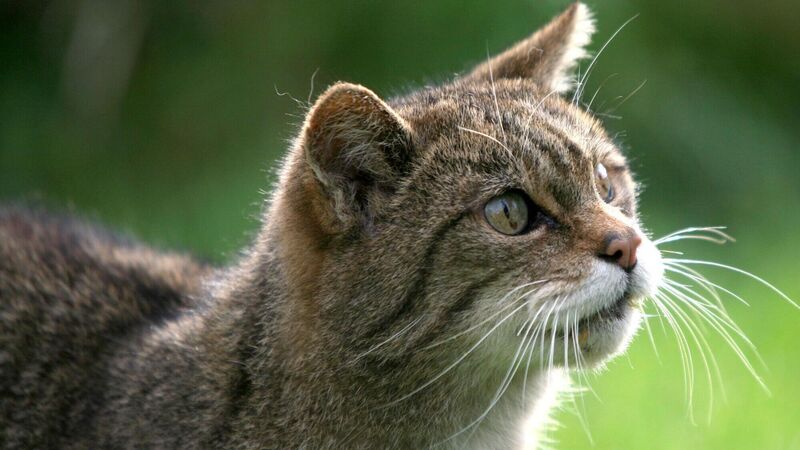
Wildcats are to be released in Cairngorms National Park this summer after a new licence application from a conservation group was approved
The slogan ‘Touch not a cat bot a glove’ appears above an image of a Scottish wildcat on the Clan Macpherson emblem.
Don’t mess with a cat whose claws are unsheathed, it warns.
There are captive-bred ones at the Highland Wildlife Park in the Cairngorms. On a visit there, I asked their keeper what would happen if I petted a particularly cuddly one. "Go ahead," he said, "and I’ll take you to the hospital afterwards to have your hand sewn back on".

I had failed to see this rare mammal in the wild. A park warden reported noticing one cross a road many years previously. A scientist had seen only those he trapped for his research. What hope of encountering a wildcat had this misguided idiot from Ireland?
The ‘highland tiger’ resembles a stocky domestic tabby. Its thick bushy tail, which features prominently on the Macpherson clan logo, doesn’t ‘taper’ like a domestic cat’s, but remains thick down to its black tip. The rings on the tail are the definitive field-mark.

But the wildcat has a problem; it can’t resist the illicit sexual advances of its domesticated cousin. If ‘the wages of sin is death’, it’s the wildcat gene-pool that is dying. All individuals tested recently have been hybrids.
Some zoologists consider the species to be ‘functionally extinct’ in Scotland.
Repentance and mending the cats’ wicked ways are not an option, but all may not be lost; moves are afoot to restore the wildcat population to its ancestral purity. The Highland Park is one of eight institutions engaged in a captive breeding programme.
Scottish wildcats have been released into the Cairngorms National Park 🐈.
— Scottish Government Nordic Office (@ScotGovNordic) June 15, 2023
Known as Highland tigers, they are Scotland’s last remaining native cat species.
We're proud to support this project which draws on global conservation expertise.
Find out more➡️ https://t.co/qMFykAAlEA pic.twitter.com/o8Bd5gk2Ac
According to a BBC report, the first of 22 captive-bred wildcats have been let loose, at secret locations, in the Cairngorms. All going well, about 60 others will join them over the next three years. GPS devices will enable their progress in the wild to be monitored.
How will the pampered pussies cope with the trials and tribulations of life in the big bad world? With no feline Ne Temere Decree to keep the gene-pool pure and wholesome, will they avoid sinning in one-night stands with domestic cats they encounter? Poor John Knox would be apoplectic!

A feline equivalent of the Belfast ‘peace line’ offers hope by providing a degree of segregation. Wildcats like to live in remote well-covered woodlands, whereas feral domestic cats prefer open grassy habitats near human habitation. By carefully choosing release locations, the two communities may be kept sufficiently apart that enough pure-bred wildcat kittens are produced to save the species from extinction.
Wildcats once roamed much of Europe — but were they ever in Ireland? Hares, badgers, and stoats got here over the land-bridge at the end of the last Ice Age. Surely wildcats managed to do so as well.
Robert Francis Scharff, in a 1905 paper entitled The Wild Cat in Ireland, maintained that references to cats in Irish folklore "are so authentic that I do not think the fact that the wildcat was here can any longer be in doubt". But his opinion was not shared by later commentators. Old stories about cats, they argue, probably referred to the pine marten, the ‘marten cat’, known in Ireland as the 'cat crann'.