Richard Collins: Study on childhood trauma in gorillas and chimpanzees
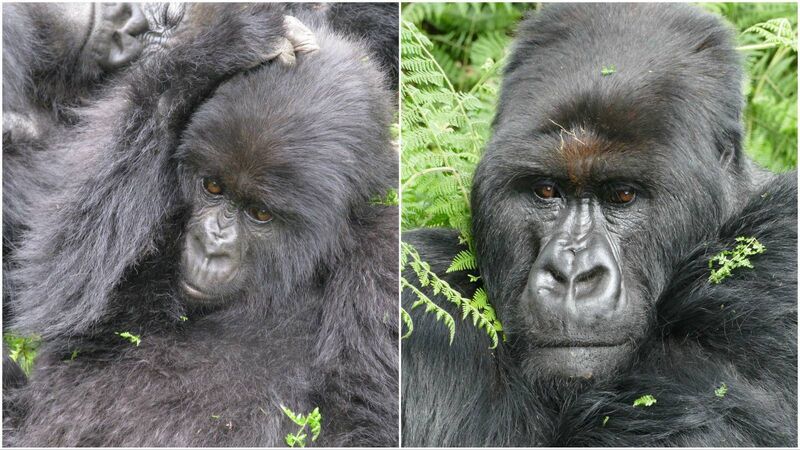
Segasira (shown as a youngster on left) lost his mother and father before the age of 4 but has recently established himself as the leader of a group at the young age of 17. Picture: gorillafund.org / Dian Fossey Gorilla Fund
Between October 1944 and May 1945, the German occupiers cut off food supplies to the western Netherlands. Between 18,000 and 22,000 people died during what became known as the Dutch Hunger Winter. There were also long-term effects. Children of women who were pregnant during the famine developed diabetes, obesity, and heart disease later in life. Grandchildren, in turn, were smaller at birth and more vulnerable to illness.
"The negative effects of early life adversity have been documented in a wide range of species from fish to birds to humans," note the authors of a paper just published. Researchers at the University of Michigan say that wild creatures, traumatised as youngsters, tend to have reduced life expectancies and produce fewer offspring. However, the effects of ‘early life adversity’ are complex.
Experiencing stress, for example, makes young animals streetwise: nature can be cruel in order to be kind. Wolves and big cats seek out vulnerable calves when targeting herds. It seems nasty to us, but culling the weaker members benefits a herd in the long run. This ‘viability selection’ ensures that the fitter individuals survive and go on to breed.
Our nearest relatives, the chimpanzees and gorillas, are sensitive souls with emotional needs broadly similar to ours. It might be expected, therefore, that those of their youngsters who experience childhood traumas, would exhibit Dutch Hunger Winter symptoms. Chimps raised in captivity are prone to neurosis, but this might be due mainly to their artificial environment.
Are primates growing up in the wild equally vulnerable?

In 1967, the Diane Fossey Gorilla Fund established a database which has been maintained ever since. Observations on more than 400 mountain gorillas, living in Rwanda’s Volcanos National Park, have been recorded. The Michigan team studied the life-history records of 253 individuals.
Excited to share a cool new paper @DrRobinMorrison, @SavingGorillas & I have out in @CurrentBiology. Mountain gorillas who survive a variety of sources of early life adversity do not have shorter lifespans than those who had 'silver spoon' childhoods: https://t.co/FmUwr0maSI
— Stacy Rosenbaum (@stacylrosenbaum) May 15, 2023
Although the area is protected from poachers and loggers, and there is abundant food, a young gorilla faces many potential challenges. It might, for instance, lose one or both of its parents. Also, rival siblings may bully it, or infanticide resulting from adult conflicts may be witnessed. Some youngsters experience several such horrors, others encounter few.
Thrilled to share my paper with @stacylrosenbaum and @SavingGorillas just out in @CurrentBiology. We find that gorillas that experience early life adversity don't suffer the reduced later-life survival common in other long-lived mammals (including us!) https://t.co/KbtqHVgypG
— Robin Morrison (@DrRobinMorrison) May 16, 2023
The research results showed that the more traumas a young gorilla endured, the more likely it was to die without reaching the crucial age of six. However, if a gorilla managed to survive until then, the traumas of its early childhood no longer seemed to matter. Indeed, those that experienced three or more adverse incidents actually lived longest and produced more offspring. Longevity, particularly among males, was 70% greater, on average, than that of peers experiencing few early crises.

‘Viability selection’ helps explain this counter-intuitive result — with the weaker specimens eliminated, only the stronger individuals remain. Also, gorillas live in tightly-knit social groups. Losing a mother seldom leads to isolation; other gorillas soon fill the maternal gap. Bereavement "actually increases the time" a youngster spends near other gorillas after the loss of its mom and in particular the highest-ranking male, says lead-author Robin Morrison on the University website.
Gorillas, it seems, have more resilience against early life adversity than we have.