Richard Collins: Study shows fish can recognise their mirror image
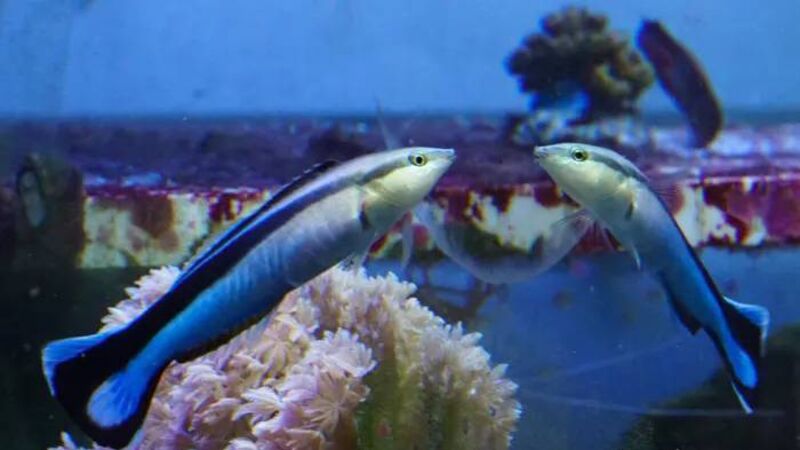
Cleaner-fish recognise self in a mirror via self-face recognition like humans. Masanori Kohda et al.
When it reaches the kitchen, the flesh of large animals becomes English version of old French words ‘porc’ ‘mouton’ or ‘boeuf’. Why do we replace the ancient terms ‘pig’ ‘sheep’ and ‘cow’ with these more polite ones? What do our elaborate table-manner rituals really signify? Are we trying to distance ourselves from the horrors of the abattoir?
Fish doesn’t trigger such guilt; penitents were permitted to eat it during Lent and on Fridays — nor does ’fish’ become ‘poisson’ at table.
A furry mammal isn’t ‘one of us’, but neither is it a mere ‘brute beast’. We regard our hairy companions as virtual people, with thoughts and feelings somewhat resembling our own. But fish, the primordial creatures from which all vertebrates are descended, are deemed not to be like us at all.
We don’t baulk at hooking them by the mouth and dragging them on lines from the water. Dumping fish from choking nets into the smothering dark holds of trawlers, gills heaving as they gasp for oxygen, doesn’t disturb many of us.
But do such victims experience distress or pain? Could these, apparently robotic, creatures have ‘minds’ or an awareness of self?
A paper just published suggests that fish have some remarkable mental faculties. Masanori Kohda, and colleagues at Osaka University, have demonstrated that some fish are self-aware.
In 1970, Gordon Gallop developed the ‘Mirror Self-Recognition Test’ (MSR). He placed marks on children’s foreheads. On seeing themselves in a mirror, children aged two or more searched immediately for the mark. They knew that the image in the mirror was theirs. When the test was applied to other mammals, great apes and Asian elephants were also shown to be self-aware.
But how to apply the test to fish? Working underwater with mirrors is messy. Despite the difficulties, a species of cleaner-fish was found to respond to seeing its image in a mirror. However, "any implications of self-awareness", the Osaka researchers say, "remain controversial" They developed an alternative approach using photographs.
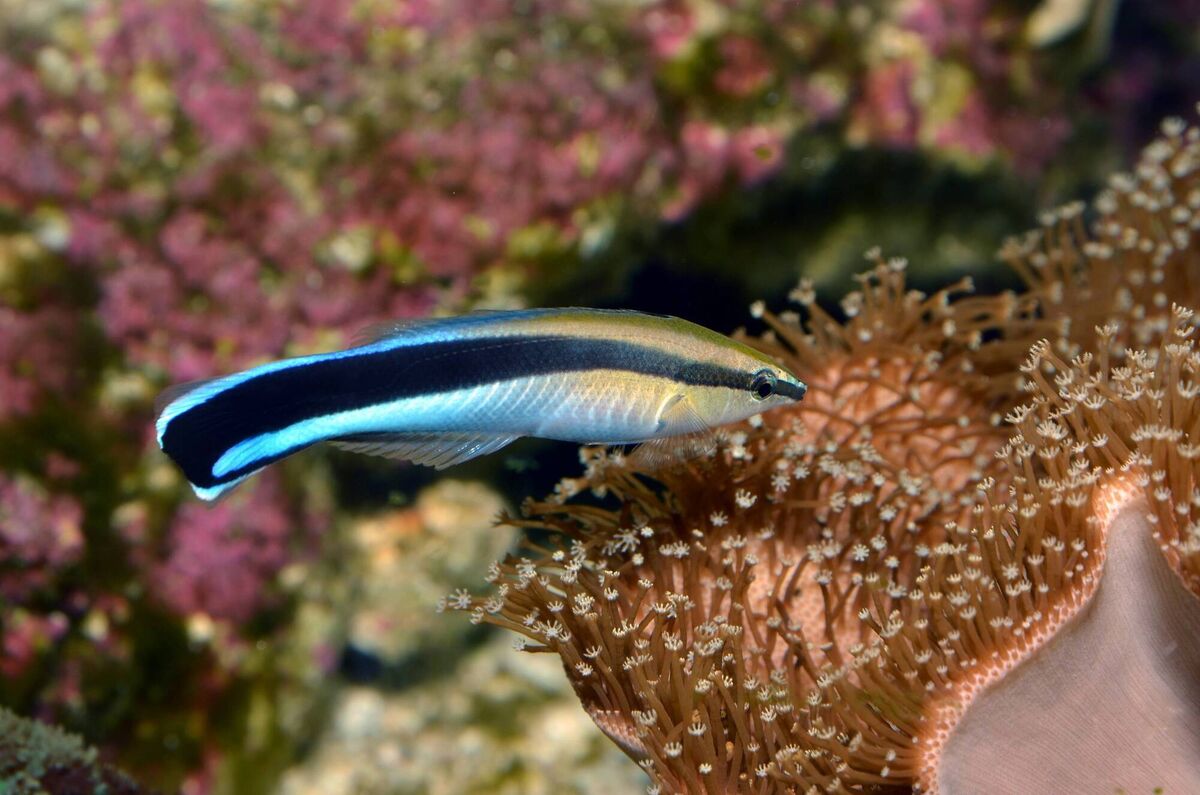
Cleaner-fish are territorial; an individual will attack an intruder of its own species venturing into its patch. When the team showed them photographs of fish, some cleaners attacked images of strangers, but not those showing themselves. When eight fish were presented with images of cleaners with a mark placed on the throat, six of them rubbed their throats against objects in an apparent attempt to remove the mark.
When shown photographs doctored so that the heads of other cleaners were superimposed on bodies, an individual would attack images of its own body bearing a stranger’s head. But it wouldn’t attack when its own head was on another’s body. The researchers concluded that self-recognition must depend on the face: "Our results suggest that cleaner-fish with MSR ability can recognise their own mirror image, based on a mental image of their own face, rather than by comparing body movements in the mirror."
They note: "Humans are also capable of having a mental image of the self-face, which is considered an example of private self-awareness."
It’s not a surprising result; we are, after all, just very precocious fish!
CONNECT WITH US TODAY



Be the first to know the latest news and updates



![<p> The International Union for the Conservation of Nature says that “an ecosystem is collapsed when it is virtually certain that its defining biotic [living] or abiotic [non-living] features are lost from all occurrences, and the characteristic native biota are no longer sustained”.</p>](/cms_media/module_img/9930/4965053_13_augmentedSearch_iStock-1405109268.jpg "<p> The International Union for the Conservation of Nature says that “an ecosystem is collapsed when it is virtually certain that its defining biotic [living] or abiotic [non-living] features are lost from all occurrences, and the characteristic native biota are no longer sustained”.</p>")
