Islands of Ireland: Spanish Island sees invaders, plunder, betrayal, and revenge
Locals once imprisoned their guests, stole 100 tonnes of their wine and distributed it in the town — however, there were consequences...
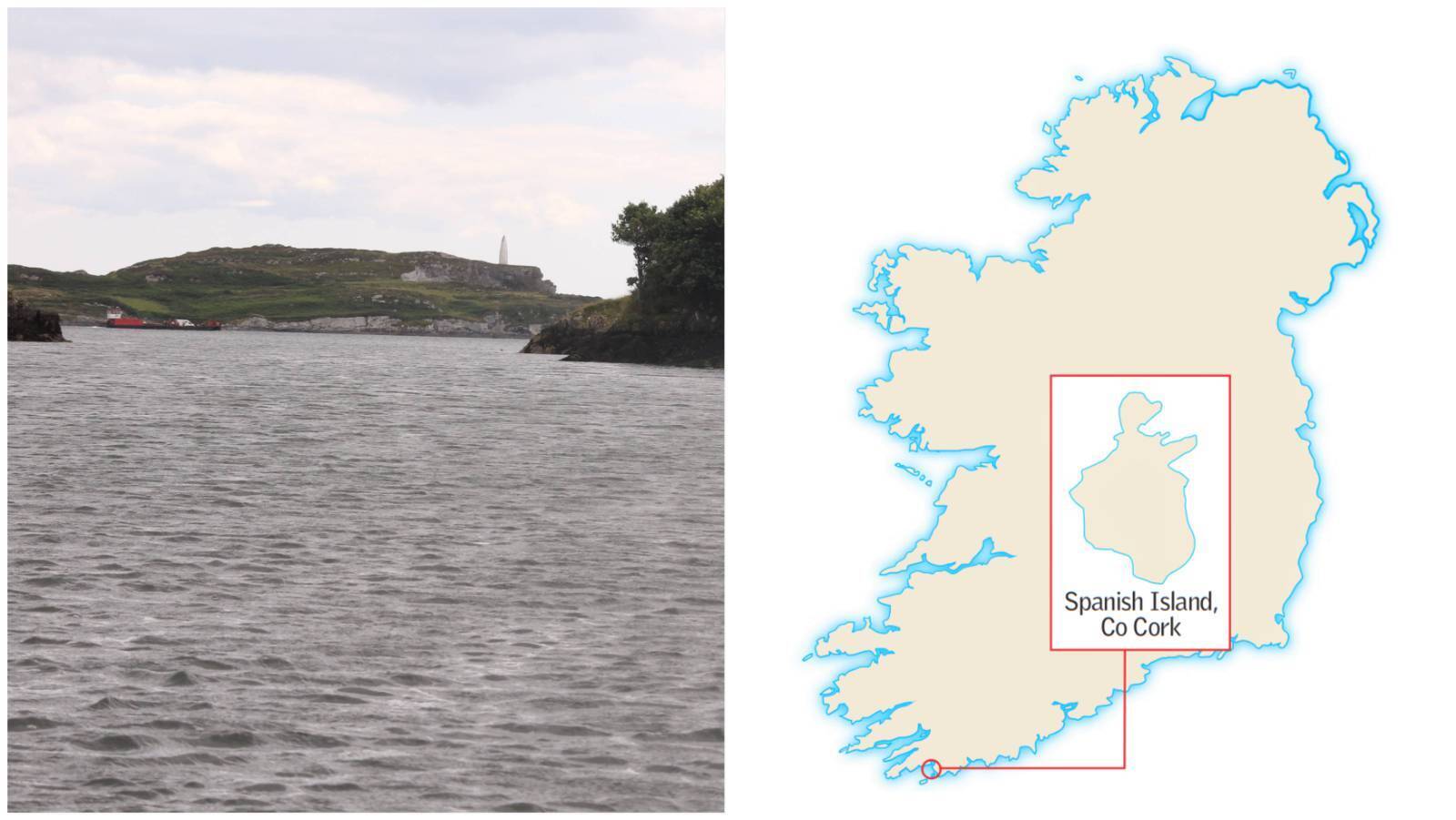
Spanish Island. Baltimore Harbour, County Cork with the Beacon in the distance. Picture: Dan MacCarthy

Spanish Island. Baltimore Harbour, County Cork with the Beacon in the distance. Picture: Dan MacCarthy

The scale of runaway vegetation comprising mostly fern and furze on Spanish Island in Baltimore Harbour, West Cork, makes it an unappealing destination for a ramble. If, for example, it was wooded, or had a nice sandy beach it would have far more appeal. However, its geographical location in the harbour saw it as a major site for the historic events that played out around it for a few hundred years.

This is one of at least three Spanish islands in the country (there are others at Kilmakilloge Harbour in County Kerry and in Connemara) and there are many coastal references in our maps to locations with the word ‘Spain’ in them: Spanish Point in County Clare, for example.


The 134-acre island had a population of 26 people in 1841 living near the channel, but that figure declined rapidly afterwards.

Just after the Battle of Kinsale in 1601, the island was known as Inispicke (1607), and by 1655 it had become Enispike with an alias of Spanish Island. By 1811 it was Spain Island (there is also a Spain townland and tower in Baltimore) before reverting back to Spanish Island. It is known locally as Inish Bhreac and also as Green’s Island. Other names include Inis Picte which has been suggested to mean Pict’s Island, and Inishspite.

The best explanation for the Irish name is by the botanist, John Akeroyd, writing in Sherkin Comment who explained that the ‘stripe’ from the Inish Bhreac reference refers to its rock formation of the Upper Devonian period of 350 million years ago and which is visible in aerial views.

Spanish Island. Baltimore Harbour, Co Cork with the Beacon in the distance. Picture: Dan MacCarthy

The Spanish reference is much fuzzier and may be attributable to one of several possible sources including Spanish ships involved in the pilchard industry. Other Spanish ships had been active in County Cork for hundreds of years culminating in the landing of Spanish troops in Kinsale in 1601 to help in the fight against English occupation. As part of this geopolitical manoeuvring, expeditionary parties were also landed in Castlehaven and Baltimore under a commander called Alonso de Campo. Spain took temporary control over the O’Driscoll castles on Sherkin, Baltimore and the ruins on Spanish Island. By 1602 these had been ceded back to the English.

The O’Driscoll castle on Spanish Island was located on the east of the island at Hackett’s Cove where it would have commanded the more easterly approaches to Baltimore. Not a trace remains of this castle today, unlike the other O’Driscoll castles which are in various states of repair. The castle was likely completely destroyed in another infamous attack in 1537. In that year a sequence of events played out that led to widespread destruction in the Baltimore vicinity. A Portuguese ship, 'the Santa Maria de Soci', bound for Waterford with 100 tonnes of wine for their Waterford customers took shelter in Baltimore Harbour from a huge storm. The mariners and merchants were initially wined and dined in Baltimore by the chieftain Finghin O’Driscoll. After contemplating the size of the potential booty, Finghin clapped his guests in irons and seized the wine before distributing most of it to the town.

Revenge was served cold.

Two weeks later an expedition from Waterford under the command of a Captain Dobbyn was launched. They recovered 25 tonnes of the wine. They returned again a few weeks later with 400 men and “the great galley ship of the city in Waterford” armed to the teeth. The O’Driscoll castle on Spanish Island as well as the one on Ringarogy Island were destroyed. Baltimore itself was also attacked. However, Sherkin Island bore the brunt of the attack. The O’Driscoll castle there was bombarded and most of the dwellings of the people on the island were torched in the vengeful rampage. The Franciscan friary was also burned.

Hackett’s Cove was the route by which the eponymous Hackett led a party of Algerian pirates to over-run what was by then the English colony of Baltimore in 1631 when about 100 of the citizens were abducted.

How to get there: No pier; baltimore.ie Or kayak from pier in Baltimore. Beware of low-tide sludge.

Other: Logainm.ie; Sherkin Comment, No 62, 2016; Sherkin Island: A local History by Dolly O’Reilly

More in this section

Revoiced

Newsletter

Had a busy week? Sign up for some of the best reads from the week gone by. Selected just for you.

Cookie Policy Privacy Policy Brand Safety FAQ Help Contact Us Terms and Conditions

© Examiner Echo Group Limited