Juanita Browne: Learn how to identify our amazing Irish dragonflies and damselflies
Dragonflies and damselfies are the 'jewels' of insects
Juanita Browne: Learn how to identify our amazing Irish dragonflies and damselflies

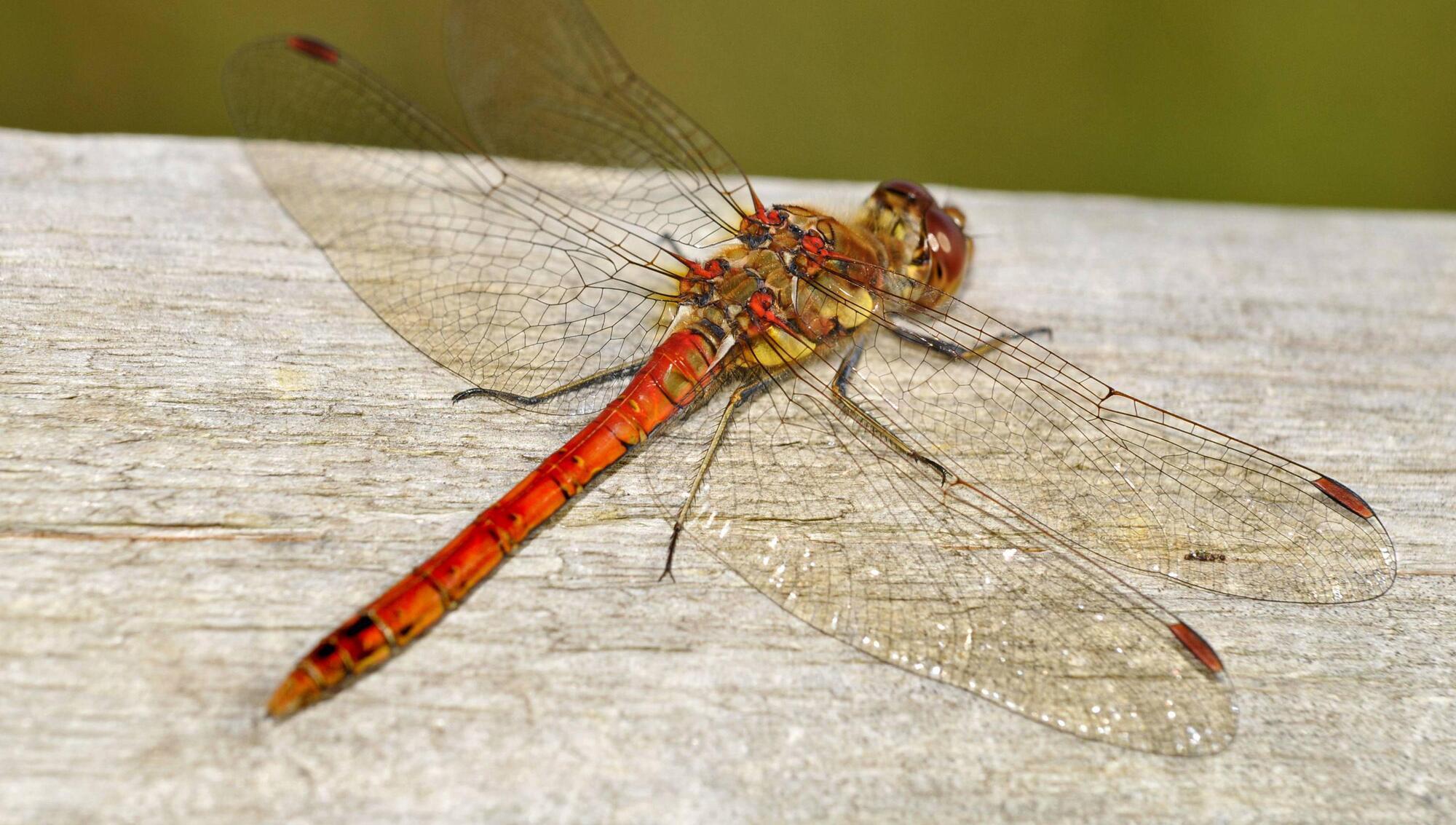
A close-up of a male Common Darter resting on a piece of wood. The wood retains the heat as the sun sets and dragonflies rest there for warmth.

If you visit a wetland between now and September, you should keep your eyes peeled for our ‘jewels’ of insects — the beautiful, brightly coloured dragonflies and damselflies.

These really are the most charismatic and intriguing of our insects. They have been around for 320 million years — both before and long after the dinosaurs disappeared. Their excellent body design — and engineer’s dream — hasn’t changed in all that time, except for their size. The largest dragonflies that once ruled the skies, before flying dinosaurs and birds, had a wingspan of 70cm, the same as a small hawk!

Dragonflies may have become smaller over the millennia, but both underwater and in the skies, these pretty little insects are actually fierce predators! The bottom jaw of the underwater nymph is said to have inspired the star of the film Alien — as it can shoot out to snare prey such as tadpoles and small fish.

A little known fact about flying dragonflies is that they are thought to be one of the world’s most successful predators! Researchers have found that dragonflies succeed 95% of the time when they chase their prey — tiny midges, moths and flies, while birds of prey only have a 20-25% success rate, and even lions only succeed in 30% of hunts! This is down to their flying skills and excellent vision — with those massive compound eyes and a head that turns independently of their body. They are truly masters of the air. Each wing can move independently of the other three, meaning they have no limitations in flight, being able to hover and even fly backwards. Robotics researchers have tried to copy dragonflies to create drones, but so far they have been unable to master such minute yet complex mechanics.

How do I hunt for dragons?

Some 33 species of the Order Odonata (dragonflies and damselflies) have been recorded in Ireland, while 25 are considered resident species, making it a manageable group to learn to identify. Dragonflies and damselflies are most often seen around ponds, streams, rivers and lakes, as they lay their eggs in water. Even a small garden pond will attract breeding dragons. Most species actually spend most of their lives underwater, many spending up to three years as underwater nymphs, before they grow large enough to emerge to begin their aerial life stage. The Golden-ringed Dragonfly spends five years underwater.

One super way to learn more about these insects is to take part in the Dragonfly Ireland 2019-2024 survey — an all-Ireland survey coordinated by the National Biodiversity Data Centre in the Republic and by the Centre for Environmental Data and Recording in Northern Ireland, and funded by the Environmental Protection Agency.

According to Dave Wall, manager of the Dragonfly Ireland survey, “there are three levels of participation. Dragonfly Spotter encourages the submission of casual sightings of any Odonate species. Dragonfly Recorder asks volunteers to conduct two timed surveys of a freshwater site, to record all dragonfly and damselfly species present and assess their habitat. Finally, Dragonfly Monitor asks volunteers to conduct a minimum of four surveys at their local site, and to repeat site surveys annually.”

The National Biodiversity Data Centre runs workshops to help train new biodiversity recorders, including these upcoming Dragonfly Ireland workshops:

· May 7: St. Joseph’s Community Centre, Kilcormac, Co. Offaly

· May 25: The Sports Pavillion, Tolka Valley Park, Dublin.

· May 28: Mohill Family Support Centre, Mohill, Co. Leitrim

· June 25: Sheskinmore Nature Reserve, Co. Donegal

· July 9: Belcarra Community Centre, Co. Mayo

· July 9: Tralee Bay Wetlands Eco & Activity Park, Co. Kerry

For more details on all courses, and to register, see biodiversityireland.ie/workshops/

If you can’t make a workshop, don’t worry. There are also lots of online resources to help, including an online Identification Course: biodiversityireland.ie/surveys/dragonfly-ireland/dfi_id_course/

More in this section

Revoiced

Newsletter

Sign up to the best reads of the week from irishexaminer.com selected just for you.

Cookie Policy Privacy Policy Brand Safety FAQ Help Contact Us Terms and Conditions

© Examiner Echo Group Limited