Damien Enright: Christopher Columbus, romance and murder in La Gomera
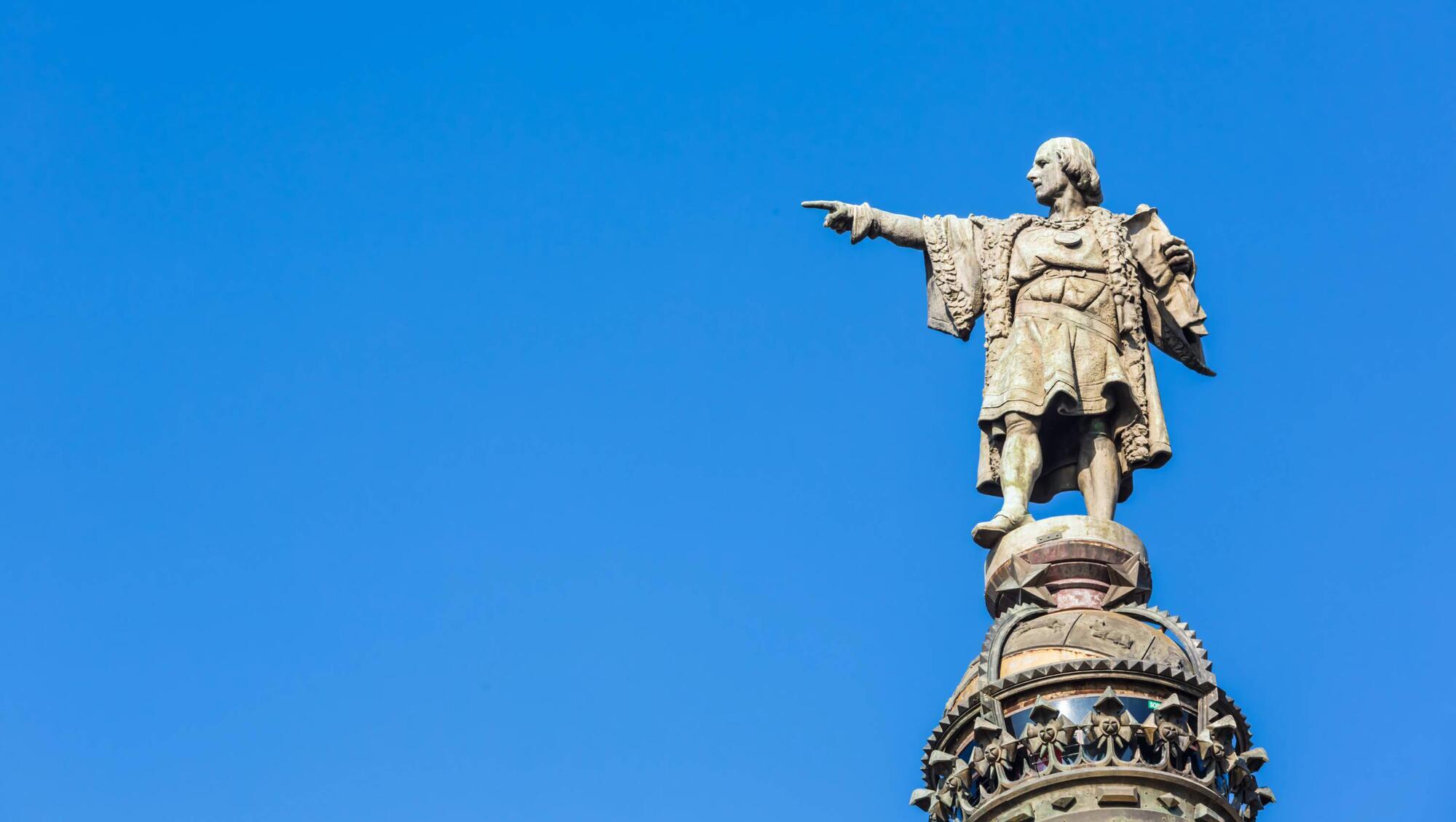
A statue of Christopher Columbus.
To the south of Tenerife, the Canary Islands resort, lies the small and very beautiful island of La Gomera. Too mountainous for an international airfield, it is still usually reached by ferries plying from Los Cristianos in Tenerife to the small capital and port of San Sebastian.
Christopher Columbus arrived in San Sebastian in 1492, the last port in the known world before the unchartered ocean. He came on the invitation of a young Castilian noblewoman, recently widowed, the Countess Beatriz de Bobadilla. Her husband, Hernan Peraza, had been the Count of La Gomera. Now, she ruled the wild island alone. Columbus made lengthy stops there on the first three voyages.
It was on La Gomera itself that I heard the story of Columbus and the young widow. On journeys across the island, I often passed through a place in the mountains, high above the port town, San Sebastian, where the road at last levels and enters the highland forests. I stopped there for a lunchtime tapa of goat meat now and then.
"Degollada de Peraza", as it is called, is not a place but a name on the roadside, no houses, no settlement but one large road-side bar. ‘Degollada' was not a word I knew at first. I assumed it referred to some landscape feature on Peraza lands. I was surprised to find it meant not Peraza's domain but Peraza's demise. 'Degollar', to 'execute' or 'behead', my dictionary says, so it meant the beheading of Peraza.
On my first visit, I bought a beer and strolled across the cool, tiled interior to the big windows opposite the door. I wasn't prepared for the surprise that met me. Outside, the ground fell dizzily away. Spread out below was a huge valley hidden from the road, a valley I had never known was there. On the slope opposite, long-abandoned terraces slipped like a patched cloak off the mountain's shoulder and fell in narrowing folds to the valley floor. There, ancient paths followed green contours under bone dry hills, supporting nothing but a few birds and lizards. Far away, the valley widened into a blue plain between massive escarpments framing the sea.
The longest memories are carried in song, ballads of a hundred verses. The history I heard in the Bar Degollada de Peraza was as much the history of Gomera's ancient Guanche people as it was of a passing Italian sailor and a countess. The story of Columbus and Beatriz de Bobadilla begins a few years before they met.
Peraza was a second-generation conquistador. As a young man, he inherited title to La Gomera. Unlike his uncle, the original conquistador, who lived in peace with the indigenous Guanche people, he broke the accords between them. And then, for some unknown reason, slaughtered the Spanish governor, a fellow conquistador, of nearby La Palma when he was unlucky enough to be shipwrecked on Peraza's shores. Murdering natives was one thing; eviscerating fellow conquistadors was another. He was called to Madrid to stand trial. There, Queen Isabella interceded to save him from execution by making a secret agreement that he would take her husband's young mistress, Beatriz de Bobadilla, as his wife and take her off to far-away.
Bobadilla made a good match for avaricious Peraza. Together, they rode roughshod over every accord forged by Peraza's uncle with the still unconquered native kings. The final straw for the Guanches was when Peraza singled out the thirteen-year-old Stone Age princess Iballa and seduced her. Iballa, the daughter of the great Hupalupa, ruler of the Valle Gran Rey, a vast green valley to the island's south, was betrothed to a neighbouring prince.

Bobadilla was a very beautiful woman, but the old songs record that the teenage Iballa far eclipsed her. Iballa, as a result of the tragedy that later enfolded, was to be the last princess of the Guanches. A fair skinned, fair-haired people, they inhabited the paradise islands, that had been rediscovered by geographers only a half-century before. The Berber tribes who had settled there from north Africa had forgotten how to make boats, presumably because there was nowhere they wanted to go. Today, the people of the Gomera highlands are still rich in Guanche blood. They preserve a whistling language which is unique on earth — not a convention of signals as one would use with a dog but an articulated tongue in which conversations may be held across the abysses of the deep valleys.
When Hupalupa heard of Peraza's despoliation of his daughter, the vessel of peace was broken for good. Off the shore of Valle Gran Rey stands a rock to which the ringleted Gomero boys and girls still swim out today. It is called the Baja de Secreto, the Reef of the Secret. There Hupalupa and Iballa's betrothed made their plan.
On the night of November 20, 1488, they crossed the island with their men and surrounded the cave in which the Count and Iballa were making love. Iballa heard the whistled exchanges between her father's men – exchanges which Peraza, although he had spent most of his life on the island, couldn't understand – and tried to warn him but, surrounded and lost on a mountain side, he ran onto the Guanche spears. It is ironic that the only full sentence of Guanche still extant was uttered by Iballa trying to save the life of the rapacious foreigner. "Run," it goes, "fly, they are climbing by your path...". It is repeated in the chanted 'canciones' of the island.
After the execution, Hupalupa marched on San Sebastian, intent upon driving the Spaniards into the sea. However, Bobadilla, with or without husband, was a formidable woman. Pausing only long enough to dispatch a caravel for help, she carried her children to the tower, stocked to sustain the tiny Spanish population through a siege. When the caravels came and the new-made widow emerged again into the sun, it was to wreak a terrible vengeance on the Guanches. Afterwards, there were no more Guanche princesses or kings.
Before supplies in the tower ran out, the powerful Pedro de Vera, Governor of Gran Canaria, sailed into San Sebastian with a large force of men. The Guanches, armed only with stone weapons, were routed. Hupalupa is said to have escaped by swimming to Tenerife, then still free. Bobadilla, pressing advantage, pursued his routed people to every corner of the island. Men, women and children were murdered, drowned or mutilated. Those that survived were sold as slaves.
Columbus probably met Bobadilla for the first time in 1490 at the court in Castile where she had been summoned from Gomera to answer charges of slavery and genocide against her subjects. By grace of Queen Isabella, the Guanche survivors were ransomed into freedom and returned to La Gomera. Bobadilla, from a powerful family, was admonished but reinstated.
When she and Columbus met, he would have been a man of 46, strong, healthy and not long a widower. She was a Contessa, far above him in status, but woman of her times and not one to languish in mourning for long. There might be business to be done if the handsome Italian were to visit her on his outward voyage in search of a route to the Indies. The island, the scene of murder and savage repression only a few years before, was hardly a place where Columbus, driven by the urgency of dreams and aspirations, would have wasted time but for Bobadilla's charms.
The nearby islands of Tenerife and La Palma were still unconquered. San Sebastian, comprising the small, fortified tower, a church and a few simple houses, was a thousand miles south of Cadiz, the last harbour in the Spanish world. Behind, lay a largely impassable and dangerous hinterland. For the all-but-exiled young countess, the company of the cosmopolitan and inspired Italian, straight from the court, must have been blessed relief from petty colonists, sweating soldiers and her whistling, neolithic subjects. Later, she married the most powerful governor in the islands. It is ironic that her vicious past is often forgotten, although not in La Gomera. It was her liaison with Columbus, and the part she played in equipping him for the colonisation of the New World, that earned her a vivid line on history's bloody page. Today, the tower that saved her life is still in use, the oldest building in the Canary Islands. The sea that once almost surrounded it, has drawn back. The tower stands marooned in what is now a pleasant park.
The people closest in blood to the Guanches, once rulers of all the Canary Islands, still live in the highlands above the Valle Gran Rey. Over the centuries, they have cut mountains into terraces, harnessed water from the forests and made gardens of the valley sides. Where they live by the coast, they swim like fish in the sea. In 1492, when Columbus first visited the half-wild islands, the Spanish practice of colonisation and Christianisation, slavery-and-God or death-by-the-sword was in full swing. As he and the widow sat together, or lay together, in the tower lapped by the sea at San Sebastian, it is hard to believe that Columbus could not have imagined the tragedy soon to befall the blameless peoples of his New World.