‘I consider myself one of the very, very lucky ones’

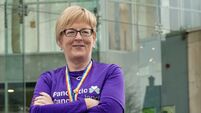
Elaine O'Callaghan: 'I know I’ll never be ‘in the clear’ — I’ll be having the scans for the rest of my life. Pictures: Alf Harvey
For Cork woman Elaine O’Callaghan, a scheduled eye exam on a Thursday inSeptember 2018 was the start of a frantic weekend culminating in a cancer diagnosis on Monday.
“I had a routine eye examination at Specsavers in Portlaoise, my two-year check-up. During the exam, the optician asked me if there was anything bothering me, and I mentioned a ‘flicking’ sensation in my right eye. She suggested I get an OCT [optical coherence tomography] scan, which she was able to do there and then.”
Once the optician had reviewed the scan, she advised O’Callaghan to make an urgent appointment at either a hospital in Dublin or the Whitfield Clinic in Waterford.
Although she works at Pfizer in Dublin and lives in Portarlington, O’Callaghan opted for the Waterford clinic. “My dad had attended that clinic for treatment of macular degeneration, so I was familiar with it, and I thought I could take a half day and make a nice afternoon of it”.
On arrival at the Whitfield the next day, the 55-year-old was immediately ushered in and underwent further scans. The tests revealed she had a detached retina, but the cause wasn’t immediately obvious. She needed an MRI.
At this stage, O’Callaghan called her sister Olivia, a naval nurse working in Haulbowline in Cork.
Doctors told her she had a tumour in her right eye, an ocular melanoma. “They said they couldn’t treat me in the Whitfield, so I would need to go to the Royal Eye and Ear Hospital in Dublin, and see ophthalmologist Mr Noel Horgan — the only doctor in Ireland that deals with this type of cancer.”
Although ocular melanoma is a rare cancer, affecting just five in 10,000 people in Europe, Ireland has one of the highest rates of ocular melanoma in the world, with about 50-60 diagnoses each year.
“Countries in Northern Europe — Ireland and Scandinavia — have higher rates of ocular melanoma. While the exact reason isn’t known, it seems to be more common in blue-eyed people with a fair complexion or skin that doesn’t tan well,” says Mr Horgan, an ocular cancer specialist.
That weekend, the family home in Cork was “mayhem”, a flurry of “Dr Google searches”, as O’Callaghan, her sister Olivia, and her parents tried to understand what was happening. On Monday morning, she received word Mr Horgan could see her at 2pm.
“My sister and I drove up to Dublin, where Mr Horgan confirmed the diagnosis of ocular melanoma.”
Mr Horgan explains there are a couple of warning signs for this type of cancer. “Some people may present with a shadow in their field of vision; some will present with something like flashing lights in their vision; some may present with reduced vision; and then some people may be picked up incidentally when they go to their optician.”
The treatment is as unique as the cancer itself. “The most common treatment is brachytherapy. It’s
targeted radiation that’s delivered by a device that’s surgically placed on the eye,” explains Mr Horgan.
A month after her diagnosis, O’Callaghan attended St Luke’s Hospital, the only place in Ireland offering this type of brachytherapy. In theatre, O’Callagahan explains Mr Horgan sewed a small plate “like the top of a Coke bottle” onto the tumour. The plate contained “radioactive seeds”.
This radioactive plate stayed in place for 10 days, slowly releasing radiation to kill the tumour cells.
Mr Horgan explains targeted radiation is an effective treatment for ocular melanoma. “In 95% of cases, this type of radiation is successful at reducing the tumour and preserving the eye, depending on the location of the tumour,” he says.
O’Callaghan was in a dedicated ward at the hospital, along with three other patients who called themselves “Patches” because of the eye patches they had to wear. “The four of us were in this situation together, relatively isolated because of the radioactive plaque, so we formed a strong bond.”
After 10 days, O’Callaghan returned to the theatre for the plate to be removed. She was then discharged with detailed aftercare instructions and long-term follow-up plans. Although her eye was preserved, O’Callaghan has experienced a gradual decline in the vision of the affected eye.
This is one of “the collateral effects of the radiation on those critical structures”, explains Mr Horgan. “We do everything we can to preserve as much vision as possible. Our goal is to treat the tumour, control the tumour, reduce the risk of metastatic disease, save the eye when we can, and then reduce the risk and maintain as much vision as possible.”
With ocular melanoma, there is a risk it can spread to other areas of the body, most notably the liver, says Mr Horgan. This is why he referred O’Callaghan to oncologist Prof John Crown in St Vincent’s Hospital, Dublin, where she has regular liver scans. Initially, the scans were every three months, but now, eight years post-treatment, they’re annual.
Although O’Callaghan considers herself “one of the very, very lucky ones”, she experiences deep anxiety every year ahead of her scan. “I know I’ll never be ‘in the clear’ — I’ll be having the scans for the rest of my life.”
She also carries “survivor’s guilt”, as two women in the original Patches group have since passed away.
But O’Callaghan makes a point of focusing on the positive — she set up a cancer support group at work, bringing together people like her who have experienced cancer.
- The Irish Cancer Society’s annual fundraiser, Daffodil Day, is today, March 20


CONNECT WITH US TODAY



Be the first to know the latest news and updates