Life with epilepsy: 'It looked like my daughter was having a stroke'
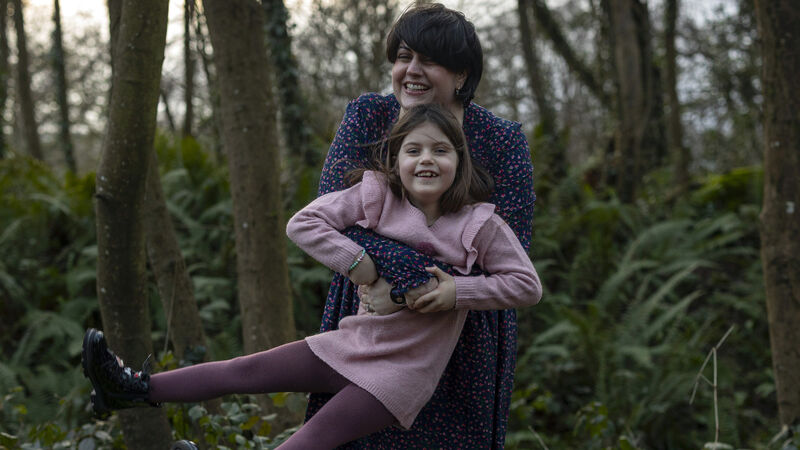
Aisling Allan and her daughter Bonnie, who was diagnosed with epilepsy. Picture: Clare Keogh
ON September 29 last year, Aisling Allan and her husband Seán waved their three children Áine May, 12; Aindriú, 10; and six-year-old Bonnie off on the bus to the gaelscoil in Carrigaline.
Shortly afterwards, Allan received a text from Áine May saying that Bonnie was ill, and she went to the school immediately.
As soon as she saw her daughter, she knew something was seriously wrong.
“She had her head down, and she wasn’t speaking very much … and she was drooling a lot,” says Allan, who is a primary school teacher.

When Bonnie tried to stand, the left side of her body began seizing.
“Her face started to twitch, and it looked like she was having a stroke,” says Allan.
“From her head to her toes, one side of her body was seizing. I panicked and started shouting.”
An ambulance was called, and the school staff took care of Allan and her daughter while they waited.
“They kept everything so calm … they drew all the blinds because obviously her siblings were upstairs, and they could have seen [what was happening].”
The ambulance crew administered anti-seizure medication via nasal spray before transferring Bonnie to Cork University Hospital. During this time, Allan feared the worst.
"I thought I was going to lose my little girl, my baby. It was just horrendous.”
When the seizure continued, the ambulance had to stop to call an emergency doctor. The doctor administered a higher dose of medication intravenously to bring the seizure under control.
In the hospital, doctors brought Bonnie’s temperature up by wrapping her in a foil blanket used to treat hypothermia.
It was a couple of hours before she came around, and Allan praises the hospital staff and healthcare workers for their care and kindness during this time.
“It was just all really child-friendly and so lovely and gentle. In the chaos, they kept it so calm,” she says.
Doctors ran numerous tests, including an electroencephalogram (EEG), to understand what had happened to Bonnie. After two days, they confirmed it was epilepsy.
A video Allan had recorded of the seizure helped them make their diagnosis.
“I didn’t know it was a seizure, I just said I’d record it. That’s a really important message that I want to get across to people, because it really helped the neurology team to figure out what was happening,” she says.
Treatable and manageable
About one in 200 children will develop epilepsy. It can develop at any age, with more than 60% of children outgrowing the condition.
“Epilepsy is usually defined as a brain condition which leads to multiple unprovoked seizures,” says Dr Niamh Lynch, a Cork-based paediatric neurologist.
“Unprovoked means that the seizure has not been triggered by anything, for example, low blood sugar, high temperature, or illness.”
Receiving the epilepsy diagnosis eased Allan’s worry.
“I felt [relieved] that it wasn’t something worse, because epilepsy is treatable and manageable.”
Bonnie was prescribed medication to help control the seizures, and doctors advised it might take several months to find the right dosage.
She has had seizures since leaving hospital, but the medical team are easily reachable and quick to respond.
“The support has just been unbelievable,” says Allan.
Taking tablets daily has been an adjustment, but Bonnie has adapted to it. “She’s amazing,” says Allan. “She knocks them back … then she gets on with it.
“Kids are just so resilient.”
The signs of epilepsy vary according to the condition type, and it does not always involve loss of consciousness or shaking of the limbs.
“Signs can be very subtle, such as suddenly stopping and staring for a few seconds. Children may experience sensory changes such as a sense of fear, déjà vu, a strange smell or taste, tingling or numbness,” says Lynch.
“If your child suddenly starts displaying movements or behaviours that you have never seen before, and it concerns you, then you should contact your doctor.”
The type of seizure Bonnie gets is known as a focal seizure, meaning it only affects one part of the brain and causes symptoms on the opposite side of the body. She experiences an aura — an early warning sign of a seizure — which helps her parents and teachers to be prepared.
“Bonnie gets a fizzy feeling in her mouth,” says Allan.
“In school last week, she was able to say to her muinteoir: ‘I’m having a fizzy.’
“They made sure that she was safe.”
Embrace the new normal
Life has changed for Bonnie’s family since her diagnosis, but they are embracing their new normal.
“We’re looking at all the silver linings. I’ve had to change the way I do things, and we have to keep stress to a minimum,” says Allan.
“It’s really refocused and reprioritised things in our life … your health is your wealth.
“We’re all really after seeing that our family is the most important thing.”
Rest, regular meals, and routine are key to managing Bonnie’s epilepsy.
“Sleep is really important for people with epilepsy, because exhaustion can trigger seizures,” says Allan.
Routine is really important — we have to get up at the same time every day because that’s when the medication has to be taken.”
The hospital put the family in touch with Epilepsy Ireland. “I can pick up the phone to [the team], they’re running courses the whole time, and there’s never a problem answering questions,” says Allan.
Paddy McGeoghegan, the advocacy and communications manager at Epilepsy Ireland, says: “We know epilepsy can bring many worries and anxieties. There can be a natural reaction to overprotect a child following their diagnosis, but it’s important to listen to your child and face the condition in partnership with them.
“Education and information about the condition are so important — and that’s what Epilepsy Ireland can provide you with through a range of services and events.”
Allan also wants to acknowledge the support of the local community in Carrigaline since Bonnie’s diagnosis. “We’re so lucky and so blessed with family and friends,” she says. “And the community are just unbelievable ... her school have been absolutely exceptional as well.”
- International Epilepsy Day 2026 takes place on Monday, February 9. For more information, see epilepsy.ie

CONNECT WITH US TODAY
Be the first to know the latest news and updates