Mollie's first Christmas: My fertility journey ended with the greatest of gifts
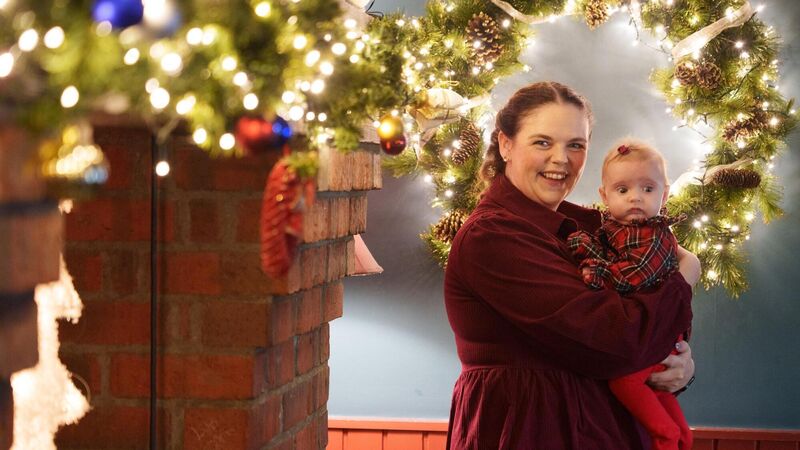
Sinead Mathews and her daughter Mollie, says dealing with the fertility treatments on her own was âoverwhelmingâ at times, but her background as a nurse helped her overcome those challenges. Picture: Barry Cronin
FOR Sinead Mathews, the road to becoming a mother had many twists and turns. But after choosing to undergo fertility treatment on her own using donor sperm, she is now looking forward to what will be her first Christmas with her baby girl, Mollie.
Mathews, who lives in Dunleer in Co Louth, experienced an ectopic pregnancy in December 2020 while in a relationship. The experience of being pregnant made it clear to her that she wanted children, and even though that relationship subsequently broke down, she decided to start a family on her own.
In early 2023, at the age of 37, Mathews went to Sims for a fertility check. The results showed that her anti-mullerian hormone (AMH) levels were low, indicating a low ovarian reserve or number of eggs: âGiven my AMH levels and my age, the doctor advised me to consider fertility treatment using a sperm donor. It was a lot for me to get my head around, but I ultimately decided to go ahead with that plan,â she says.
Dr Marta Moschetta, consultant at the Sims IVF Clinic in Clonskeagh, says they are seeing an increasing number of heterosexual and same-sex couples, as well as single women, using donor sperm. The experience of Sims is reflected in the national figures; the number of IVF cycles using sperm donors in Ireland in 2020 was 485, an increase of over 200% from 158 in 2009.
Sims works with a third-party sperm bank that operates a website where women or couples can browse and select their chosen sperm donor.
Moschette explains: âThe selection is made by either face matching or genetic matching [the biological mother can have a genetic test, with the results compared with the chosen sperm donor to check for any shared gene mutations]. The sperm bank screens all donors for sperm quality and medical history, and screens family members for three generations. The donors are also screened for karyotype, infectious diseases, and genetic carrier tests.â
Using the sperm donor website, Mathews says she initially honed in on facial features: âYouâre thinking about what any potential children will look like, so I looked at donors with blond hair and blue eyes, as this was similar to my brothers and my family in general. Then I also looked at their backgrounds. The donor I chose had a mother and grandmother who were nurses, and because Iâm a nurse and midwife, it felt like our backgrounds were similar.â

At this stage in her journey, she had only told her sister about her plans. But once sheâd chosen the sperm donor, she told her mother: âMy mom was so supportive about my decision, which was great as I knew Iâd be needing as much support as I could get if the process were successful.â
With the donor selected, Mathews began her first round of fertility treatment: Intrauterine insemination, or IUI. This cycle failed, and the clinic suggested moving on to a cycle of in vitro fertilisation (IVF).
âFrom my first egg collection, I ended up with two viable embryos. The first embryo transfer failed to result in a pregnancy. While the second round did lead to a pregnancy, it was whatâs called a chemical pregnancy or a very early miscarriage. That happened over Christmas 2023, and I was devastated,â she says.
She decided to proceed with a second egg collection, resulting in three viable embryos. The first embryo transfer produced another negative pregnancy test: âThe clinic did some more tests to see if they could figure out why the treatments werenât working. Nothing showed up, which is good in one sense, but then also, thereâs no particular reason, which can be difficult.â
A new transfer was also unsuccessful, leaving Mathews with only one remaining embryo: âMy doctor at Sims made a change to the treatment plan, modifying my medications for that transfer, and thank God they did, because it worked.
âWe donât know whether it was that change or just luck, but it was the best news. I had also worked with a local reflexologist during that cycle, and that could have been part of it too, you just donât know.â
It was December 2024, and Mathews recalls feeling like sheâd received âthe best Christmas gift you could imagineâ.
Going through the fertility treatments on her own was âoverwhelmingâ at times, but Mathews credits her background as a nurse and midwife for helping her through the physical side of the treatments: âI knew what to expect to a certain degree. With the hormone injections and the medication, I was well able to handle that side of it.â
Emotionally, though, it was more difficult: âIn my job, I was seeing women with their babies every day, in for their six-week checks or their babyâs vaccines. So that was difficult. But you just have to live month to month, and I tried not to think about it too deeply.â
Going through pregnancy as a single mum, Mathews relied on the support of her family and friends. When she gave birth to Mollie in July 2025, her family rallied around her. Now she lives with her mum and their dog Lulu, who she says is âgreat with Mollieâ.
âLiving with mum is great,â she says. âIt means I have another person to rely on, or to pass Mollie to, when I need a shower or just a breather. And thereâs my sister, too, who has kids of her own, and theyâre great with Mollie.
âRight now, weâre all looking forward to Mollieâs first Christmas."
Celebrating 25 years of health and wellbeing