What is ‘eldest daughter syndrome’ and do first born girls really take on more duties?
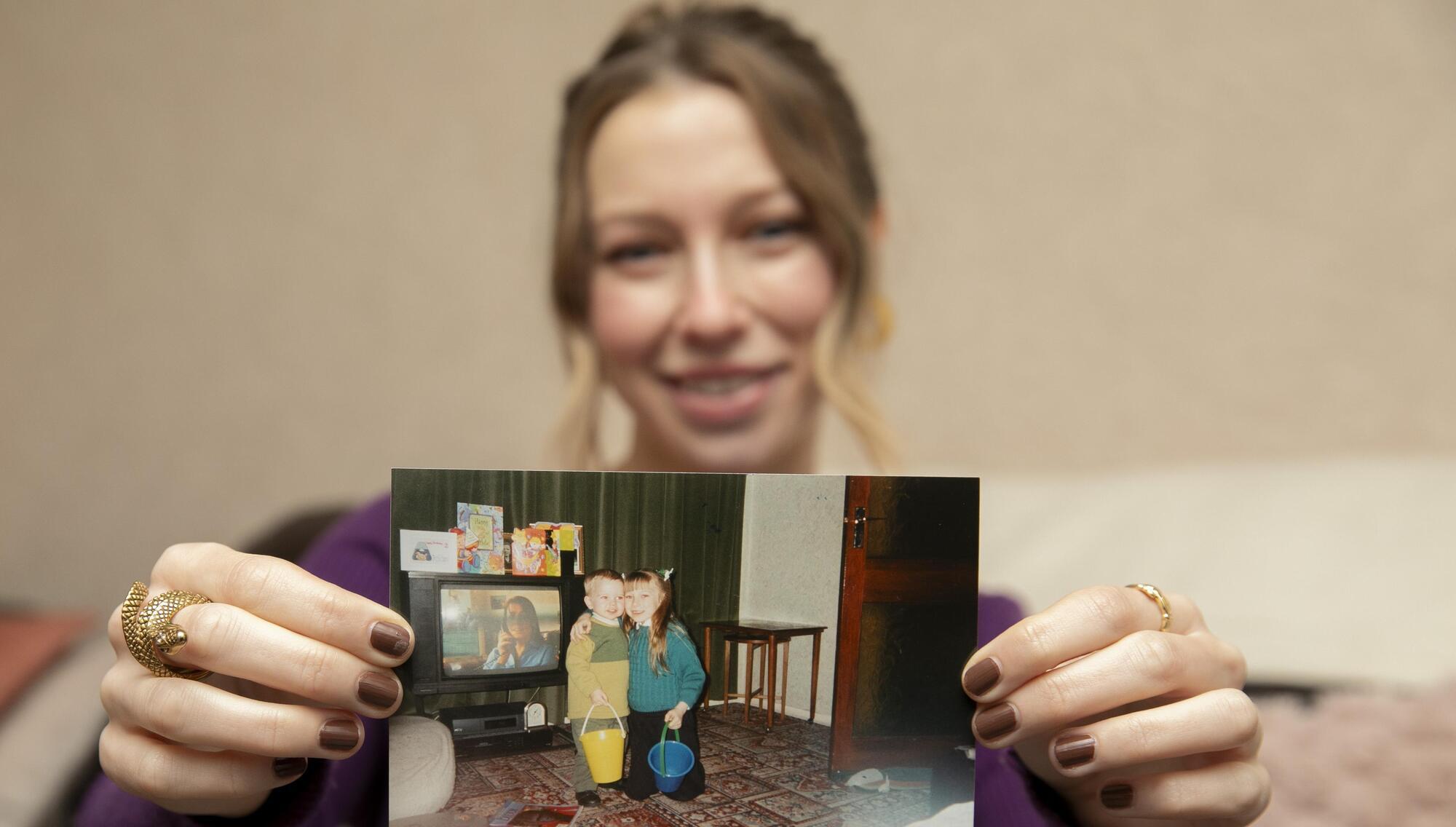
Adele Miner with photos of her brother Aidan at her home in Kilbarrack, Dublin. Photo: Gareth Chaney
I’m doing a callout on my Instagram account to recruit eldest daughters to interview for for this feature. I write my usual line, “Hi! I’m looking for eldest daughters to chat to for a feature I’m writing. Send me a DM”.
Often, it can take a day or so of waiting for replies, sometimes I have to post it again before someone bites, but not eldest daughters.
Within the first 15 minutes of posting, my inbox is flooded with eldest daughters reporting for duty, all ready and willing to help me. The situation couldn’t be more on point.
People-pleasing, responsible, reliable, efficient, are just some traits associated with being the eldest daughter in a family. Of course, they don’t apply to every first-born female, but judging from my heaving DMs, they’re relevant to quite a few.
I am an eldest daughter, the first child and the first grandchild, followed by one brother and two male cousins — making me the only girl. I had five years as an only child before my brother came along and was delighted to become a big sister, immediately stepping into my role as commander-in-chief. I turned the sitting room into a classroom, teaching my baby brother his ABCs from his baby bouncer. I ran a very tight ship, allowing breaks only for nappy changes or quick bottle feeds. While I reveled in being the managing director of the children in the family, it became clear that my services were essential.
Family outings often consisted of me corralling my younger relatives at the expense of enjoying myself. Being the eldest and the only female meant that I was expected to take on more responsibility and conduct myself accordingly, while younger male family members could behave unruly and often get away with it.
As an adult, I see that taking responsibility has become my default position. As a child, I wanted to protect and nurture my younger sibling. I was the listening ear for elder relatives, and I wanted to make sure that everybody and everything was OK at all times.
This leaves me questioning — have I eldest daughtered too hard? Now I worry about every possible thing. I want to fix problems before they’ve even happened, and I find it hard to relax.
Dr Lorraine Lynch, health psychologist and CEO of The Child Psychology Institute, lists the key traits and behaviours associated with eldest daughters: “A need to be perfect, feeling responsible for the emotions of others, being highly organised, self-reliant, and maybe hyper-independent, becoming an over-achiever and constantly experiencing anxiety about the future.”
It’s a tick, tick, tick, for me. However, I’m curious to find out if other eldest daughters feel similar.
Dubliner Aisling O’Broin, aged 29 and the eldest of three girls, became more involved with childcare at home after her parents separated during her teenage years: “Growing up, I was told to be a good example for my sisters. Once I reached my teens, I started to have more responsibility with my siblings. During the summers, I would mind my sisters five days a week.
“This caused a lot of resentment on my part as I felt I was missing out on time out with friends, etc.”
Another eldest daughter, Saoirse Hammond, aged 25, from Limerick, says her role as a big sister also doubled as a second mother: “My sisters joke that I’m stricter than our actual mom! I think I tend to look after my mom more, too. I help around the house, I buy Christmas presents, I give lifts.”
Sadhbh O’Hara, aged 24, from Dublin, is also a first-born daughter. She has carried her caregiving skills through to adulthood, even considering a career in helping others: “I have always loved being a big sister. Until recently, I was training to be a teacher because I felt it was necessary for me to continue my life looking after young people. I felt such a strong connection to spending my life helping [my younger siblings] grow and understand who they are.”
A research team at the University of California found that first-born daughters tend to mature earlier than normal.
The study authors noticed a correlation between early signs of puberty in eldest daughters and their mothers having experienced high levels of prenatal stress. In theory, this puts girls in the correct headspace to fulfil the role of caretaker. However, just because we can doesn’t mean we should.
Lynch sees a lot of eldest daughters come to her suffering from burnout after taking on the role of caregiving and family mediator as children: “What I often see in clinic is very anxious women whose nervous systems are now so attuned to the emotional states of others around them that they are constantly in fight or flight, ready to make things better. These women become adept at scanning their environments for threat, which eventually leads to them becoming exhausted and burnt-out, without knowing why.”
How do we change this behaviour? Many eldest daughters might argue that having such responsibilities can benefit you as an adult, equipping you with necessary life tools. But Lynch says taking on the stereotypical elder sister role shouldn’t be second nature.
“It’s so important for an adult eldest daughter to reframe her priorities and value systems and question what truly matters to her and what can she let go of,” she says.
“Adult eldest daughters should think about what part of them has been conditioned and what part is their authentic self. If we’re not tapped into our authentic self, we are in danger of creating a life that looks great on the outside but does very little to keep us genuinely happy in ourselves.”
As for the next generation of eldest daughters, O’Broin — who is now a mother to two girls — says that she will not expect her eldest daughter to take on the responsibilities she once did: “I am very conscious that as my eldest daughter grows up, I won’t burden her with too much pressure. I’m aware it can be easy to shoulder responsibility onto her, but I want her to enjoy her childhood and grow up without the pressure I did.”
Lynch says the key is removing expectations around responsibility through conversations and actions with eldest daughters: “It’s important to support these children so they don’t develop anxiety by ensuring they know they are not responsible for their siblings and/or parents. A conversation could sound like: ‘Lately, I’ve been asking a little too much from you. I’m sorry because that is my responsibility, not yours. From now on, you focus on play, school and your chores.’
“Or in a situation where a child is parenting a younger sibling, ‘Remember, it’s only Mammy or Daddy’s job to parent. You go and play, and I’ll take care of this’.
“Other helpful suggestions are to allow and celebrate mistakes to break down that need to be perfect, promote play to give the child an opportunity to work through what she naturally wants to do. Also, ask yourself if you are giving the same care [to your eldest] as the other children or are they being expected to do the caring?”
Eldest daughters may have got used to being the doer, the fixer, the therapist, and the babysitter all in one. But that doesn’t mean our entire identity must rest on that. There’s so much more to us, and letting go of these behaviours is possible if done in small steps.


CONNECT WITH US TODAY



Be the first to know the latest news and updates