Parentification: When you’re not the problem in a fractious family

Katie McKenna and Helen Villiers
Most people grow up thinking their childhood was normal, and they are right, it was their ‘normal’. But does that mean it was healthy?
It is hard to identify unhealthy or toxic family dynamics when they are normalised in societies. Parentification is one of those toxic dynamics that’s rarely talked about.
In fact, most societies laud and praise the parentified child, instead of recognising the damage it causes to their development. They are perceived as ‘the good child’, ‘the helpful child’, ‘a mature child’, or ‘an old head on young shoulders’.
The conditioning of parentification means they can assume the role of mom/dad in their peer group and take on a caring position, which can detach them from the rest of their group.
They only know how to connect through servitude.
So what is parentification?
Parentification is when a child assumes parental responsibility for siblings or even, sometimes, parents.
Parentification conditions the child to act as caretaker, mediator and protector in the family home. The child is forced to fend for themselves and take over the caretaking role and practical responsibilities for siblings, even their parents.
The parentified child never receives praise for who they are as a person; they’re only acknowledged when they are ‘helping’ or meeting their parents’ needs.
The child feels fulfilled in their ‘parenting’ role because they think they are receiving love and attention from someone, but this is not love, this is exploitation.
Parentification emotionally cripples a child, leaving them isolated and vulnerable to exploitation.
It is a form of emotional abuse that destroys a child’s emotional physical, spiritual and sexual boundaries, not to mention any chance they have of building a healthy sense of identity, value and worth.
A parentified child focuses on helping and making others happy and sacrificing themselves continuously as a result.
Emotional Parentification
A telltale sign of emotional parentification is when a parent refers to their child as their ‘best friend’, confiding in them about their struggles, whether financial, emotional or relationship-based.
The child is forced to be responsible for their parent’s emotional well-being because the parent prioritises their own emotional needs, and as a result, the child’s needs are neglected.
Emotionally parentified children are the mediators in the home, often used by parents as the ‘go-between’, breaking up fights and taking on the roles of peacekeeper, mini therapist, confidant and emotional caretaker.
The child is taught their ‘job’ is to protect and support their parents however they can.
They spend their childhood trying to ‘keep the peace’ and resolve conflict, the weight of which is far too much for anyone to carry, let alone a child.
A child should never be offering emotional support to their parent, even in adulthood.

The emotionally parentified child can develop a deep sense of loyalty toward a parent, often becoming totally enmeshed in their emotions. They don’t have any idea who they are separate from the parent.
Children adapt quickly to this role, likely a lonely and confusing one because, while they care for and manage everyone’s emotions, no one checks to see how they feel, what they think, or even if they’re OK.
Children in this role often end up feeling as though their siblings or parents cannot survive without their help and this will impact every single relationship in their adult life.
All co-dependent relationships stem from parentification in childhood because the child learns to push down or ignore their own needs and feelings and prioritise the needs of others above their own.
In adulthood, the parentified child seeks relationships with people who reject or ignore their needs because it feels familiar to them.
They are more likely to enter into relationships with people who take advantage of and exploit them.
Instrumental Parentification
Instrumental parentification occurs when a parent relies on their child to help them run the house in a way not in keeping with the child’s age, such as making them responsible for cooking, cleaning, running the home, as well as caring for younger siblings and/or being a carer to a family member or sick relative.
Their entire identity becomes rooted in service to their family, who exploit and demand that they prioritise household chores and childcare over their needs and wants.
This is described as Cinderella syndrome because the child is responsible for ensuring that everyone else’s needs are met, while their own usually go ignored.
A clear sign of instrumental parentification is the child playing a mothering role to their younger siblings.
The normalisation of this in many cultures comes at a tremendous cost to the child, who loses out not only on their childhood, but also their relationship with their siblings.
The siblings can end up resenting the parentified child, who is left feeling confused, unable to understand why this is happening when they’re just doing what is expected of them.
In adulthood, instrumentally parentified children show excessive caring and parental attitudes in peer relationships because the caring role has become an intrinsic part of their identity, and they often end up working in caretaking roles, such as nursing, counselling, childcare and teaching.
They struggle to delegate and ask for help and end up doing too much because of their ingrained sense of duty and fear of the repercussions if they say no.
Narcissistic Parentification
Narcissistic parentification involves emotional and instrumental parentification and more.
A child is given a role by the parent (golden child, invisible child, parentified child, scapegoat).
The golden child is treated like they are the sun, in the parents’ eyes they are perfect. The invisible child is just that, invisible, nobody sees them, they are completely forgotten about. The scapegoat is blamed for absolutely everything.
The narcissistic parent projects an entire identity onto the child and if they step outside of that fictional character, they are given the silent treatment, stonewalled, punished, humiliated and emotionally abandoned.
When someone grows up in chaos and dysfunction these behaviours become normalised. The repetition of these behaviours means the baton of trauma is passed from generation to generation until someone decides to change it.
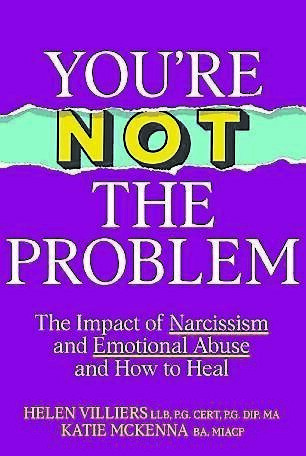
- You’re Not The Problem: The Impact of Narcissism and Emotional Abuse and How to Heal by Katie McKenna and Helen Viliers, available in bookshops now
CONNECT WITH US TODAY
Be the first to know the latest news and updates
Celebrating 25 years of health and wellbeing