Christmas dips: Making a splash at festive swims around the country
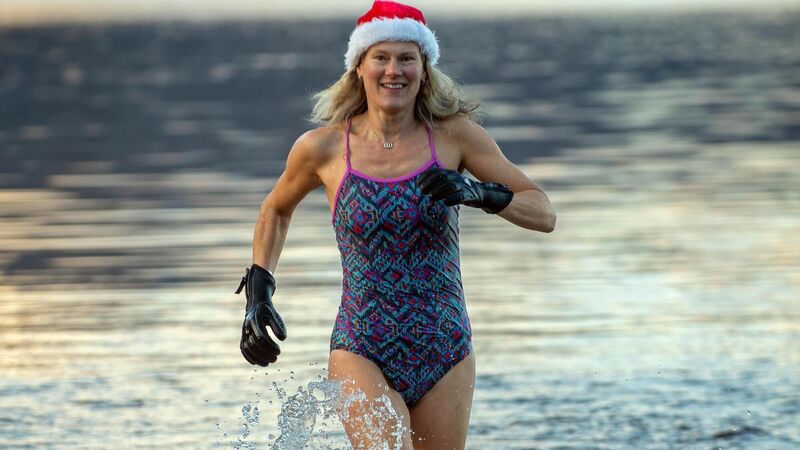
Nikki McCarthy who organises the Christmas Day swim at Dundag Bay on Muckross Lake Killarney in aid of Aware. The annual swim which started in 2009 takes place from 11am with access through Muckross House main gate down to the lake. Photo: Don MacMonagle



- “Wear clothes that are easy to take off and put back on again,” says McCarthy.
- “Booties on your feet make a big difference,” says Fawl.
- “Don’t stay in the water too long,” says Power.
- “People can egg each other on to stay in the water for longer and longer. This can easily backfire. You should only stay in the water for a minute or two before getting back out again.”
- Warm up quickly once you do, says Fawl. “The air temperature is often colder than the water and you really feel it when you’re wet. So don’t hang around. Dry yourself off and put on warm clothes. A hot water bottle can be nice, and a hot drink helps too.”
- Most of all, enjoy it. “We missed gathering for the Christmas swim during covid,” says McCarthy. “It felt extra special when we could all do it together again. There’s something so unique about sharing this experience together.”
Swimming in cold water has many health benefits - physical and mental.
A University of Limerick study published in the this October suggests that it is, noting that swimmers show significant improvement in overall mood and physical wellbeing.
The participants in the study were found to have lower blood pressure and cholesterol levels and enhanced immunity, which meant they were less susceptible to colds and flu, and had better mood.
A 2021 Swedish study supports these findings. It showed that cold water swimming led to better metabolism.
A 2016 study from Poland demonstrated that swimming in cold water for a season helped middle-aged women balance their blood sugars by raising their sensitivity to insulin.
These studies suggest that cold water swimming could help combat obesity and type 2 diabetes.
It has psychological benefits too. Research conducted in England in 2020 found that those who swam in cold water experienced a ten-fold increase in mood compared to a control group who watched from the shore, which could be due to the release of endorphins and dopamine caused by exposure to the cold.
You don’t need to be an avid swimmer to experience these benefits. Some participants in the University of Limerick study were only in cold water for 25 seconds.
Cold water can shock the system, and hypothermia can set in within minutes, leaving you too weak to climb out of the water. So, never go swimming alone and slowly build up your tolerance to the cold over time.

Tánaiste Mícheál Martin doesn’t go swimming on Christmas Day. Instead, he waits until New Year’s Day before plunging into the ocean at Courtmacsherry Beach in aid of the RNLI.
“I’ve been doing it for 20 years or more,” he says. “It’s a great way to clear the head and start the new year feeling invigorated after what has usually been a late night the night before.”
The Tánaiste does the charity swim with friends. “A few of us have made it a yearly tradition,” he says. “We meet for the swim, warm up with a shower afterwards and then head out for a long walk before ending up at Mary O’Neill’s bar in Butlerstown. It’s a day for us to catch up.”
He’s a fan of sea swimming in general. “I do it as much as I can in the summer and would do it more often were it not for my job,” he says.
“On New Year’s Day, I run in, put my head under and swim around for two or three minutes before I start feeling too cold. Being in the water gets me out of my head for a while.”
Doing the swim in aid of the RNLI makes it extra special. “The lifeboat is so important to the people of this area — it’s interwoven with the life of the community,” he says.
He’s looking forward to this year’s swim. “There’s always a great atmosphere on the beach as 100 people or so prepare to run into the water, cheered on by all the spectators. You feel exhilarated coming out and set up for the day and the year ahead.”