UK’s first womb transplant a ‘massive success’ after sister’s donation
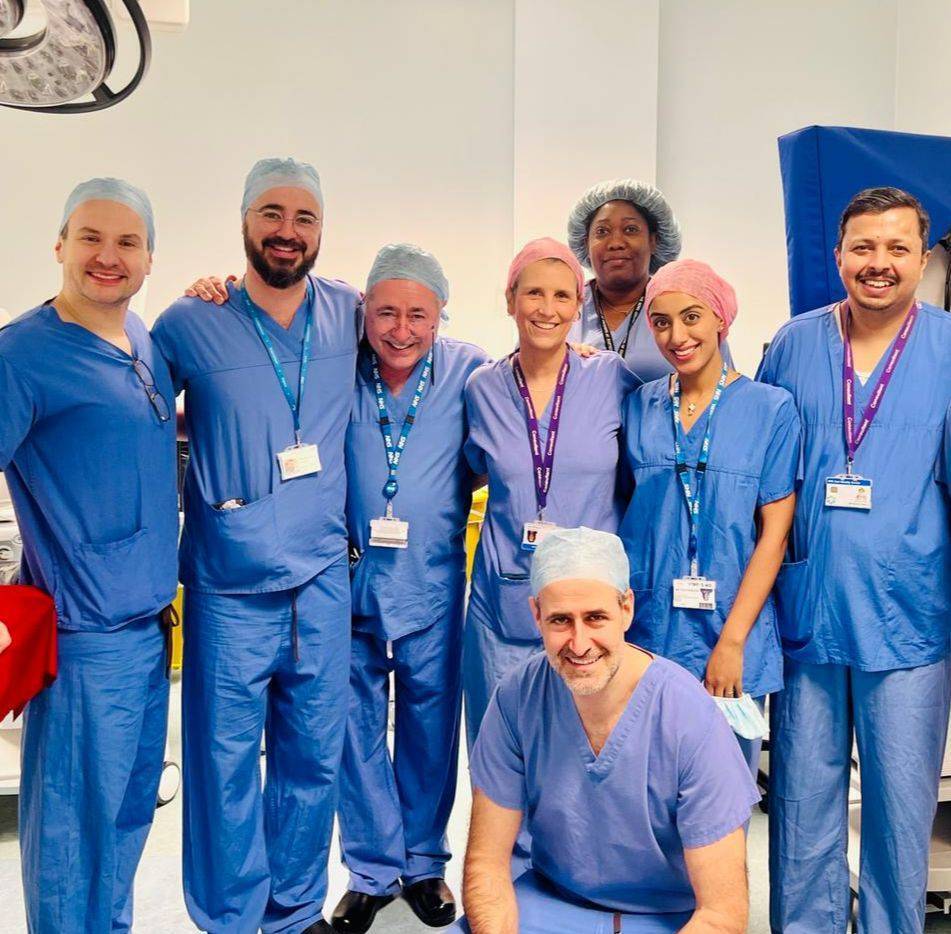
The surgical team behind the UK's first womb transplant.
Surgeons have performed the UK’s first womb transplant on a woman whose sister was the living donor.
The 34-year-old married woman received the womb – also called the uterus – during an operation lasting nine hours and 20 minutes carried out at the Churchill Hospital in Oxford.
Her sister, 40, has completed her own family by giving birth to two children, and was willing to donate her womb.
The recipient, who lives in England and does not wish to be named, has stored embryos with the aim of undergoing IVF later this year.
The lead surgeons for the transplant, which took place on a Sunday in early February, were Professor Richard Smith, clinical lead at the charity Womb Transplant UK and consultant gynaecological surgeon at Imperial College London, and Isabel Quiroga, consultant surgeon at the Oxford Transplant Centre, part of Oxford University Hospitals.
Speaking to the PA news agency, Prof Smith said the experience had been “quite remarkable”, adding that the operation had been a “massive success”.
He added: “It was incredible. I think it was probably the most stressful week in my surgical career but also unbelievably positive.
“The donor and recipient are over the moon, just over the moon.
“I’m just really happy that we’ve got a donor who is completely back to normal after her big op and the recipient is, after her big op, doing really well on her immunosuppressive therapy and looking forward to hopefully having a baby.” Miss Quiroga told said she was “thrilled”, adding that, following the operation, transplant staff were still cautiously taking it all in.
She said: “It was a very proud moment but still quite reserved – the first two weeks after the operation are nerve-racking.
“Now, I feel extremely proud of what we’ve achieved and desperately happy for her.” Miss Quiroga said the patient was “incredibly happy”, adding: “She was absolutely over the moon, very happy and is hoping that she can go on to have not one but two babies.
“Her womb is functioning perfectly and we are monitoring her progress very closely.” The woman receiving the womb was born with Mayer-Rokitansky-Kuster-Hauser (MRKH), a rare condition that affects around one in every 5,000 women.
In MRKH, women have an underdeveloped vagina and underdeveloped or missing womb. The first sign of the condition is when a teenage girl does not have periods.
However, their ovaries are intact and still function to produce eggs and female hormones, making conceiving via fertility treatment a possibility.
Before receiving her new womb, the woman had two rounds of fertility stimulation to produce eggs, followed by intracytoplasmic sperm injection (ICSI) to create embryos.
Five embryos reached blastocyst stage – which means they have a good chance of success in IVF – and were frozen for when the patient undergoes treatment at the Lister Fertility Clinic in central London later this year.
Prof Smith said that, at present, the transplanted womb is “functioning exactly as it should” and the plans for IVF are on track.