How horses at a care farm in West Cork help children with additional support needs
At a small care farm in Bantry, children with additional support needs learn about communication through therapeutic riding, which also helps to relieve stress and build social connection 
How horses at a care farm in West Cork help children with additional support needs

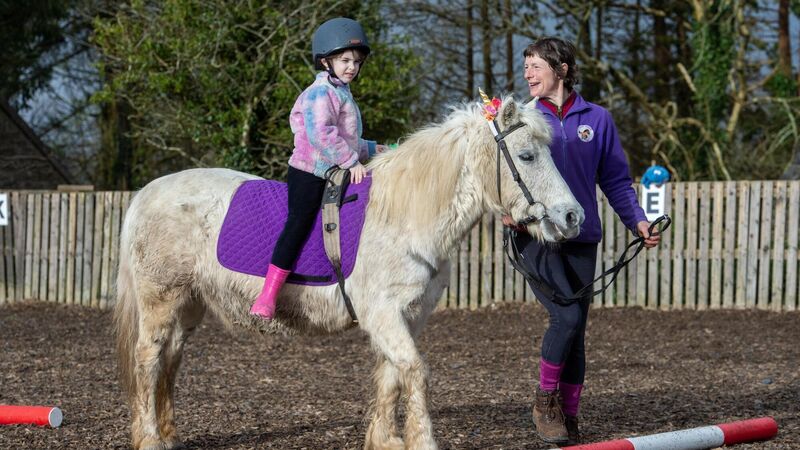
Sandra Schmid of Hairy Henry with six-year-old Ava Green, who has been diagnosed as autistic, having fun with Daisy at the Hairy Henry Therapeutic Riding and Care Farm, Ballylickey, Bantry, West Cork. Pictures: Dan Linehan
Orla Green’s six-year-old daughter, Ava, couldn’t wait to sit up on the white pony, Daisy. But no sooner was she up than she wanted down again.

“The sensation of being up there was so different. It was so high, and the horse was moving under her. She was only sitting there for five minutes,” says the Glengarriff-based mother of two, who also has two-year-old Ellen.

Orla brought Ava to Hairy Henry, a small care farm near Bantry, because Ava is on the autism spectrum. Hair Henry supports children and adults with additional needs. It offers therapeutic horse riding and farming activities to help with emotional, physical, educational, behavioural and mental health challenges.

“Ava finds her emotions hard to regulate,” says Orla. “She finds changes in routine hard. She can be triggered by environmental factors, like noise. She’s pre- to partially verbal, so she’s not able to hold full conversations. She has echolalia, where she repeats a lot of phrases.”

More recently, Ava was finding it tough to deal with some changes that happened in her life. “The principal at Castletownbere NS, where she attends the autism unit, put us in touch with the family resource centre in Beara and Ava qualified for a grant for horse-riding therapy.”

Orla hopes the activity will calm Ava. “I want it to help her regulate her emotions, help her cope when things go wrong, to understand it isn’t the be-all and end-all when that happens. I want it to help her confidence.”

Gaining independence

Sandra Schmid, a therapeutic riding coach, founded Hairy Henry in 2013. “We take children from as young as two years, when they’re just about walking independently and can sit up straight on a horse.”

Challenges that bring children to Hairy Henry span a wide range: developmental, mobility, and speech delays, as well as cognitive and socialising difficulties. Children may have dyslexia, dyspraxia, ADHD, or be on the autism spectrum. Outlining the ways in which therapeutic riding can help, Schmid cites the neuromuscular benefit.

“For a person who isn’t great on their legs, the horse mimics the movement of walking. This rocks our pelvis in a way not dissimilar to when we’re walking. Our muscles and nerves are stimulated to send signals to the brain that can help us walk better.”

Contact with other people can be challenging for children on the autism spectrum. “Animals are unpredictable, up to a point, but less so than children in a playground, where a child who’s autistic is thinking, ‘What does this other child want me to do? How do I start playing with him? How do I start a conversation?’ With a horse, you don’t have to talk with words. You can feel part of a social group with horses, even just stroking and being around them.”

At Hairy Henry, Schmid sees children take first steps in communication. “They learn to communicate with a horse, ask him to do what they want to do: Go for a walk, turn left/right. They say ‘giddy up’ and the word has an effect. And they think, ‘Wow! I can tell this big, half-ton horse where I’d like to go with him’. They feel they’ve some sort of influence in their life, they can achieve something.”

Alongside the horse — and their peers — children learn social skills. “For example, every child will have a favourite brush. They learn to share, to take turns. I might say, ‘wasn’t it nice of so-and-so to let you have the special brush? And let’s brush Daisy and she’d love that’, and so I help it along by putting narrative on it,” says Schmid.

Children become calmer, more relaxed. “Children who feel failures in school, who feel social stress, their bodies are full of the fight-or-flight response. This blocks their rational thinking. When these children are being rocked along, very rhythmically and repetitively, they find it very relaxing. Balancing on a horse, being rocked about, relaxes the vagus nerve and the muscles around it and counteracts stress.”

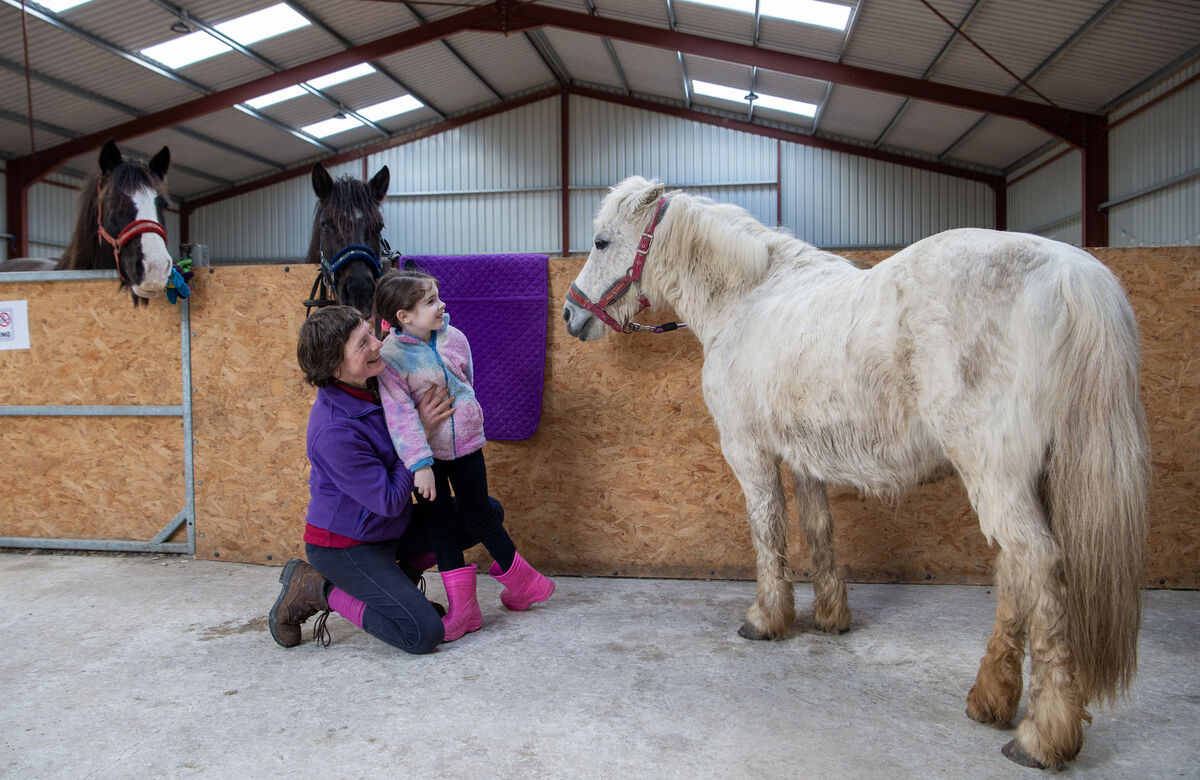
Sandra Schmid and Ava Green having fun in the stables with Daisy at the Hairy Henry Therapeutic Riding and Care Farm, Ballylickey, Bantry, West Cork.

Cycle of life

At Hairy Henry, sessions last one hour. Families might book at least eight, if something specific needs work, for example, self-regulation and relaxing, improving speech, following a schedule or boosting confidence. “Some children have been coming for three to five years. They might only come once a month or every eight weeks because they’ve ongoing issues,” says Schmid, who liaises with the child’s teachers/therapists so she can reinforce goals in her sessions.

Schmid has to think when I ask how many animals are on the care farm. “Five horses, a lamb, three sheep, two goats, two dogs, four donkeys, there are rabbits and six guinea pigs. The children love to see all these other animals. The sheep is fluffy and calm, rabbits are soft, but hop a lot, and you can feed the guinea pigs carrots. Every animal can contribute to a person’s life.”

Seeing seasonal changes on the farm brings benefits, Schmid says: “It’s about the cycle of life. Children feel part of something bigger. When you’ve challenges in life — you know you’re not as good at things as other children — you can get self-absorbed. But then you see the animal world is full of these scenarios, too, where, for one reason or another, an animal needs extra care. It helps you see there’s a whole world out there.”

When I speak with Orla, Ava has had three sessions at Hairy Henry. By now, she’s sitting on the horse for 30 minutes. “She’s sitting upright, holding herself up. And she’s confident enough to let go of the reins and do games, so she’s developing fine motor skills and doing little puzzles,” says Orla, who also notices Ava’s communication skills improving.

“She’s communicating a lot more. She trusts Sandra knows what she’s trying to say. She’s bonding with Sandra and with Daisy.”

Orla says Ava’s world got very small during covid and it was hard for her to venture out again, into shops, schools - life. “She’s doing really well, but this is another step again. And she loves it. She’s so happy going to Hairy Henry and she’s so happy there and in great form all evening and into the week. She’s much more settled in herself.”

More in this section

Lifestyle

Newsletter

The best food, health, entertainment and lifestyle content from the Irish Examiner, direct to your inbox.

Cookie Policy Privacy Policy Brand Safety FAQ Help Contact Us Terms and Conditions

© Examiner Echo Group Limited