'Grit your teeth and do the thing': Strategies to eliminate procrastination
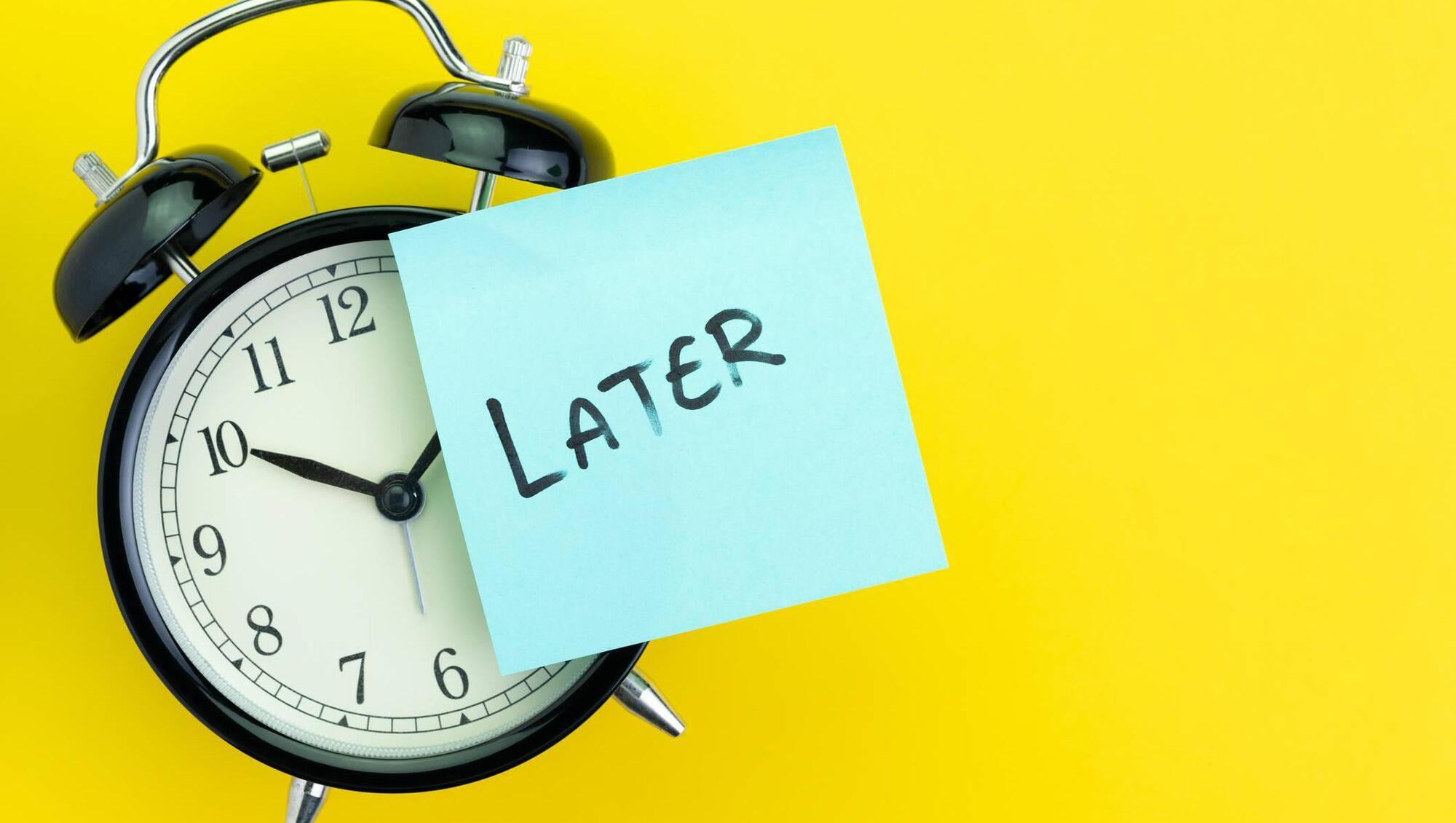
There's no time like the present to get back into a routine!
I’ve been at my desk for 40 minutes and have just finished writing one sentence. That’s because I’ve been procrastinating, something most people in the workplace struggle with occasionally.
“We all procrastinate to different levels,” says Brian Pennie, a former heroin addict who is now a doctor of neuroscience and about to deliver a course titled: ‘ How to Boost Energy, Increase Productivity and Eliminate Procrastination’ at the Work Well Institute in Dublin. “I help people understand why they procrastinate and give them strategies to overcome it.”
Procrastination is defined as a gap between intention and action, a voluntary delay to a task that needs to be done despite the possibility of a potentially negative outcome.
It’s what I do when I check my emails instead of writing. It’s also what Brian Crooke, the former management consultant who founded the Work Well Institute, does when faced with his to-do list.
“I pick easier tasks over ones that will take longer and require more work,” says Crooke. “I put those off even though they are what I’ll get more value from in the long term.”
This is classic procrastination,” says Pennie. “It’s not that procrastinators do nothing - they are busy doing things other than what they are supposed to do.”
And it’s a mistake to assume they’re lazy. “It’s often seen that way, but other things are going on,” says Pennie.
Maybe they’re unsure. “Uncertainty is a big factor,” says Pennie. “People procrastinate when they don’t know exactly what they are supposed to do. You often see it in kids studying for exams. They don’t know where to start, so they put off starting altogether.”
Environment is crucial
A 2012 study from the Journal of Counselling Psychology links perfectionism and procrastination. Pennie often sees this in his clients. “Their inner critic tells them they’re not going to do a good job, so they procrastinate,” he says.
People also procrastinate to avoid discomfort. “We don’t like hard work, so we distract ourselves with other tasks instead,” says Pennie.
Research has shown that certain personality traits are associated with procrastination. A 2018 study published in Frontiers in Psychology (exa.mn/Self-Regulation) showed that the more impulsive you were, the more you struggled with self-regulation, and the less perseverance you had, the more likely you were to procrastinate.
Remote working may have made things worse. “Our environment is crucial,” says Pennie. “Our internal environment – self-regulation, impulsivity, and anxiety – can prevent us from getting things done and so can our external environment. Working in a bedroom at home with people downstairs and children wandering about, you’ve got a golden excuse to procrastinate.”
There are costs to pay for this. Delaying work means our performance is likely to suffer and so will our wellbeing as our stress levels soar.
A 1997 study titled ‘ The Costs and Benefits of Dawdling’ established a link between putting things on the long finger and stress levels. College students were asked to rate their procrastination levels and track their academic performance, stress, and mental health for a term. By the end of term, the self-confessed procrastinators reported lower grades and far higher levels of stress and illness.
“They suffered more and performed worse – an outcome we all want to avoid,” says Pennie.

Focus strategies
What strategies will help us to stay focused? Finding our motivation is one. “Say you’re delaying going for a run,” says Pennie. “You’d run if there was a vicious dog behind you because your motivation would be clear. I recommend starting each day by writing down three clear tasks you want to achieve.”
Then break them into smaller steps. “Make those steps easy to achieve and with each achievement will come a reinforcement of your motivation,” he says.
Pennie has a tactic for those who struggle to overcome their inner procrastinator. “Lots of us negotiate with ourselves internally,” he says. “Maybe we’re trying to get up early and our inner procrastinator tells us to hit the snooze button - we deserve a lie-in. That’s the older part of our brain, the limbic system that only cares about self-preservation, trying to override the newer part of the brain, the neocortex. Motivational speaker and author Mel Robbins’ five-second rule can help.”
Here’s how the rule works. “Spend more than five seconds negotiating and the old brain wins. You’ll hit the snooze button,” says Pennie. “You have to act within five seconds, so count down from five and go.”
Another strategy is to take control of your environment. “Internally, try to deal with the anxiety and stress that causes you to procrastinate,” says Pennie. “And externally, keep your workspace as free as possible from distraction.”
Crooke believes managers can help employees avoid procrastination. “When I work with line managers, I advise them to do three things.”
1. “They must have two-way communication with employees and listen to their needs.
2. “They must have empathy in understanding what procrastination is and the steps that can be taken to overcome it.
3. “They and their employees must agree on milestones to be achieved and the small steps that can be taken to achieve them.”
While employees and managers should employ these strategies to counter procrastination, they must balance them with reasonable expectations of what people can deliver. Nobody can operate at optimum all the time, says Pennie. “Pushing yourself too hard for too long can result in poor mental health and burnout, and this will eventually result in not being able to do your best work, which may bring you right back to procrastination.”
Procrastination may need a rebrand. Far from being caused by laziness, it stems from internal psychological factors and external circumstances that can be overcome with strategies that allow us to make the most of our time at work.
“Don’t listen to that inner voice urging you to put things off,” says Pennie. “List the tasks you want to achieve and break them down. Take the first step, and you’re already setting up an action-oriented routine instead of giving in to procrastination.”
Perfect is the enemy of the good
Megan Cassidy, a 33-year-old commercial director at the Zahra Media Agency and co-host of the Before Lunch podcast, has learned that she needs to pay attention when she feels the urge to procrastinate.
“When I start to put off a project, it usually means one of three things,” she says. “Firstly, is that it’s really important to me.”
This ties in with procrastination being linked to perfectionism. “When a task is important, we can blow it out of proportion in our heads,” says Cassidy. “We tell ourselves to wait for the perfect moment to start so that conditions are just right for our work to be the best it can be. I always think of the phrase ‘perfect is the enemy of good’ in this scenario. Waiting for perfection means missing out on the time needed to do a good job.”
Secondly, Cassidy says she procrastinates when she’s unsure. “If I’m working in a new area and don’t know where to start, I’ll delay starting.”
Thirdly, procrastination can also indicate burnout, she says. “It’s often one of the first signs that I’ve taken on too much and need to revisit my schedule and manage people’s expectations.”
The Art of War, a book by Stephen Pressfield, has helped her to understand procrastination. “His theory is that every worthwhile creative endeavour is met with resistance,” says Cassidy. “There’s no curing it. You just have to go to war with it every day.”
Reframing procrastination in this way has helped her to overcome it. “Now, when I think ‘I don’t feel like doing this’, I tell myself ‘that’s a normal feeling and I’m certainly not the only one battling it. Better just get on with it’. Grit your teeth and do the thing.”

CONNECT WITH US TODAY
Be the first to know the latest news and updates