Breaking the barrier: thalidomide survivor Dr Austin O'Carroll takes a run at fundraising
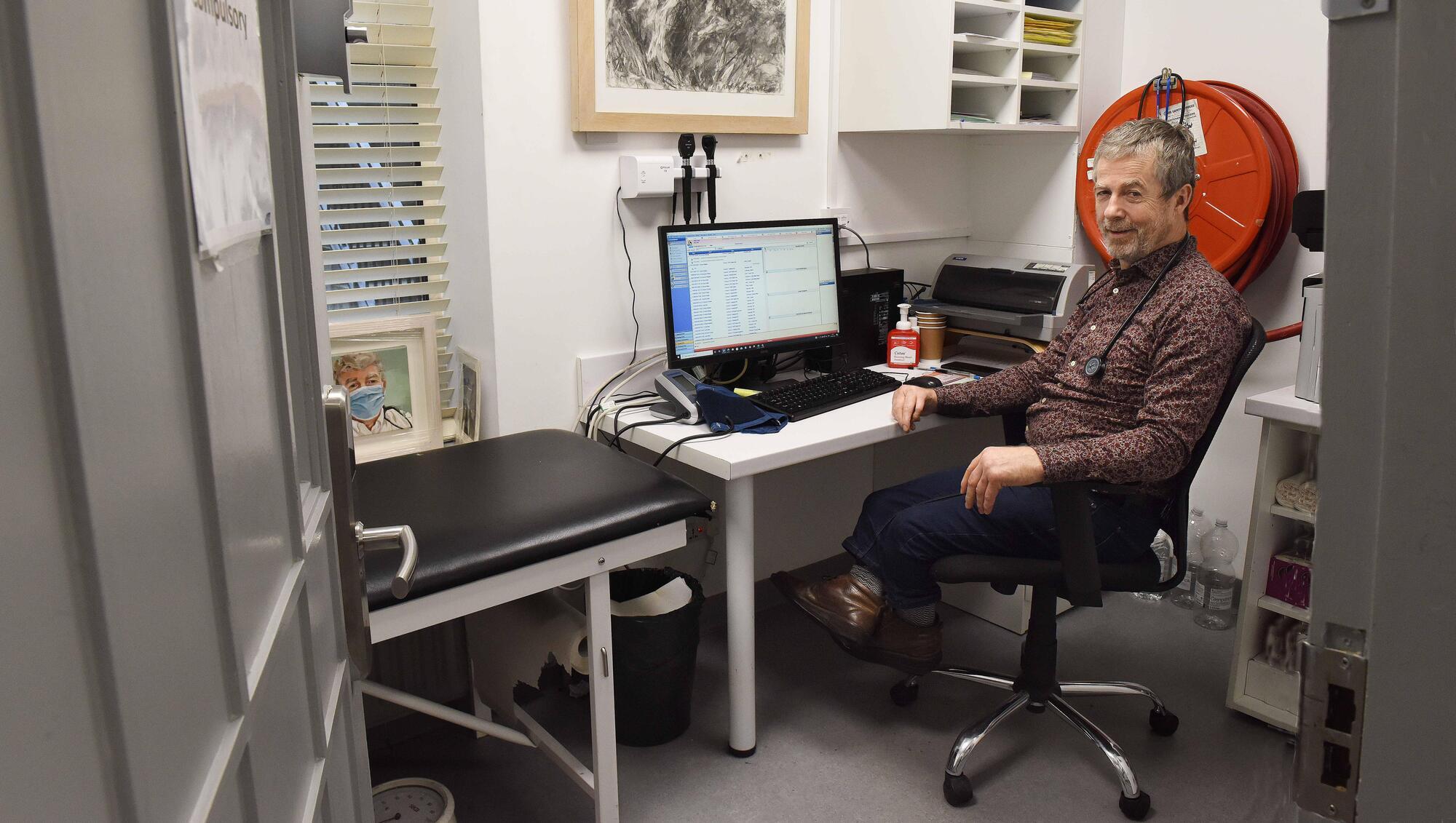
Dr Austin O'Carroll. Photograph Moya Nolan
Dr Austin O’Carroll is challenging himself to do a 5km fundraising walk in the Phoenix Park next December.
This is no ordinary challenge. Ten years ago, O’Carroll could barely walk 50 metres. He was preparing to be wheelchair-bound, planning to adapt his house for wheelchair accessibility.
He is one of 40 Irish thalidomide survivors, whose mothers in the late 1950s and early ‘60s were prescribed the nausea-combating drug that – unknown to them – was highly toxic to unborn babies. Depending on stage of pregnancy they took it, thalidomide caused miscarriage, eye and ear defects, damage to major organs and body systems. The main deformity was shortened or absent limbs.
In O’Carroll’s case, the bones below his knees were poorly formed. “The joints were poorly formed. I couldn’t walk until I was five years old.”
He’ll be 60 in May and – like other survivors – by the time he was 50, after the cumulative effects of years compensating for his disability, he saw marked deterioration in his mobility. “I looked at the idea of amputation because people with amputation can walk.”
This wasn’t an option – but losing weight was. “Mainly through diet, I lost 20kg, around one-quarter of my body weight. It’s probably the hardest thing I’ve had to do. I started the diet and basically haven’t stopped since. I definitely noticed the effect on my joints of losing weight – the pain was less.”
He also got fit. Already an avid cyclist, he found losing weight made it easier to go uphill in a higher gear. He started doing weights, as well as paralympic sailing. But it was a doctor’s throwaway remark after he enquired about osteoporosis-risk that got him doing what he loves best – dancing.
“She asked ‘do you like dancing?’ She said ‘do it 20 minutes a day’.” So, twice a week for 40 minutes at a time, O’Carroll, his earphones in, dances in his garage, in his cycling trousers, no top – “because I sweat”.
He listens to a mix of dance music. “This morning I started at 7.45 – Diana Ross, Lady Gaga, some Global Music. I went down quite sleepy. I came up buzzing. I always feel great after, full of energy.” With dancing, he can ignore the pain.
He’s obsessive about exercise, generally cycling 30-60km three times weekly. He swims, does the exercise bike, the weights. “Every day there’s exercise. I’m a bit obsessive, slightly from fear that if I lose it I’ll go downhill. I’m so delighted to be able to walk – I intend to keep it.”
Initially, he wanted to run the Phoenix Park 5km – when his exercise bike wasn’t working one day over Christmas, he tried out his daughter’s running machine and to his great surprise managed 400m. “Then my sister, Claire, a physiotherapist, heard me saying on the radio I was going to do a 5km run. She rang and said ‘you’re not to run, it’ll put a lot of strain on your joints – but you can walk’. Initially, I was disappointed but at least I can do the walk.”
He’s doing the 5km challenge to prove to himself that a way to manage pain is to get fit. In 2009, he cycled the Ring of Kerry to fundraise for Safetynet, which he founded in 2007 – it provides GP services to over 6,000 marginalised patients annually throughout Ireland.
“I wasn’t sure I’d be able to cycle the Ring of Kerry. As someone with disability, you can get into proving yourself. It can lead you down paths you shouldn’t go, but proving myself has given me the drive to get fit.”
He’s also doing the challenge to fundraise for GPCareforAll, a social enterprise he founded that creates new GP practices in deprived areas. O’Carroll set up the North Dublin City GP Training programme in 2009, the first programme internationally that trains GPs to work in communities affected by deprivation/marginalisation. “I’ve been passionate about addressing health inequality all my life. People die five to 10 years younger in areas of social deprivation. They spend more of their shorter lives with chronic disease.”
The scheme has seen one new GP practice set up in Dublin’s Summerhill. The hope is to establish a second in West Finglas, where the population is 27,000. “It’s an area of blanket deprivation. Not a single GP practice is located there – there are a number in East Finglas, across the motorway and inaccessible for most West Finglas patients.”
He loves the inner city people, their sense of humour and community – their resilience, despite huge inequality.
He credits his mother, Maureen, with giving him resilience. She took a tough-love approach to his disability, never giving him special treatment. “Some would say it wasn’t the right approach. It mightn’t be for everyone, but it gave me a strong sense of normality early in life. I didn’t go around taking care of myself – she let me go out, play football with the other kids. It allowed me to have normal dreams – I dreamed of being a footballer, ridiculous, but still I did. She taught me to get out, get on with it – and not give up.”
He recalls his mum always saying he had “a great personality” and, in his early 20s, he realised he was presenting himself as “the fun guy, the one you can talk to” – rather than as an attractive, sexual being. Learning to be the latter – and present himself as such – was important. “It means you’re in the game. You have to be in the game. Once you are, you’ll meet people.”
He met his wife, Dorothy, in 1993 when they shared an office in the City Arts Centre – she was working in the arts and he was filling in a position for a disability rights organisation. “I knew I was attracted to her – absolutely – but we were both with other partners. We didn’t get together until 1998.”
He loves being dad to son Naoise, 18, and daughter Hannah, 20. But parenthood can be tough. “I found the first few years hard. It’s quite physical – you have to be on your feet a lot, keeping an eye on them, and going places. I managed it but I wasn’t able to walk much. When Dorothy took them walking in the hills, I couldn’t do it – I’d go for a cycle and meet them after.”
A strong volunteering ethic in his family background helped form his wish to be a doctor. But going into medicine with a disability wasn’t straightforward – in addition to foreshortened legs, his thumbs are very poorly formed. “Three doctors said I wouldn’t be able to do medicine because I wouldn’t be able to use my hands. So I started studying Law.”
Inter-railing one summer, he found himself in a romantic setting with a girl he fancied, a medical student. They were on the edge of a cliff along the Amalfi coastline in Southern Italy. “Nothing happened! But she said she couldn’t understand why they didn’t let me do medicine, she believed I could. I went straight back to college and my tutor Mary McAleese got me a meeting with the board of the medical school. I had to go around and show them my hands and legs. It was touch and go, but I got in.”
Working in hospital was tough initially. “I found the walking hard – and taking bloods and putting in a canula, partly because I was frightened of it. Eventually, I found my own way of doing it. I became very good – now I’m one of the best at it in the practice I’m in.”
He mainly works in GMQ, a primary care programme for homeless people that also specialises in addiction services. “I feel for the people there. We get lots of deaths but we make many interventions. There’s a sense we make a difference – there are definitely people you know would be dead if you hadn’t made an intervention. There are also people who don’t get out of homelessness, but we’re with them through it.”
Last November marked the 60th anniversary of the international withdrawal of thalidomide. O’Carroll’s mother died last year. He knows an apology would have been important to her – and to the other mothers.
That thalidomide wasn’t removed from shelves here until nine months after its international withdrawal is indefensible, he says. “You could argue they didn’t know before November 1961, but even if they didn’t know they could apologise. People are frightened to apologise.”
Around the inevitability of ageing, a childhood lesson learned in hospital gives him strength. “I often had to return to hospital. I began always expecting to hear the worst – it was good if it didn’t happen. That gave me an ability to survive, a kind of stoicism. I think things will go downhill for me. It’s not imminent – but I’ll probably be in a wheelchair some day. But I will manage and still have a great life.”
On the 60th anniversary last November of the international withdrawal of Thalidomide, the Irish Thalidomide Association (ITA) reignited their campaign. Worldwide100,000 babies were affected by the drug in utero. Ninety thousand died from miscarriage. Of 10,000 born, half died at birth or within first year of life.
Only about 4,000 of the 5,000 born survive today. Ireland has 40 survivors today. They are aged between 58 and 62.
Finola Cassidy, survivor and ITA spokesperson, says their campaign has four pillars:
- Apology – for the very few surviving mothers who need to hear it was not their fault.
- Acknowledgement – by the State for “its hand, act and part” in the Irish tragedy. Cassidy says: “The State allowed a drug – wholly untested for use in pregnancy – to be licensed for sale. The non-recall of the drug here for seven months after its international withdrawal is the most shameful thing. People were needlessly affected.”
- Fair and equitable compensation to allow survivors plan for their old age and future unique needs. “Nobody planned for us to survive to middle and old age,” says Cassidy.
- Person-centred care package. “We know our bodies best. We’ve adjusted to them and to their feelings all the way along for 60 years,” says Cassidy, who explains that once survivors reached their 50s, they experienced a wide range of unplanned and unprecedented deterioration. It was caused by the overuse and misuse of their deformed limbs. “We’ve twisted our bodies for 60 years and it has taken a toll.”
CONNECT WITH US TODAY



Be the first to know the latest news and updates