'You're in a blur, you don't know day from night.' The reality of having a child in hospital
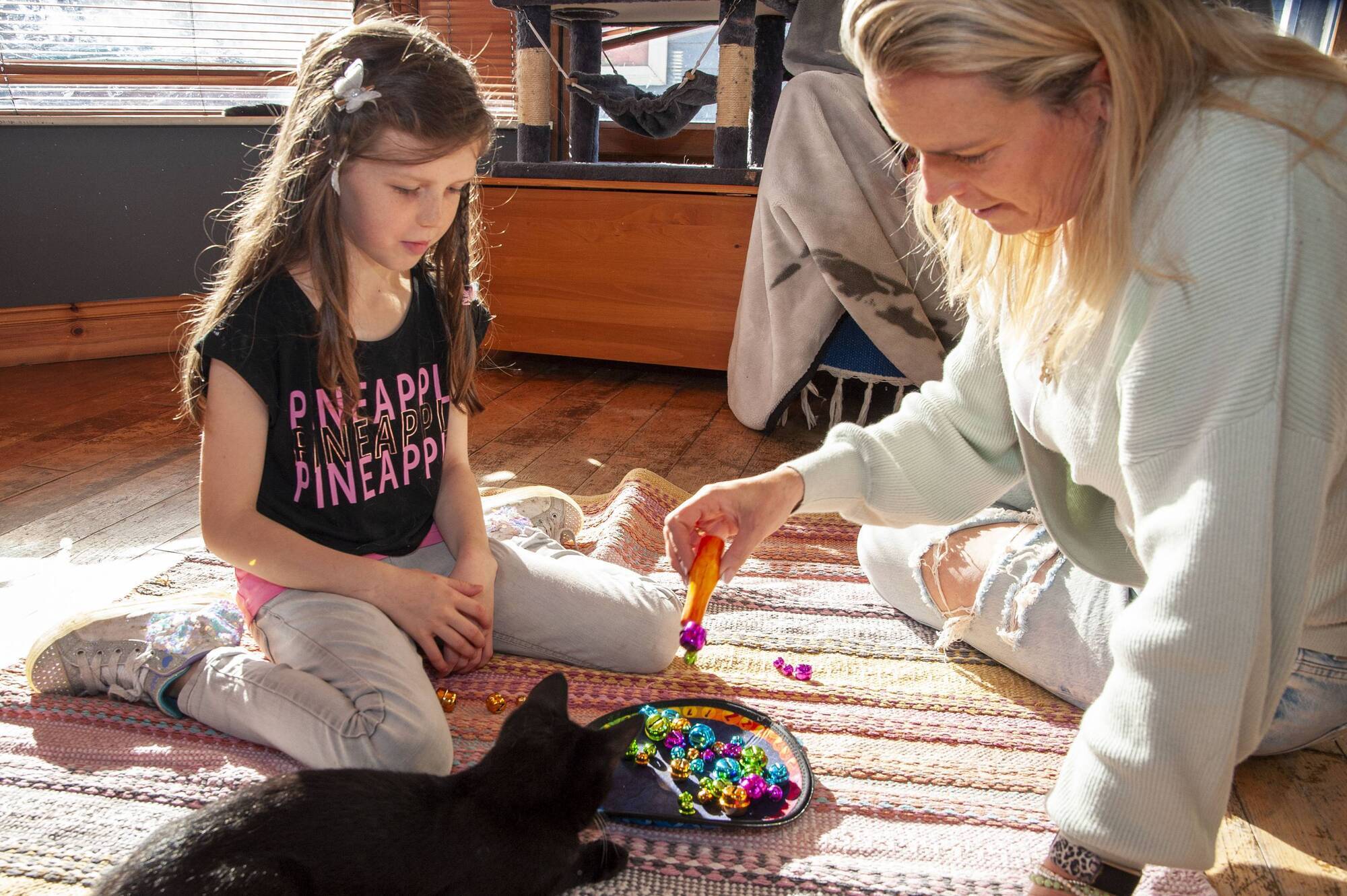
Fearne and Sinead Tivy.
Fearne is nine and her epilepsy has meant multiple stays in hospital, where her mum Sinéad slept on a chair for weeks on end. They talk to Donal O’Keeffe about why hospitals need to do more to look after the parents of sick children
“IT all started the day Fearne’s pony, Bling, died,” says Sinéad Tivy, remembering the first time her daughter, who was then six-and-a-half, suffered an epileptic seizure.
“Fearne was sitting there on the floor, colouring in a picture to cheer up her sister and, whatever way I looked at her, I could see her eyes were rolling back in her head and she just crumpled.”
On a blustery Saturday afternoon in Youghal, with the rain outside spattering the windows of their toasty kitchen, Sinéad and Fearne, who has just turned nine, tell the story of an ordeal that has been long and often terrifying — not that you’d ever know that from Fearne, who is cheerful, funny, and apparently completely fearless.
However, for Sinéad the feeling of dread and panic was a constant companion from that first day, and she talks of the lurching sensation in the pit of her stomach when she tried to revive her little girl.
“I knew straight away and I called an ambulance immediately,” she recalls.
That first hospitalisation, in Cork University Hospital (CUH), lasted 15 days, and Sinéad stayed with Fearne throughout.
Two days after Fearne was discharged, she had another seizure.
Fearne takes up the story: “I’d wanted to get ducks for a long time and, when I got out of hospital, there was three ducklings in a box. When I opened the box to pick my duck, I had a little seizure — but I still picked my duck.”
It was straight back to hospital, that time for two weeks. Since then, Sinéad says, she has lost count of the times Fearne has been hospitalised. Sinéad asks: “How many times have you been in hospital, Fearne?”
She replies, with the sort of practised weariness only a nine-year-old can carry off: “Too many times.”
Fearne seems to thoroughly enjoy the squeamishness of her interviewer as she gleefully describes the gory details of medical procedures up to and including brain surgery. She seems genuinely unfazed by all she has gone through.
“This lady is a tough cookie,” Sinéad says. “Do you remember the times you were really sick, Fearne? The doctors and nurses would say, ‘How are you today Fearne?’ And what would you always say?”
Fearne grins at what is clearly an old joke between them, replying: “I’m good”, stretching out the ‘gooood’ of the punchline for added bravery/insincerity.
“She has never complained and she’s been through lumbar punctures, I can’t count how many MRIs, Pet scans, X-rays,” Sinéad says proudly. “Do you remember that time they put the long tube into your arm, Fearne?”
Her daughter beams back: “I wanted to see everything. I wanted to see how long it was.”
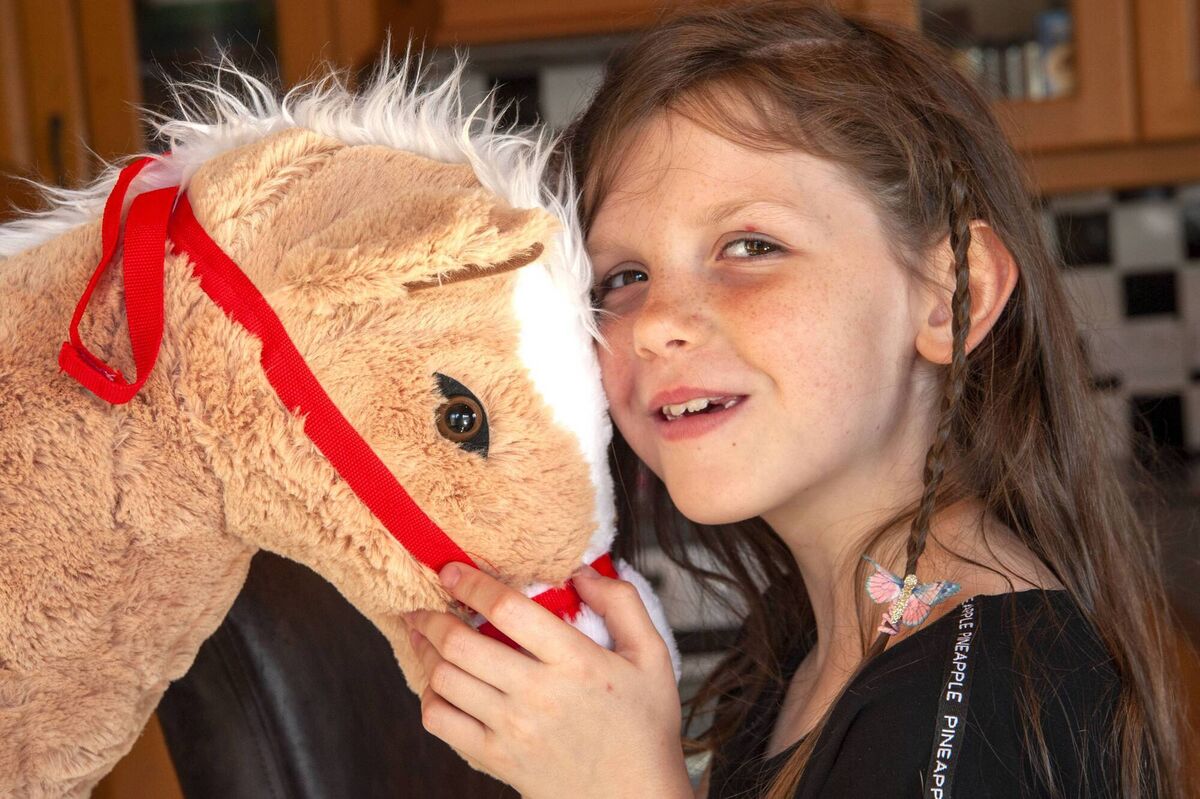
With her great friend Pixie, the magical pink pony toy who has shared every step of her journey as her constant companion, Fearne endured procedures that would terrify most adults.
I ask, foolishly: “How far did the tube go?” She replies: “All the way to here”, tapping her chest.
This was during Fearne’s first hospital stay, Sinéad says. She was on an antibiotic three times a day and her doctors didn’t want to continually insert new lines.
“She actually had a bet with the nurse when the tube was coming out about how long it was,” Sinéad says, while Fearne giggles at the horrified expression on the paling face of the man from the Irish Examiner.
As Fearne was in hospital during the Covid-19 pandemic, she suffered terrible isolation, missing her dad, Gavin; sister Isolde, 12; and brother Neil, 15. They would come and visit her in the car park and one day they brought Fearne’s best friend, Butsy (short for Buttons), in the car so she could cuddle her beloved cat. Butsy, who was once knocked down and lost an eye, knows all about bravery too.
A born animal lover whose ambition is to be a jockey, Fearne was blown away to receive a message from fellow Youghal native and National Hunt jockey Davy Russell when she was in hospital. He told her that he was her number one fan, and promised to introduce her to Tiger Roll. Russell was true to his word, and on the kitchen wall is a photo of Fearne sitting atop the horse that has twice won the Grand National.
At the height of Fearne’s seizures, she was suffering up to 80 attacks in one day and was hospitalised for seven weeks, with Sinéad staying by her side all that time, nodding off briefly on a chair by the bed, but never getting proper rest.
“The chair was so uncomfy,” Fearne says. Her mother agrees.
“If you’re a parent sitting there in a chair, obviously you’re not sleeping, you’re not eating, you’re not drinking properly. We were often in the observation room, where the lights are always on. You’re actually in a blur, you don’t know day from night. It was complete torture.”
Fearne had a big operation in Dublin’s Temple Street Hospital at the end of March, and she traces the track of the 55 stitches she received along her scalp, just above the hairline. They’re completely invisible, but she says sometimes a strand or two of hair sticks up as a result, and she refers to them as her aerials. There’s a portrait of Bling, Fearne’s dear departed pony, hanging on the kitchen wall, and she laughs in fascination at her reflection on the glass as, sure enough, a few stray hairs wave back.
Sinéad explains that the condition Fearne suffers from is called cortical dysplasia.
“When Fearne was being formed, around 20 weeks, one little group of cells didn’t go where they were supposed to go and they just sat there. One nurse described it as a little flower bud that didn’t open up.”
The operation was a success and, although the doctors warned that Fearne might not be able to walk for a while, she was bouncing around the very next day.
While Fearne had been unconscious, the surgeons had plaited her hair, and the Easter Bunny had snuck in for a visit, hiding chocolate eggs in the folds of her bandages.
Fearne hasn’t had a seizure in over a year, and Sinéad says the hope now is to slowly decrease the medication that has helped her so much.
They’ve come a long way from the worst days of Fearne’s illness, when Sinéad remembers her little girl sobbing in despair: “They don’t know how to fix me. They’ll never fix me.”
On the day I call to her home, Fearne has been out of school for a little while, following a local outbreak of Covid-19 and, while she misses her friends, she has been keeping up with her normal after-school activities like pony riding, gymnastics, Irish dancing, and swimming.
So, basically, I suggest to her, she’s getting spoiled. Sinéad laughs, joking that Fearne is always getting spoiled. Fearne reacts with a look of hurt and dismay that she can’t quite pull off without breaking into a big grin.
Sinéad and Fearne hope their experience may spare another family a similar ordeal.
Without a dedicated children’s hospital in Munster, Fearne was forced to spend lots of time far from home in Crumlin and Temple Street, with her dad driving a six-hour round trip so he could mind Fearne’s brother and sister, leaving Sinéad trying to catch what sleep she could on an “uncomfy” hospital chair, often for weeks on end.
Sinéad says that the solution for families like hers is a specialised children’s hospital in CUH, and she is anxious that the plans for such a facility — which are already in place — will soon bear fruit.
“It would be such a relief to parents like me, with children who have life-limiting or even life-threatening illnesses, to have a dedicated children’s hospital close to home.”
Sinéad and Fearne are backing a growing campaign to build that hospital in CUH because, as Fearne puts it, after all that she has come through, “it’s time to look after other people”.


CONNECT WITH US TODAY



Be the first to know the latest news and updates