Can mindful movement help you to lose weight? 
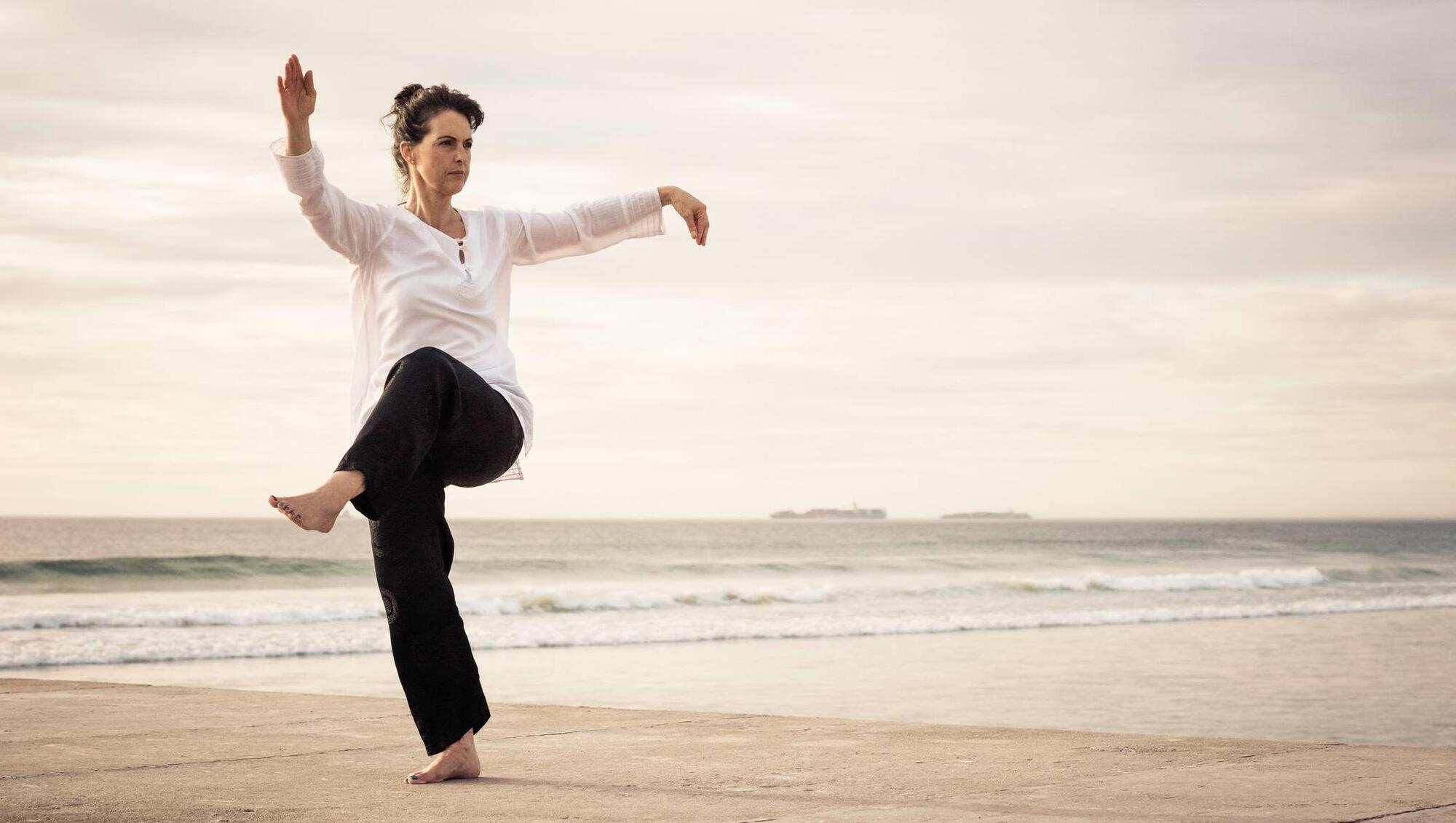
Take a break from high-energy workouts and instead try free-flowing t'ai chi. The ancient Chinese martial art may even help to reduce your waistline 
Can mindful movement help you to lose weight? 

Picture: iStock 

T’ai chi is not your typical type of exercise for weight loss. In fact, its slow and graceful movements are the antithesis of high-energy gym workouts, and observing t’ai chi might bring to mind deep relaxation rather than rapid weight reduction.

However, scientists have found that, in addition to helping with a wide range of health issues, the ancient Chinese martial art form is also a route to aiding weight loss.

For t'ai chi’s army of glamorous followers — including supermodels Gisele Bündchen and Naomi Campbell — its body-boosting benefits are old news, but recent findings from researchers at the University of Hong Kong and the Chinese University of Hong Kong, published in the journal Annals of Internal Medicine, could lead to a new generation of followers.

For the trial, participants were assigned to three groups. One group was prescribed a conventional weekly workout programme of aerobic exercise and strength training, another was asked to follow a t’ai chi plan. The remaining group was asked to maintain their usual daily movements.

After three months, those who participated in the t’ai chi and regular exercise groups had lost modest amounts of weight, and had they had also reduced HDL (bad) cholesterol levels compared to the control group. However, the waistlines of the ta’i chi practitioners had shrunk by the most significant amount.

The t’ai chi group shed 1.8cm from their waist following the 12-week programme, compared to 1.3cm lost by those doing the weights and aerobic exercise. After 38 weeks, both activity groups had maintained the changes in body weight and waist circumference, but only the t’ai chi group had maintained their improved blood cholesterol profile.

“Our data suggests that ta’i chi, a gentle mind-body exercise, can be an effective alternative to conventional exercise in the management of central obesity,” wrote lead author Parco M Siu, of the University of Hong Kong’s School of Public Health.

It’s not the first time that t’ai chi has been hailed for its fat-fighting abilities.

Although using only around 108 calories in half an hour, a previous study proved that practising five times a week for 45 minutes per session helped middle-aged adults shed a pound or more in 12 weeks, with no additional lifestyle changes.

Based loosely on the movement patterns of animals, t’ai chi is designed to keep your body in constant motion and is all about harnessing your spiritual and mental energy. As with yoga, it involves deep breathing and does not require special clothing.

T’ai chi movements range from simple shoulder and arm circles to complex balances and martial-art kicks and punches. It’s as short or as complex as you want to make it, although, for most beginners, a 20-minute daily routine works well.

Yang-style t’ai chi, with a focus on relaxation, is a good starting point, whereas Chen style, involving slow and fast movements with crouching, kicking, and punching, is better suited to the more experienced.

Holding even the basic stances for stamina and muscle conditioning, such as the horse stance (with knees bent, feet parallel and shoulder-width apart) and bow stance (similar to a lunge), will develop leg and gluteal strength, as well as core strength as you maintain the position, and will help your balance.

“T’ai chi can help dissolve many physical problems, especially those caused by modern-day stress and tension,” says Declan Mills, an instructor based in Dublin (taichiclassesdublin.com). “The more you do, the more you build strength, stamina and flexibility through the subtle realignment of body posture.”

These cumulative muscular gains can lead to a raft of other fitness improvements, all of which can help weight loss by making exercise easier.

A review involving 9,263 participants, conducted at the University of Auckland, reported that t’ai chi yielded “psychological and physical benefits” including better flexibility, improved lung capacity and balance, and even improving the running speed of volunteers.

The well-documented stress-busting effects of t’ai chi also contribute to it being a dieter’s ally. A 2019 pilot study on middle-aged women at Arizona University described how regular t’ai chi practice can “potentially reduce weight and improve body composition through psychological, behavioural, and physiological” effects, and “reduce emotional distress” that leads to overeating.

Mills says some of his clients experience similar benefits.

“Because of the flowing, co-ordinated movements, participants gain better control over various functions of the body,” he says. “Their breath slows down and deepens, which balances the nervous system and increases energy.”

Moves to try at home

One-leg balance: Stand with your feet hip-width apart, holding on to a chair if you need support.

Slowly lift your right leg and bend your right knee until your right thigh is parallel to the floor. Hold for 30 seconds, then return your right foot to the floor and repeating on the left.

Progress until you can hold a one-leg balance on each leg for 60 seconds.

Brush knee: Stand with your feet hip-distance apart and hold your arms out to the sides. Turn your right palm upwards as you raise the right arm towards the sky on the right side. Simultaneously, turn the left palm face down as you float the left arm downward on the same side.

Bring one foot slowly forward, twist your hips and push your right hand forward, while putting the left hand down. Continue to circle your arms back to starting position and repeat on the other side.

Warrior: Stand with your feet together and hands hanging loosely at your sides. Inhale deeply and bend your knees to sink down, left hand flat and right hand in a fist. Continue to inhale while covering your right fist with your left hand, raise yourself slowly upwards.

Come to a straight-legged stance, breathe out and sink back down to repeat on the other side.

Horse Mane: Stand and place your right hand on top of the left with a space in the middle, palms facing each other as if you’re carrying a small ball. Shift your weight to the right foot.

Bring the left leg in front of your body an, as you shift your weight to the left leg, move the left hand forward as if you’re throwing a Frisbee. Bring the right hand back and down to rest. Repeat on the other side.

More in this section

Lifestyle

Newsletter

The best food, health, entertainment and lifestyle content from the Irish Examiner, direct to your inbox.

Cookie Policy Privacy Policy Brand Safety FAQ Help Contact Us Terms and Conditions

© Examiner Echo Group Limited