To school through the woods : Getting children to learn about their environment
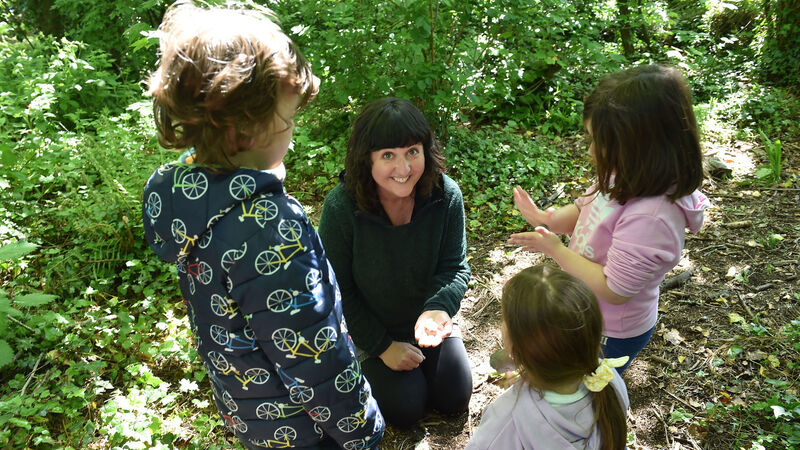
Children from the Education Together School on Grattan Street, Cork, attending the Mucky Boots Forest School with Niamh Geoghegan. Picture: Dan Linehan
The benefits of fresh air and connecting with nature have never been more clear than in the last year, as people headed outdoors for relief from the pressures of lockdown. Our renewed enthusiasm for getting out and about has also highlighted the advantages of outdoor learning, an educational approach that has become increasingly popular in recent years, with research mounting on the positive effect it can have on wellbeing, development and life skills. Outdoor learning encompasses many forms of practice outside the classroom, including forest school and outdoor play.
Joan Whelan is chair of the Irish Forest School Association, a voluntary organisation that represents forest school programmes throughout the country and aims to raise awareness of the benefits of learning in nature. A retired teacher and educational psychologist, in 2011 she set up a forest school programme in the Dublin primary school of which she was principal.
“This is very much a growing approach, both within schools, early years settings and in the community as well,” she says. “It has gone from strength to strength and obviously the past year has seen a huge surge in interest in learning outdoors and the benefits of being outside.”
Outdoor learning also has a role to play in terms of our relationship with nature and how we respect the environment.
“The ongoing issues of sustainability, climate change and environmental issues would also be very important to people who are interested in forest school,” says Whelan.
CLIMATE & SUSTAINABILITY HUB
She describes forest schooling as a progressive pedagogical approach to delivering the curriculum, involving regular visits to local woodland or wooded areas in the school or nearby.
“Ideally one day a week, instead of going to a regular classroom, a child would arrive in school with waterproofs and head off pretty much straight away with a teacher and probably a couple of other adults, one of whom needs to be a trained forest school leader. They would be spending the guts of the day outside, minimum two hours, ideally four or five. It is about that idea of repeated visits to the same site — it is not just a one-off nature walk.”
Another enthusiastic proponent of outdoor learning is Ollie Sheehan, who, with his wife Mary, owns and runs Mary Geary’s Childcare in Carrigtwohill, Co Cork, one of the largest childcare facilities in Ireland, spanning four-and-a-half acres and encompassing a creche, pre-school and after-school service.
“We have plenty of room to roam and we very much encourage outdoor learning,” says Sheehan. “Covid has highlighted the benefits of learning outdoors. We have 47 defined outdoor areas, everything from sandpits to mud kitchens, a number of full-sized playgrounds, astroturf pitches, woodlands and within that, fairy trails, apple trees and walks. We also have hens and rabbits.”
Learning opportunities abound in such an environment, says Sheehan.
It is very much a child-led approach, which can result in learning on more than one level.
“If the child is happy making mud pies, digging a hole or whatever, they learn through that play. As a practitioner or teacher, you would encourage them — it is like putting up the scaffolding for them to build what they want,” says Sheehan.
“For example, you could ask a child to go over and pick up three stones and bring them to you. By that action, the child is learning what the number three is, they are also learning what three feels like, about texture, engineering, maths. They are not learning as if someone put up the number three with three apples on a sheet of paper in front of them.”
And it’s not only children who benefit from this approach. A study carried out at Swansea University in 2019 found that as little as an hour a week of outdoor learning had tremendous benefits for children — and also boosted teachers’ job satisfaction.
“The idea that we are all learners is very important in forest school as well so there is something for the adults to learn as well as the children,” says Whelan. “The research would tell us that forest school has benefits back in the classroom as well.”
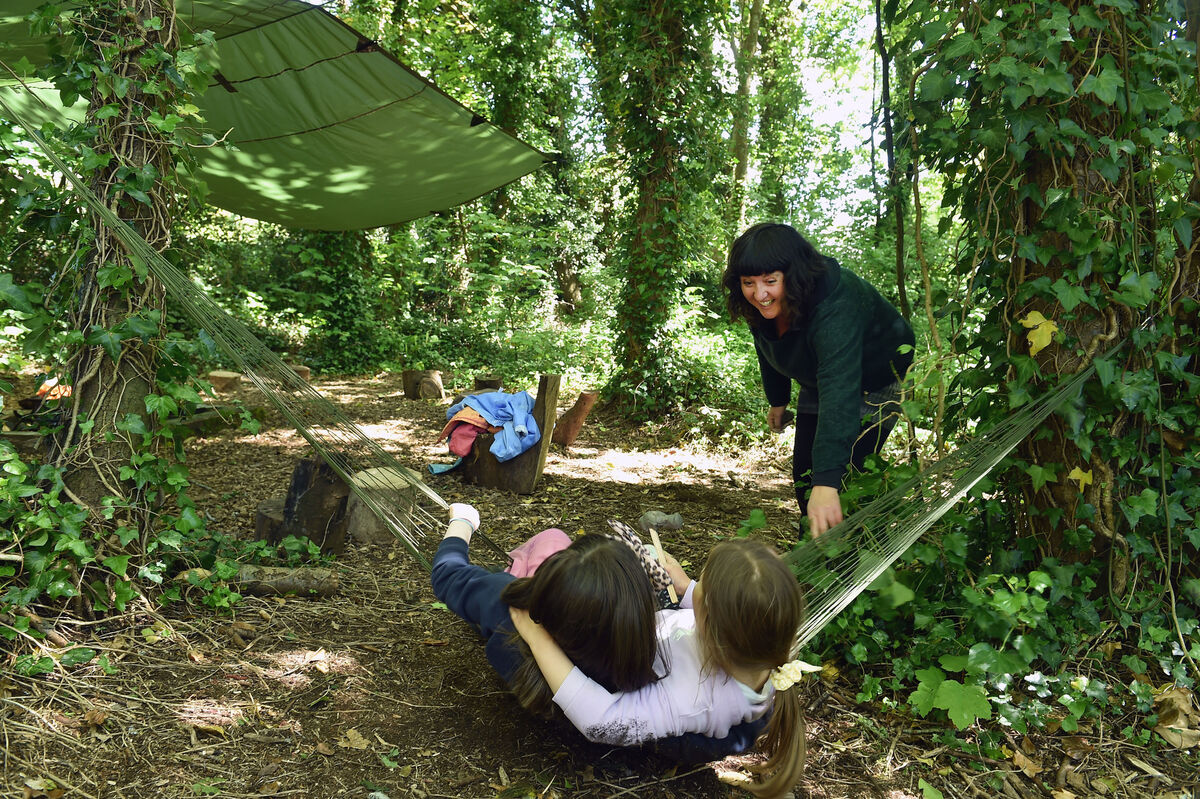
Our unpredictable weather can put some parents off the idea of outside activity — a survey carried out by Early Childhood Ireland and the Institute of Technology, Sligo, showed that Irish parents value play but that 88% of children play outside less in winter and 74% of children don’t get to play outside when it is raining. However, the old adage that “there is no such thing as bad weather, only unsuitable clothing” is very much factored into the outdoor learning approach.
Whelan says forest school is never cancelled for weather reasons, unless it is very windy while, according to Sheehan: “The first thing we tell parents is not to send their children in with designer clothes.”
Whelan hopes the impetus for outdoor learning is maintained and that forest school becomes a standard feature of educational practice.
“Hopefully this increased awareness and interest will stay with us after the pandemic. Forest school should be available to everyone who wants to do it. We see it very much as part of mainstream education — it fits with early years, primary, transition year, right across the board. But we don’t want it to become just another programme, that we have to do — we want to maintain the passion and spirit of the people involved now, who have started this social movement and really believe it is an important way forward for us in terms of that human/nature connection, and living well on the earth, " she says.
"We know from the research that the earlier children get opportunities to be in nature, the more likely it is they will care for nature and maintain that into their teenage years and adulthood. That is where it is at, as a race and as a society.”

CONNECT WITH US TODAY



Be the first to know the latest news and updates